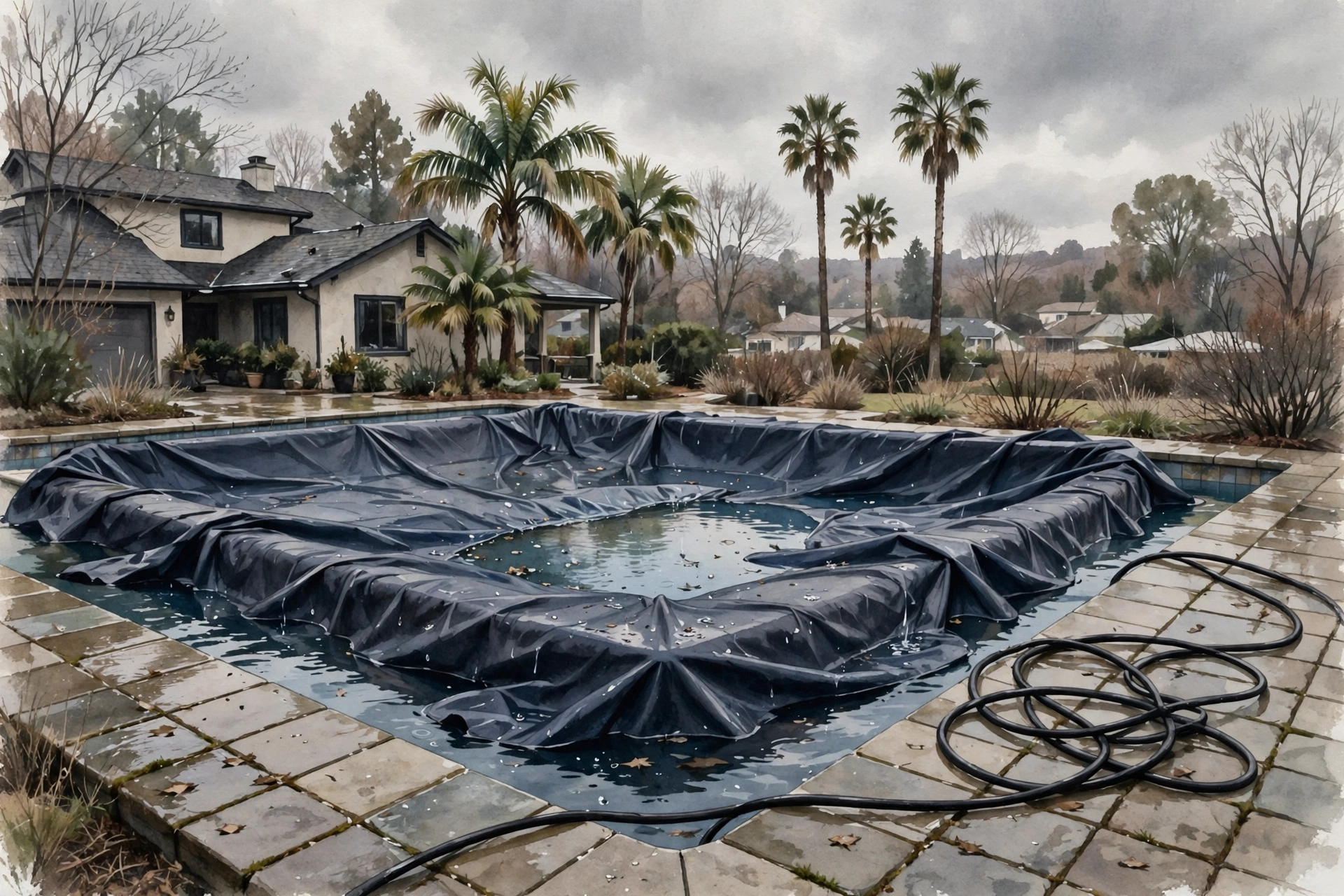
The most common winter pool cover mistake in Karachi is also the most counterintuitive: pulling the cover too tight. A winter cover must lie on the water surface with slack. When stretched tight above the water, rain pooling on top pulls at the seams, the pool edges, and the coping. This article covers correct versus incorrect cover tension.
Why a Tight Cover Fails in Karachi Winters
Karachi winters bring cold nights, dust, sea breeze, and occasional heavy winter rain rather than snow. A tight cover acts like a trampoline: rainwater collects in the middle, and with no slack to give, the weight transfers straight to the cable, the water bags, and the coping stones.
Seams then take a load they were never designed for, and stitching splits, usually at the corners, while the cover pulls inward and upward on the pool edges. On the in-ground concrete and tiled pools common in DHA, Clifton, Gulshan, and Bahria Town, that pull can lift or crack coping tiles and strain the edge at the waterline. A cover with slack rests on the water, and the water supports it — the anchors only stop it drifting. Rain pooling on a tight cover here does the same damage as snow load elsewhere.
How Much Slack Is Right
A correctly fitted cover sits directly on the water across the whole pool, with a gentle dip:
- The centre should rest on the water. If you can slide a hand underneath and feel open air, it is too tight.
- The edges should have enough give to lift a few centimetres by hand without the whole cover moving.
- Allow at least 30 centimetres of overhang past the pool edge for secure anchoring.
- Top the water up to its normal winter level before fitting, so the cover rests where it should.
A cover that can only be fitted tight is the wrong size — speak to your supplier before winter.
Fitting the Cover Step by Step
Fitting takes under an hour:
- Clean the pool first. Remove leaves and debris, balance the water, and empty the skimmer baskets.
- Set the water level to its normal winter level, so the cover has full support from below.
- Centre the cover with even overhang on all sides. Lift and place it rather than dragging it across coping, which scuffs tiles.
- Let it settle on the water, pushing trapped air gently outward. It should lie flat on the water, not bridge across it.
- Anchor without tensioning. Tighten the winch only until the cable is snug — not until the cover lifts or stretches. Water bags sit on the overhang; their weight holds the cover down.
- Check the fit from every side. No section should be pulled up off the water, and no edge should lift in the breeze.
Final test: press the middle of the cover with your palm. It should meet the water immediately. If it feels like a drum skin, loosen the cable and let it drop.
Cable, Winch, and Water-Bag Anchoring
The winch is for taking up slack in the cable, not for stretching the cover. Tighten in small turns and stop as soon as the cable is firm; if the edges lift off the water as you winch, you have gone too far. Water bags should sit fully on the deck or coping overhang, spaced evenly — not half-hanging off the edge, where they drag the cover sideways. In Karachi’s sea breeze, the answer to a flapping cover is even anchoring all round, not cranking one side tighter.
Removing Rainwater Promptly
Even a correctly fitted cover collects rainwater, and it must not be left standing: it adds weight, breeds mosquitoes, stains the cover, and hides early signs of strain.
After every heavy rain spell, remove standing water within a day or two. A small submersible cover pump is fastest: place it at the lowest point of the puddle and run it until the surface is clear. A siphon hose works if you have no pump. Never push standing water toward the edges — forcing water sideways loads the seams where they are weakest.
Your Weekly Winter Inspection Checklist
Check weekly through the cold months:
- Cable tension: If the cable feels guitar-string tight, or is pulling up on the pool ledges, release it at once until the cover drops back onto the water.
- Cover surface: Look for pooled water, torn seams, and lifted edges. Pump off any standing water.
- Coping and tiles: Check edge stones for lifting, cracking, or gaps at the waterline.
- Water bags: Reseat any that have shifted, leaked, or rolled off the edge.
- Surroundings: Clear leaves and dust from the deck and cover; debris on a wet cover stains it permanently.
- Water level: Top it up if it has dropped, so the cover keeps its support from below.
A torn seam spotted early can often be patched; left under load all winter, it spreads.
Signs Your Cover Is Straining
| Sign | What it means | What to do |
|---|---|---|
| Coping stones lifting | Cable pulling up on the ledges | Release the cable immediately; inspect coping |
| Seams splitting at corners | Load concentrated at the corners | Loosen tension, pump off water, patch the seam |
| Edges lifting in the breeze | Uneven anchoring or one side too tight | Re-seat water bags, even out cable tension |
| Deep sagging pocket | Water level dropped or a section overloaded | Top up water level, pump off the pocket |
After a heavy rain spell, do three things in order: pump off all standing water, check the cable tension, and walk the coping for new lifting or cracks. If the cable is pulling on the ledges, release it at once.
Warranties and Local Notes
Improper installation can void warranties: manufacturers warrant fabric and stitching against defects, not damage from overtensioning or standing water load, and coping warranties usually exclude damage from external pulling forces. Fit the cover as directed — slack on the water, cable snug, standing water removed — and keep a note of your weekly checks.
One local note: many Karachi housing societies prefer or require pools to be covered when not in use, and standing water on a cover draws complaints as well as mosquitoes. We do not advise on any specific society’s rules — check your own society’s requirements — but a well-fitted, dry cover is the easiest way to stay compliant.
When to Call a Professional
Call us if the cover no longer fits after a water-level change, if coping has already lifted, if a seam has torn across a corner, or if you are unsure whether your cover is the right size. A wrong-size cover forced into service costs more in repairs than a correctly sized replacement. The Pool Guy team handles pool maintenance and repair services across Karachi; see our work in our project gallery, and pumps and cover accessories in our products range.
Frequently Asked Questions
Should a winter pool cover be tight or loose?
Loose — with slack. It must lie on the water surface, not be stretched tight above it. A tight cover transfers rainwater weight straight to the seams and pool edges, tearing seams and lifting coping.
How do I know if my pool cover is too tight?
Press the middle with your palm. If it feels like a drum skin and does not meet the water immediately, it is too tight. If the cable is guitar-string tight or pulling up on the ledges, release it at once.
How often should I remove water from my winter pool cover?
After every heavy rain spell, within a day or two, using a small submersible pump or a siphon hose. Never push standing water toward the edges.
Does Karachi get snow on pool covers?
No. Karachi winters bring cold nights, dust, sea breeze, and occasional heavy rain. Rain pooling on a tight cover does the same damage as snow load elsewhere, so the same slack-fit rule applies.
Can a tight cover really damage my pool?
Yes. Sustained tension can split seams, lift or crack coping stones, and strain the pool edge — and can void cover and coping warranties, since the damage comes from incorrect installation, not a product defect.
Get Your Cover Fitted Right
Fit your cover with slack, keep the cable snug rather than tight, pump off rainwater promptly, and check it weekly through winter. If you would like The Pool Guy to fit or inspect your winter cover, or repair coping or seams a tight cover has strained, call or WhatsApp us on +92 321 2077638. We are at 22 Dr Ziauddin Ahmed Rd, Civil Lines, Karachi, open Monday to Saturday, 9 AM to 6 PM (Sunday closed). Maintenance plans start from Rs 15,000/month, with the final quote given after a free inspection of your pool.
Leave a Reply