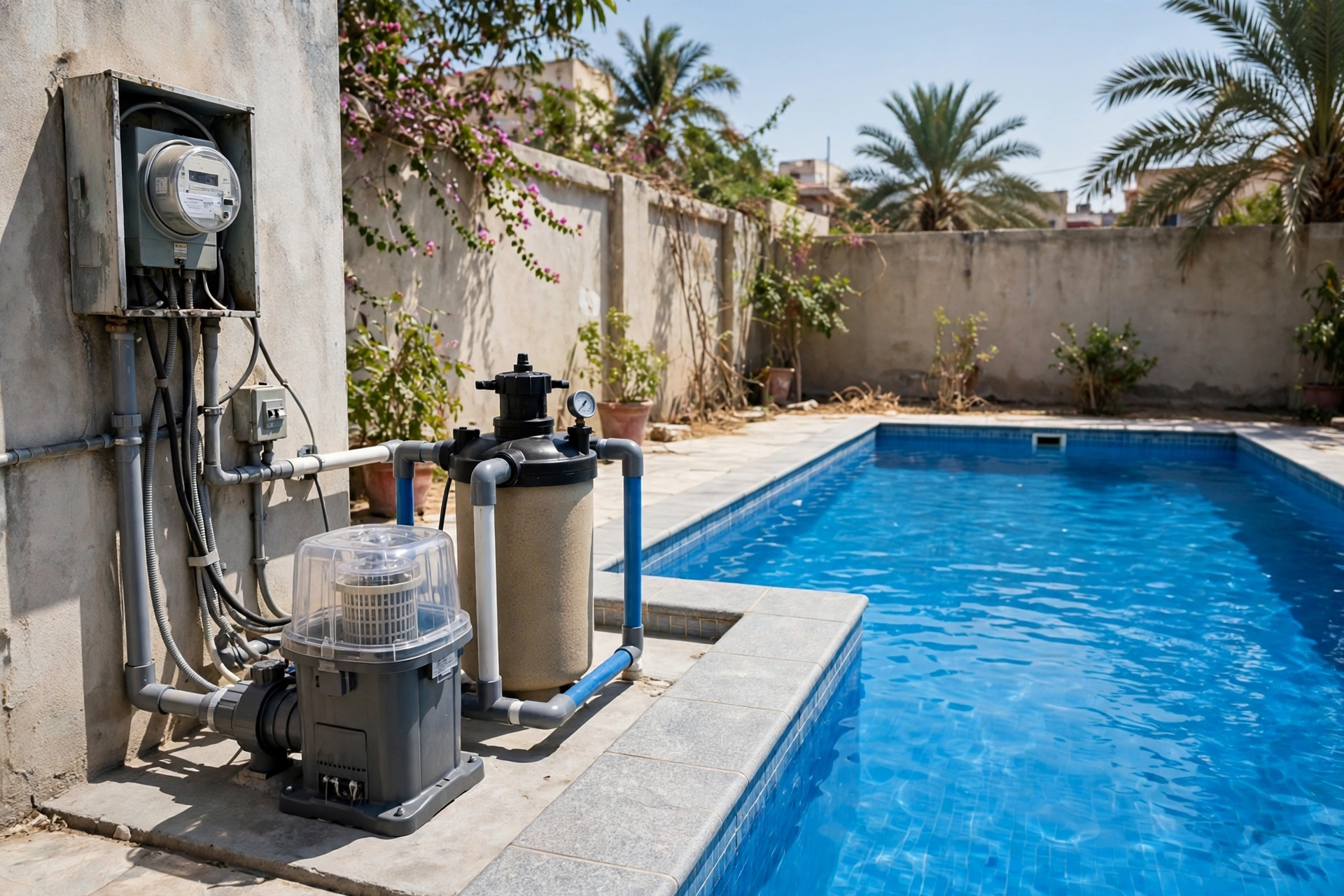
Most Karachi pool owners discover the running cost of their pool the same way: the first full month's K-Electric bill after the pool is filled. The construction quote covered the build, but nobody worked out what the pump — running every single day — would add to the bill. The answer is not small, but it is predictable, and once you know the maths you can control it. Here are the real numbers: what a pump uses, what it costs per month, why some pools cost twice as much to run as others, and the changes that genuinely cut the bill.
How Much Electricity Does a Pool Pump Use?
A pool pump's electricity use comes down to two things: how powerful the pump is, and how many hours a day it runs.
Pump power is rated in horsepower (HP). One horsepower is roughly 746 watts, but a real pump draws more than its nameplate rating once you count the motor's inefficiency. As a working rule, a 0.75 HP pump draws about 0.7–0.9 kW, a 1 HP pump about 0.9–1.1 kW, a 1.5 HP pump about 1.3–1.5 kW, and a 2 HP pump about 1.7–2.0 kW.
Most family pools in DHA, Clifton, and Gulshan run a 1 HP or 1.5 HP pump. Larger pools, pools with water features, or pools with long pipe runs often have a 2 HP pump.
The daily consumption is simple multiplication. A 1.5 HP pump drawing 1.4 kW, running 8 hours a day, uses about 11 units (kWh) a day — roughly 330 units a month, just for the pump.
The Monthly Cost: A Worked Example
K-Electric's residential tariff is slab-based, so the price per unit depends on how much electricity your whole house uses — and a house with a pool is usually already in the higher slabs. Households in the upper slabs are paying roughly Rs 35–50 per unit once taxes and surcharges are included. Tariffs change, so check your own bill for the exact figure — the maths below uses Rs 40 per unit as a realistic middle figure for a pool-owning household.
| Pump size | Hours/day | Units/day | Units/month | Approx. cost/month at Rs 40/unit |
|---|---|---|---|---|
| 0.75 HP | 6 | ~5 | ~150 | ~Rs 6,000 |
| 1 HP | 8 | ~8 | ~240 | ~Rs 9,600 |
| 1.5 HP | 8 | ~11 | ~330 | ~Rs 13,200 |
| 2 HP | 8 | ~15 | ~450 | ~Rs 18,000 |
| 1.5 HP (variable speed, low speed) | 10 | ~5 | ~150 | ~Rs 6,000 |
Two things jump out. First, the pump alone can cost Rs 6,000–18,000 a month — often more than the maintenance visit itself. Second, the variable-speed row shows why pump choice matters so much: a variable-speed pump running longer at low speed can move the same water for roughly half the electricity.
These are running costs only. Add a salt chlorinator (small draw) and pool lights (LEDs are cheap to run; old halogen lights are not). A heater, if you have one, dwarfs everything else on this list — which is why most Karachi pools do not heat water at all.
Why Karachi Pools Cost More to Run Than They Should
Four Karachi realities push electricity use up. Oversized pumps are the most common problem we find: a builder installs a 2 HP pump on a pool that a 1 HP pump would circulate perfectly well, "to be safe." The bigger pump uses far more electricity, and the extra speed does nothing for water quality — filtration depends on turnover, not pressure. We see oversized pumps on roughly half the pools we inspect. Long pipe runs and tight plumbing add resistance — every extra metre and every elbow makes the pump work harder, and poor plumbing can add 20–30% to electricity use without anyone noticing. Dirty filters and clogged baskets force the pump to work against higher pressure: it draws more power and moves less water. In Karachi's dusty air, skimmer baskets fill faster than owners expect. Load shedding and voltage fluctuation cause timers to reset after outages, so pumps end up running far longer than planned, and voltage dips make motors run hotter and less efficiently. A pump on a proper timer with a voltage guard avoids most of this waste.
How Many Hours a Day Should the Pump Run?
The goal is turnover: the whole volume of the pool passing through the filter at least once a day. For a standard family pool in Karachi, that usually means 8–10 hours a day in summer (May–September), when the water is warm, algae grows fast, and the pool is used heavily; and 4–6 hours a day in winter (November–February), when the water is cooler and the pool is used less. During monsoon and dusty spells, add an hour or two, because the filter is catching far more debris.
Running the pump 24 hours a day is almost never necessary for a home pool, and it doubles or triples the bill for no benefit. If your pump runs all day because "the water looks better that way," the real problem is usually filtration or chemistry, not run time. Splitting the run helps too: two 4-hour runs (morning and evening) keep the water circulating through the day and are easier on the equipment than one long stretch in the midday heat.
Six Ways to Cut Your Pool Pump Electricity Bill
1. Switch to a variable-speed pump. This is the single biggest saving available. A variable-speed pump runs most of the day at low speed — moving the same total water for a fraction of the power — and only ramps up for cleaning or backwashing. In our experience, a household switching from a 1.5 HP single-speed pump to a variable-speed pump typically cuts pump electricity by 40–60%. The pump costs more upfront, but on Karachi tariffs it usually pays for itself in one to two swimming seasons.
2. Put the pump on a timer. A simple timer switch costs very little and stops the two most common wastes: the pump running all night because someone forgot it, and the pump running on full hours in winter when half the time would do. Set summer and winter schedules and change them when the season changes.
3. Right-size the pump. If your pump is oversized, replacing it with the correct size is a one-time fix that saves money every month for years. A contractor can calculate the right pump from your pool volume and pipework — do not guess, and do not accept "bigger is better."
4. Keep the filter clean. Backwash a sand filter when the pressure gauge reads 8–10 psi above its clean reading. Empty skimmer and pump baskets weekly — daily during the dusty months. A clean system lets the pump do its job at lower power.
5. Shorten the winter run. Many owners keep the summer schedule all year out of habit. Dropping from 8 hours to 5 hours in winter cuts the pump's monthly units by nearly 40% for four months of the year, and the cooler water will not punish you for it.
6. Consider solar for the pump circuit. Karachi has abundant sun, and a small solar setup dedicated to the pool pump is one of the most practical home-solar uses in the city — the pump runs during the day, exactly when the panels produce. It is a bigger upfront decision than a timer, but for a pool that will run for years, get a quote based on your actual pump size and hours.
When the Pump Itself Is the Problem
If your electricity bill jumped suddenly, or the pump sounds different — louder, strained, or cycling on and off — the pump may be failing rather than merely expensive. A pump with worn bearings draws more power and moves less water. A pump that has lost prime and runs dry can burn out in minutes. A pump that trips the breaker repeatedly is a safety issue, not just a cost issue. As a rule of thumb: if your pump is more than 8–10 years old, is a single-speed model, and your monthly pump cost sits at the top of the table above, get it assessed.
FAQs
How much electricity does a pool pump use per month in Karachi?
A typical 1.5 HP pump running 8 hours a day uses roughly 330 units a month, costing around Rs 13,000 at Rs 40 per unit. A 1 HP pump on the same schedule uses about 240 units (around Rs 9,600). Your exact figure depends on your pump size, run hours, and KE slab.
Can I run my pool pump on solar in Karachi?
Yes — it is one of the best solar uses for a house with a pool, because the pump runs in daylight when panels produce. A dedicated solar setup for the pump, or a hybrid home system, can cut the pump's grid consumption to near zero in daytime. Get a quote based on your pump's actual wattage and hours.
How many hours should I run my pool pump in winter?
4–6 hours a day is usually enough in Karachi's winter, when the water is cooler and the pool is used less. Keep the water tested — if it stays clear and balanced, the shorter run is working.
Does a variable-speed pump really save money?
Yes, substantially. Because power use rises steeply with speed, running longer at low speed moves the same water for far less electricity. Most Karachi households we have switched see 40–60% lower pump electricity.
Why is my electricity bill so high with a pool?
The pump is the main cause — it is the largest single appliance in most pool-owning homes. Oversized pumps, 24-hour running, dirty filters, and old single-speed motors are the usual culprits. Check pump size and hours first.
Get Your Pool's Running Cost Checked
If your KE bill has been climbing since the pool went in, or you suspect your pump is oversized, a quick inspection tells you exactly where the money is going. The Pool Guy checks pump sizing, pipework, filter condition, and timer settings across DHA, Clifton, Gulshan, Bahria Town, and PECHS, and gives you a written recommendation — including whether a variable-speed pump or a solar setup would pay for itself on your pool.
Call or WhatsApp +92 321 2077638 for a free inspection and quote. See our services page, recent equipment work in our gallery, and pool equipment on our products page. We are at 22 Dr Ziauddin Ahmed Rd, Civil Lines, Karachi, open Mon–Sat, 9 AM–6 PM.
Leave a Reply