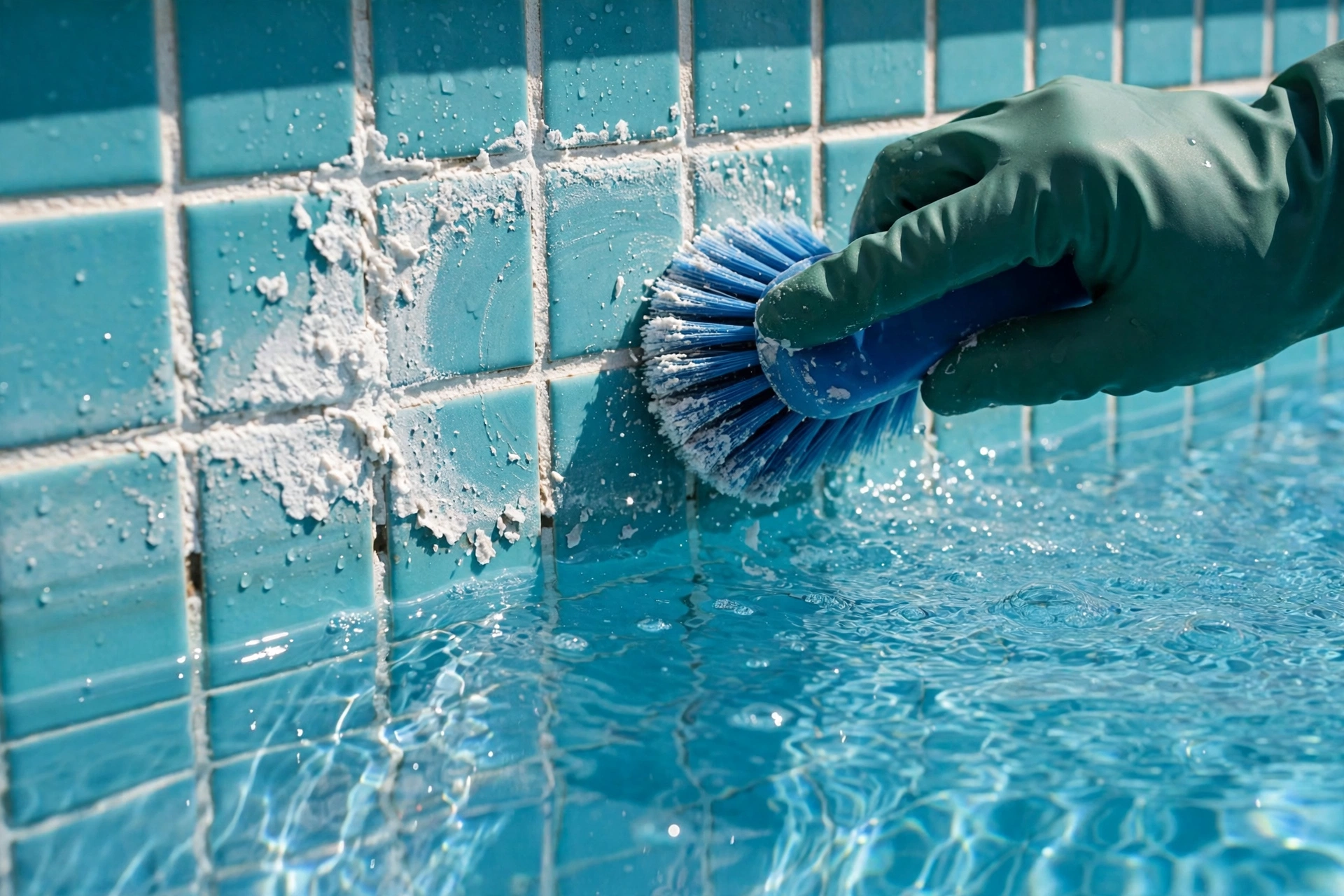
Run your hand along the waterline of your pool. If the tiles feel rough, chalky, or crusty instead of smooth, your pool is telling you something — and if a tile wobbles when you press it, it is telling you something more urgent. Tile and grout problems start as cosmetic annoyances and end as leaks, so the time to deal with them is when they are small.
This is a practical guide from a contractor who has cleaned, re-grouted, and re-tiled pools across Karachi: what causes the stains and scale, how to clean tiles properly, when grout can be repaired, and when loose tiles mean the waterproofing underneath needs attention.
Why Karachi Pools Get Dirty Tiles Faster
Three Karachi realities work against your waterline tiles. First, the water is hard. Bore water and tanker water — the two sources most pools are filled and topped up with — carry high levels of calcium. Every time water evaporates in the summer sun, the calcium stays behind and deposits on the tiles as a white or grey crust. Second, the dust. Karachi's dry, dusty air leaves a fine film on the surface that settles at the waterline and mixes with body oils and sunscreen to form a stubborn brown or yellow line. Third, the sun. Tiles at the waterline sit half in, half out of the water, baked by direct sun for hours a day, which bakes stains on and dries grout out faster than in a shaded pool.
None of this is your fault, and none of it means the pool was built badly. But it does mean waterline tiles in Karachi need more attention than the same tiles would need in a softer-water city.
Reading the Problem: What Are You Actually Looking At?
Before you clean anything, identify what is on the tiles — because the wrong treatment wastes a day and can damage the finish.
White or grey crusty deposits. This is calcium scale, the most common waterline problem in Karachi. It feels rough and chalky. It comes from hard fill water plus evaporation, and it is also a warning that your water's calcium hardness may be high overall — worth testing, since the same scale is forming silently inside your heater and chlorinator cell.
Brown, yellow, or greenish line at the waterline. Usually a mix of dust, body oils, sunscreen, and early algae. It sits on the surface rather than in it, and it is the easiest problem to fix.
Dark spots or staining on grout. Grout is porous, so it absorbs stains over time. Dark grout lines can also be the first sign of algae living in the grout itself, which is why stained grout sometimes comes back weeks after cleaning.
Cracked, crumbling, or missing grout. Grout fails from age, from water chemistry that is too acidic, and from the daily expansion and contraction of a sun-baked pool shell. Missing grout is not cosmetic: water gets behind the tiles, and that is how tiles start falling off.
Loose or hollow-sounding tiles. Tap a tile gently. A solid tile sounds dull; a loose tile sounds hollow. Loose tiles mean the adhesive behind them has failed — usually because water got in through failed grout and weakened the bond, or because the original adhesive was not a proper underwater-grade product.
Tiles falling off in patches. This is the serious end of the scale. It usually means water has been getting behind the tiling for a long time, and the waterproofing layer underneath may be compromised. Re-sticking the tiles without checking the waterproofing is money wasted — they will fall off again.
How to Clean Pool Tiles Properly
For light dirt and the oily waterline mark, start gentle and work up:
- Lower the water level a few centimetres so you can reach the full waterline band without working underwater.
- Scrub with a nylon brush and a tile cleaner made for pools. Never use a wire brush or a steel scouring pad on glazed tiles — they scratch the glaze, and scratched tiles stain faster forever after.
- For the oily brown line, a paste of baking soda and water, or a dedicated waterline tile cleaner, works well. Avoid household detergents — they foam, they upset the water chemistry, and some leave a residue that feeds algae.
- For calcium scale, you need an acid-based approach. A diluted muriatic acid solution applied carefully with a brush dissolves scale — but this is a job for someone who knows the dilution, wears gloves and eye protection, and keeps the acid off the plaster and out of the pool water in quantity. Done wrong, acid etches the tile glaze and drops the pool's pH sharply. If the scale is thick, a professional bead-blasting or gentle pumice treatment cleans it without chemicals, and is often the safer choice.
- Rinse everything down and restore the water level before rebalancing the chemistry.
One thing never to do: pressure-wash your pool tiles. A pressure washer drives water behind tiles and blasts grout out of the joints. It turns a cleaning job into a re-tiling job.
Repairing Grout: What Works and What Does Not
Grout repair is straightforward when the tiles themselves are sound. The old, failed grout is raked out of the joints — a small grout saw or an oscillating tool does this cleanly — the joints are cleaned and dried, and new waterproof grout is pressed in. The key detail is the grout itself: it must be a proper pool-grade, waterproof grout, not ordinary bathroom grout. Standard grout absorbs water, cracks, and fails within a season in a pool. Epoxy grout costs more but lasts far longer and resists staining, which is why we recommend it for the waterline band where the wear is worst.
After re-grouting, the pool needs 24–48 hours before the water level is restored, so the grout cures properly. Filling too early washes fresh grout out of the joints — a frustrating and entirely avoidable failure.
Grout repair is a maintenance job, not a structural one, and a competent contractor can re-grout a waterline band in a day. But if grout is failing across the whole pool, not just at the waterline, treat it as a symptom. Widespread grout failure usually points to water chemistry that has been running too acidic for too long, and that needs fixing first or the new grout will fail the same way.
When Loose Tiles Mean a Bigger Problem
A single loose tile is a small job: remove it, clean the back, re-bed it with underwater-grade tile adhesive, re-grout, and let it cure. A handful of loose tiles in one area is a bigger job but still a repair. Tiles coming off across a whole wall, or tiles that keep coming off after being re-fixed, mean something underneath has failed — the adhesive, the waterproofing membrane, or both.
In older Karachi pools, the usual story is this: the original build used a cement-based adhesive rather than a proper polymer-modified one, grout failed years ago, water got behind the tiles season after season, and the bond slowly gave up. The fix is not more adhesive — it is stripping the affected area back to the shell, checking and repairing the waterproofing, and re-tiling properly. It costs more upfront and it is the only fix that lasts.
If you are buying a house with a pool in Karachi, this is one of the first things to check. Loose tiles and hollow sounds across a wall are a negotiating point, not a detail — they can mean a five-figure repair is hiding under the waterline.
Preventing Tile and Grout Problems
Most of this is preventable with a small routine:
- Brush the waterline weekly. Two minutes with a nylon brush stops scale and oil from building into a crust that needs acid to remove.
- Keep calcium hardness in range (200–400 ppm). Test monthly with a liquid kit. High calcium is what feeds scale; low calcium pulls calcium out of grout and plaster instead.
- Keep pH between 7.2 and 7.8. Acidic water eats grout. This is the single most common cause of premature grout failure we see.
- Use soft water for top-ups where you can. If your bore water is very hard, even a partial top-up from a softer source slows scale build-up.
- Inspect grout every season. Catch a cracked joint in winter and it is a small repair; catch it after a summer of water getting behind the tiles and it is a re-tiling job.
FAQs
How do I remove white calcium scale from pool tiles?
Light scale comes off with a nylon brush and a pool tile cleaner. Thick scale needs a diluted acid treatment or professional bead-blasting. Never use a wire brush or pressure washer — both damage tiles and grout. Test your water's calcium hardness too, or the scale will come back.
Can I repair pool grout myself?
Small waterline sections, yes — rake out the old grout, clean the joint, and press in pool-grade waterproof grout, then let it cure 24–48 hours before refilling. But use proper pool grout, not bathroom grout, and if grout is failing across the whole pool, get the water chemistry checked first.
Why do pool tiles keep falling off?
Usually water getting behind the tiles through failed grout, which weakens the adhesive over time — or the original adhesive was not a proper underwater-grade product. If re-fixed tiles keep falling off, the waterproofing underneath needs checking, not just the tiles.
How much does pool tile and grout repair cost in Karachi?
A waterline re-grout on a standard family pool typically runs Rs 15,000–40,000 depending on length and grout type; re-fixing a few loose tiles is a small job on top of that. Full-wall re-tiling with waterproofing repair costs far more and needs an on-site quote after inspection.
How often should pool tiles be cleaned?
Brush the waterline weekly as part of normal maintenance, and do a proper deep clean of the tile band at least once a season. In Karachi's hard water and dust, a weekly brush is what keeps a small job small.
Get the Tiles Fixed Before They Become a Leak
Scale, stains, and loose grout are all cheap to fix when they are small — and all expensive when they are ignored. If your waterline tiles are crusty, your grout is cracking, or a tile moves when you press it, a quick inspection now saves a re-tiling bill later.
The Pool Guy cleans, re-grouts, and re-tiles pools across DHA, Clifton, Gulshan, Bahria Town, and PECHS, and we check the waterproofing underneath before we promise a fix. Call or WhatsApp +92 321 2077638 for a free inspection and a written quote.
See everything we do on our services page, look at recent tile and renovation work in our gallery, and browse pool equipment and finishes on our products page. We are at 22 Dr Ziauddin Ahmed Rd, Civil Lines, Karachi, open Mon–Sat, 9 AM–6 PM.
Leave a Reply