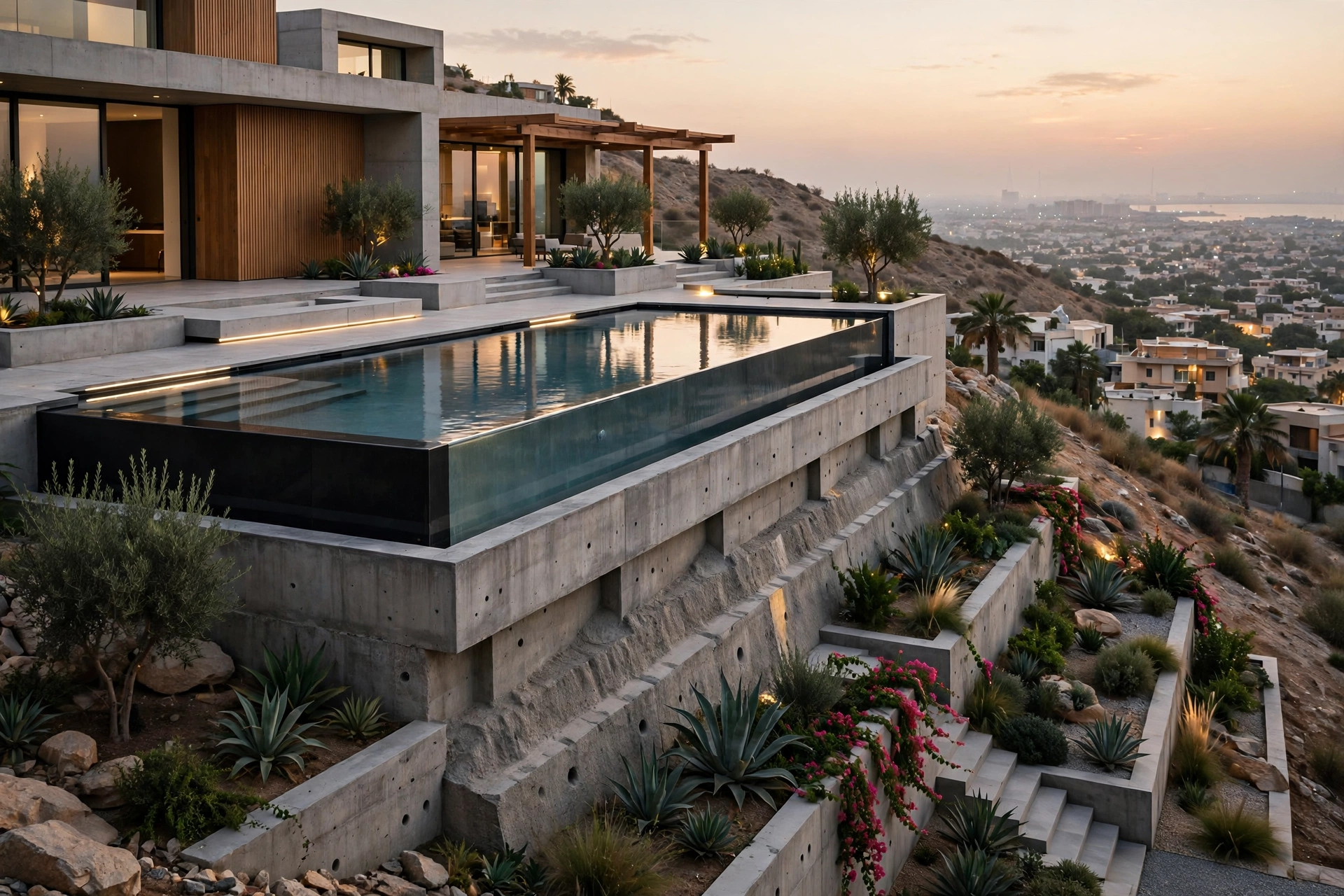
Most Karachi plots are flat, so most Karachi pools are built on flat ground. But not every plot is flat. DHA Phase 8 has hillside streets, parts of Clifton sit on rising ground, Gulshan and the farmhouse belt have plots that fall away sharply, and plenty of older houses in the city sit on land that slopes more than the owner realised until someone put a level on it.
A sloped plot does not mean you cannot have a pool. In fact, some of the best-looking pools in Karachi are on slopes — an infinity edge falling away towards the view, a split-level deck, a pool that looks carved into the hillside. But a slope changes everything about how a pool is designed and built, and a contractor who treats a hillside pool like a flat-ground pool will build you a problem. This guide explains what changes, what it costs, and how to get it right.
Why a Slope Changes the Build
On flat ground, the earth presses evenly on all sides of a pool shell, and the water inside pushes back evenly. On a slope, that balance breaks.
Soil pushes downhill. The high side of the pool carries the weight of the earth above it, and that earth is always trying to slide downhill — straight into your pool wall. A standard shell, designed for even pressure, can crack under that one-sided load. Sloped sites need thicker walls on the uphill side, extra steel reinforcement, and often a retaining wall between the slope and the shell.
Water runs downhill too. Karachi's monsoon rain does not politely soak into a slope — it runs down it, and it runs fast. A pool on a slope sits in the path of every heavy downpour above it. Without proper drainage, runoff pours into the pool, floods the equipment room, and erodes the soil around the shell. We have seen pools on slopes where the first monsoon washed soil out from under the deck.
Access is harder. Excavators, concrete trucks, and tile deliveries all assume reasonably level access. On a steep plot, machinery may not be able to reach the pool site at all, which means more hand digging, more barrowing, and more time — and the owner should know that price before signing, not after the first truck turns back at the gate.
The water table can surprise you. In coastal areas like DHA and Clifton, the water table is already high, and on a slope near the coast groundwater can seep through the uphill side of an excavation and flood the pit while work is underway. A proper site visit catches this; a contractor who skips the site visit discovers it mid-dig.
First Step: A Real Site Assessment
No hillside pool should be priced from a phone call. Before any design work, a contractor should visit the plot and check four things.
- The slope itself. How steep is it, and in which direction does it fall? A gentle slope of a few degrees is a design opportunity. A steep fall of several metres across the plot is a structural project, not just a pool.
- The soil. Karachi's soil varies sharply by area — sandy near the coast, harder and more stable inland, and pockets of loose fill on plots that were levelled years ago. A soil test tells the engineer how much the ground can be trusted to hold, and whether the retaining wall needs deep foundations.
- Drainage paths. Where does rainwater go now, and where will it go once a pool and deck interrupt it? The design has to give monsoon water somewhere safe to go — away from the pool, away from the house, and away from the neighbour's wall.
- Access. Can an excavator get in? Can a concrete mixer reach the site? If not, the build needs a different method and a different price, and the owner should know that before signing, not after the first truck turns back at the gate.
Design Options That Work on a Slope
A slope is a constraint, but it is also an opportunity. The best hillside pools use the slope instead of fighting it.
The infinity edge. The classic hillside design: the pool's downhill edge is built level with the water surface, so water spills over a vanishing edge and the pool appears to merge with the view beyond. It looks spectacular on a DHA hillside or a farmhouse plot, and it suits Karachi because the view is usually worth framing. It needs a catch basin below the edge, a second pump to return the water, and precise levelling — this is not a detail to leave to an inexperienced crew.
The split-level pool and deck. The pool sits at one level and the deck at another, connected by steps. This suits moderate slopes, keeps excavation manageable, and gives the family a natural seating terrace overlooking the water. It is often the most practical option for a residential plot.
The raised pool. On a steep plot, part of the pool can be built above ground level on the downhill side, with the shell acting as its own retaining structure. This reduces excavation on the uphill side, but it puts the full water load on the downhill wall, so the engineering has to be right — a raised pool with a weak downhill wall is a genuine safety risk.
Terracing. For very steep plots, the garden is terraced with retaining walls and the pool sits on one level terrace. This is the most expensive option, but it turns an unusable slope into a series of usable outdoor rooms, and it is the standard approach for farmhouse plots with serious falls.
Retaining Walls: The Part You Cannot Skip
On a sloped site, the retaining wall is not a garden feature — it is part of the pool's structure. It holds back the earth that would otherwise press on the shell, and it has to be built to engineering standards, not as a decorative garden wall.
Reinforced concrete is the standard. For any wall holding back more than about a metre of earth, a properly engineered reinforced-concrete retaining wall is what a pool needs. Dry-stone or block walls without steel and foundations are garden walls, not retaining walls, and they will lean, crack, or fail under monsoon-soaked soil.
Drainage behind the wall matters as much as the wall itself. Water trapped behind a retaining wall is the most common cause of failure. A proper wall has weep holes, a gravel drainage layer, and a drain pipe at its base carrying water away. A wall built without drainage holds back water as well as soil, and after one heavy monsoon the pressure doubles.
Drainage: The Monsoon Test
Every hillside pool in Karachi will face its real test in the first monsoon, and the test is simple: does the water go where the design intended?
Surface drainage above the pool. A channel or drain across the slope above the pool catches runoff before it reaches the pool area. Without it, every heavy rain sends a sheet of water, mud, and debris straight into the pool and across the deck.
Drainage around the shell. A gravel-filled drain around the pool's uphill side carries groundwater away from the shell. This also protects the pool from hydrostatic pressure — groundwater pushing up from below — which on a slope can be strong enough to lift an empty pool shell. Never drain a hillside pool completely without a contractor checking the groundwater situation first.
Cost, Timeline, and Permissions
A hillside pool costs more than a flat-ground pool of the same size, and takes longer. The extra cost is in the retaining walls, the drainage, the extra excavation, and the engineering. The extra time is in the earthworks and the curing of the retaining structure before the pool shell itself can be built. As a rough guide, add 2–4 weeks to a standard 8–12 week build for a moderately sloped plot, and more for a steep one.
Permissions deserve a mention too. Most residential pools in Karachi need a housing-society NOC, and on a sloped plot the society may also want to see the structural drawings for the retaining wall — especially if the wall is near a boundary or a neighbour's property. Sort this out before excavation, not after, because a society objection mid-build is far more expensive than a drawing submitted early.
FAQs
Can you build a pool on a steep slope in Karachi?
Yes — with proper engineering. The pool needs a structural design for one-sided soil pressure, a reinforced retaining wall, and a drainage plan for monsoon runoff. A steep slope is a structural project, not just a pool, and it should be priced and built as one.
How much extra does a sloped plot add to pool cost?
On a moderately sloped plot, retaining walls and drainage typically add 15–30% to the cost of the pool itself. On a steep plot, earthworks and retaining can cost as much as the pool. Get the retaining and drainage work itemised separately in the written quote.
What is the best pool design for a sloped backyard?
An infinity edge suits a downhill view and is the most striking option; a split-level pool and deck is the most practical for a moderate slope; terracing works best for very steep plots. The right choice depends on the slope, the soil, and the view.
Do I need a structural engineer for a pool on a slope?
For anything more than a gentle slope, yes. The retaining wall and the shell's reinforcement need engineering, not guesswork. A contractor who says engineering is unnecessary on a steep plot is a contractor to avoid.
Can monsoon rain damage a pool built on a slope?
It can, if drainage was not designed in — runoff flooding the pool, soil washing from under the deck, and water pressure behind a retaining wall are the real risks. With proper surface drains, a gravel drain behind the wall, and weep holes, a hillside pool handles the monsoon the way it was designed to.
A Slope Is an Opportunity, Not a Problem
The best pools we have built on slopes are the ones the owners are proudest of — the infinity edge at sunset, the terrace looking over the water, the garden that finally works because someone terraced it properly. The slope is only a problem when it is ignored: when a contractor prices a hillside pool like a flat one, skips the soil test, and leaves the monsoon to find the design's weaknesses.
If your plot slopes and you have been told a pool is not possible, or you have been given a quote that makes no mention of retaining walls or drainage, get a second opinion. Call or WhatsApp The Pool Guy on +92 321 2077638 for a free site visit — we will walk the slope, check the soil and the drainage, and give you a written quote that includes the earthworks, not just the pool.
See everything we do on our services page, look at recent builds in our gallery, and browse pool equipment on our products page. We are at 22 Dr Ziauddin Ahmed Rd, Civil Lines, Karachi, open Mon–Sat, 9 AM–6 PM.
Leave a Reply