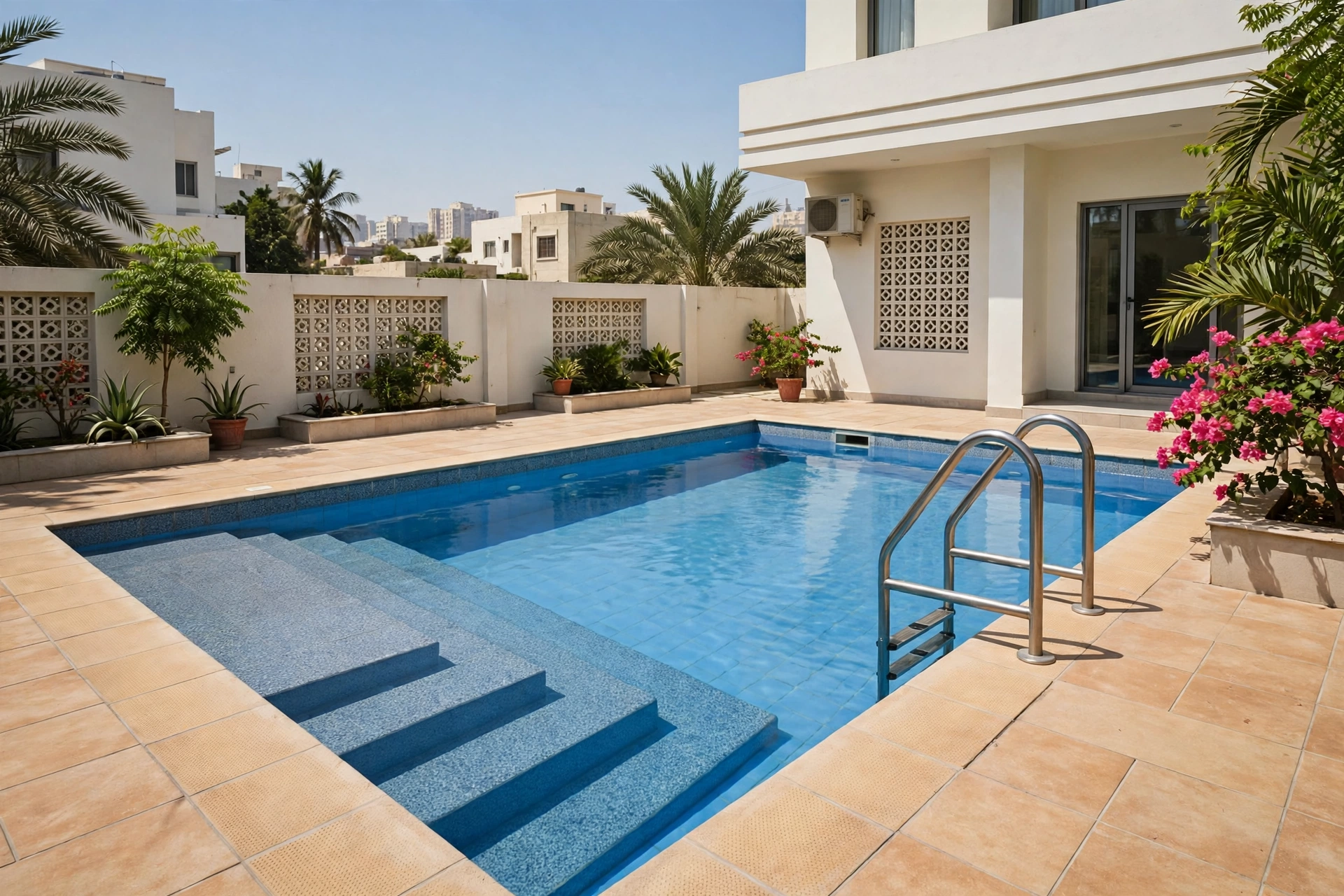
Ask a pool owner what they love about their pool and they will talk about the water, the tiles, the lights. Ask a physiotherapist what sends people to hospital around pools and the answer is far less glamorous: slips on entry and exit. Steps, ladders and handrails are the most-used parts of any pool — every swimmer touches them twice per swim — yet they are often chosen last, from whatever the builder had in stock.
Getting pool entry right matters most for the people who need it most: children, elderly parents, and anyone with a bad knee or stiff back. Here is how Karachi pool owners should choose, build, and maintain safe entry — and the mistakes that turn a simple ladder into a hazard.
The Entry Options, and Who Each Suits
Built-in steps. Wide, shallow steps formed in the pool shell, usually at the shallow end. They are the most comfortable entry: you walk in gradually, sit on a step to acclimatise, and children can play on the top step under supervision. They cost more than a ladder and take up pool space, but for a family pool — DHA villas, Gulshan houses, farmhouses — they are the default choice for good reason.
Ladders. Stainless steel or plastic ladders bolted to the deck and pool wall, with two to four treads. They are cheap, quick to fit, and ideal for small pools where steps would eat too much swimming space, and for retrofitting an older pool that has no steps. Their downside is obvious: a vertical climb is hard for small children, elderly swimmers, and anyone carrying a child or a drink.
Recessed steps and corner benches. Steps moulded into the pool wall, or a submerged bench at the shallow end that doubles as entry and resting spot — suited to renovations where full-width steps would mean major shell work.
Beach or zero-depth entries. A gently sloping floor from deck level into the water. Superb for accessibility and small children, but they need a large footprint, careful water-level control, and a bigger budget. They are rare in Karachi home pools and common in resort pools.
| Entry type | Best for | Space needed | Rough cost | Accessibility |
|---|---|---|---|---|
| Built-in steps | Family pools, kids, elderly | High | Higher | Excellent |
| Ladder | Small pools, retrofits | Minimal | Low | Fair |
| Recessed steps/bench | Renovations, medium pools | Medium | Medium | Good |
| Beach entry | Resorts, large plots | Very high | Highest | Excellent |
Step Dimensions That Actually Feel Safe
A comfortable pool step is about 10 to 12 inches deep (front to back) and rises about 6 to 8 inches per step. Steps shallower than that feel like a ladder; steps deeper than that waste pool length. The top step should sit just below the waterline so a swimmer can sit with shoulders out of the water, and the bottom step should land on the pool floor without a surprise drop.
Width matters too: a 3 to 4-foot-wide step lets a parent walk in holding a child’s hand. Keep the walking line clear of the skimmer mouth, and let the handrail continue down into the water far enough that a swimmer can hold it while standing on the lowest step.
Materials: What Survives Karachi’s Water and Weather
Stainless steel ladders and rails. Strong, clean-looking, and easy to wipe down. In Karachi, buy marine-grade stainless steel (316 grade) rather than cheaper 304 grade, especially in Clifton and DHA where sea-breeze salt corrodes lesser steel fast. Cheap steel rusts at the welds within a season or two, stains the pool wall, and eventually feels wobbly. Check welds and anchor cups yearly.
Built-in tiled steps. The step surface should match the pool’s interior finish, but with one crucial difference: the tread must be non-slip. Smooth glazed tiles look beautiful and are treacherous when wet, especially with sunscreen on feet. Use textured, anti-slip tiles or mosaic on step treads, and a contrasting tile colour or strip on the edge of each step so the edge is visible underwater. Underwater visibility is a safety feature, not decoration — a step edge you cannot see is a step you will miss.
Plastic and resin ladders. Light, rust-proof, and cheap — reasonable for above-ground or temporary pools, but flimsy under an adult’s weight in a permanent concrete pool, and their treads wear smooth faster. If budget forces one, choose wide, textured treads and check fixings monthly.
Grab rails and handrails. Fit them at every entry point, not just the “main” one. Rails must be firmly anchored into deck and pool wall, not just glued or screwed into tile — a rail that pulls loose when leaned on is worse than no rail.
Safety for Children and Elderly Swimmers
Children enter pools unpredictably — running, jumping, climbing over the side. Wide, visible steps with a handrail give them an obvious route in and out. Never rely on steps alone for child safety — supervision, a fence or barrier, and swimming lessons are the real safeguards.
For elderly swimmers, the combination that works is: wide steps, a handrail on both sides where possible, a non-slip tread, and a bench at the shallow end to rest on. A swimmer who can sit on the top step, hold a rail, and lower themselves gradually will use the pool far more often than one facing a vertical ladder. And entry points must be lit for night swimming — an unlit step in a dark pool is an accident waiting to happen.
Maintenance: The Small Jobs That Keep Entry Safe
Entry hardware fails gradually, and a monthly check catches it early:
- Tighten and test. Grab each ladder and rail and pull firmly. Any rock or loose anchor cup needs attention now, not next season.
- Check treads. Worn-smooth treads, cracked plastic steps, and loose mosaic tiles all need replacement before they cause a fall.
- Fight algae on steps. Algae loves the shallow, warm water on top steps, and an algae-coated step is as slippery as ice. Brush weekly, especially after monsoon rain.
- Inspect for rust. Rust streaks below a ladder anchor mean the anchor or steel is failing — find the cause, not just the stain.
- Re-check after renovation. Retiling must preserve the non-slip tread and contrasting step edge, or the pool becomes more dangerous, not better.
Common Entry Mistakes We See in Karachi Pools
The usual faults are a ladder as the only entry on a family pool; smooth glazed tiles on step treads, chosen for looks and regretted at the first wet foot; rails that stop at the deck and abandon the swimmer on the hardest step; ladders bolted into tile with no proper anchor, which work loose and crack the tile; no contrasting step edge, so underwater steps are invisible at dusk; and steps placed under a diving board or slide exit, where entry and play zones overlap.
What to Ask Your Contractor Before Entry Is Built
Ask: what entry type do you recommend for our family, and why? What are the step dimensions, and is the tread anti-slip? Are step edges marked with contrasting tile? What grade of stainless steel are the ladder and rails, and how are they anchored? Are handrails fitted at every entry point, reaching into the water? Is the entry lit for night swimming? A contractor who answers with dimensions and materials has thought about entry.
Frequently Asked Questions
Can steps be added to an existing pool that only has a ladder?
Often yes. A stainless-steel step unit can be bolted in, or a small built-in step formed during a renovation. A full-width retrofit needs a shell assessment first.
How do I stop steps going green and slippery?
Weekly brushing, correct chlorine levels, and good circulation over the shallow end. Algae on steps usually means the shallow end is a circulation dead spot — a return jet angled across the steps helps.
My ladder wobbles. Is it dangerous?
Yes, treat it as urgent. Stop using it and have the anchors checked — a wobbling ladder usually means corroded anchors, and it can fail suddenly under load.
The Bottom Line
Pool entry is used more than any other part of the pool, by every swimmer, every swim. Wide steps, a rail that reaches the water, anti-slip treads you can actually see underwater, and marine-grade steel that survives Karachi’s salt air — these are not extras, they are the basics of a pool people can enjoy safely for years. If your pool’s only entry is a wobbly ladder, or your steps are smooth and invisible underwater, talk to The Pool Guy before someone learns the hard way. Maintenance plans start from Rs 15,000/month after a free pool inspection.
Call or WhatsApp The Pool Guy on +92 321 2077638. We build, repair, and maintain swimming pools across Karachi — DHA, Clifton, Gulshan, Bahria Town, and beyond. Visit us at 22 Dr Ziauddin Ahmed Rd, Civil Lines, Karachi, Mon–Sat 9 AM–6 PM. See our work on the gallery, explore our services, and browse pool equipment on our products page.
Leave a Reply