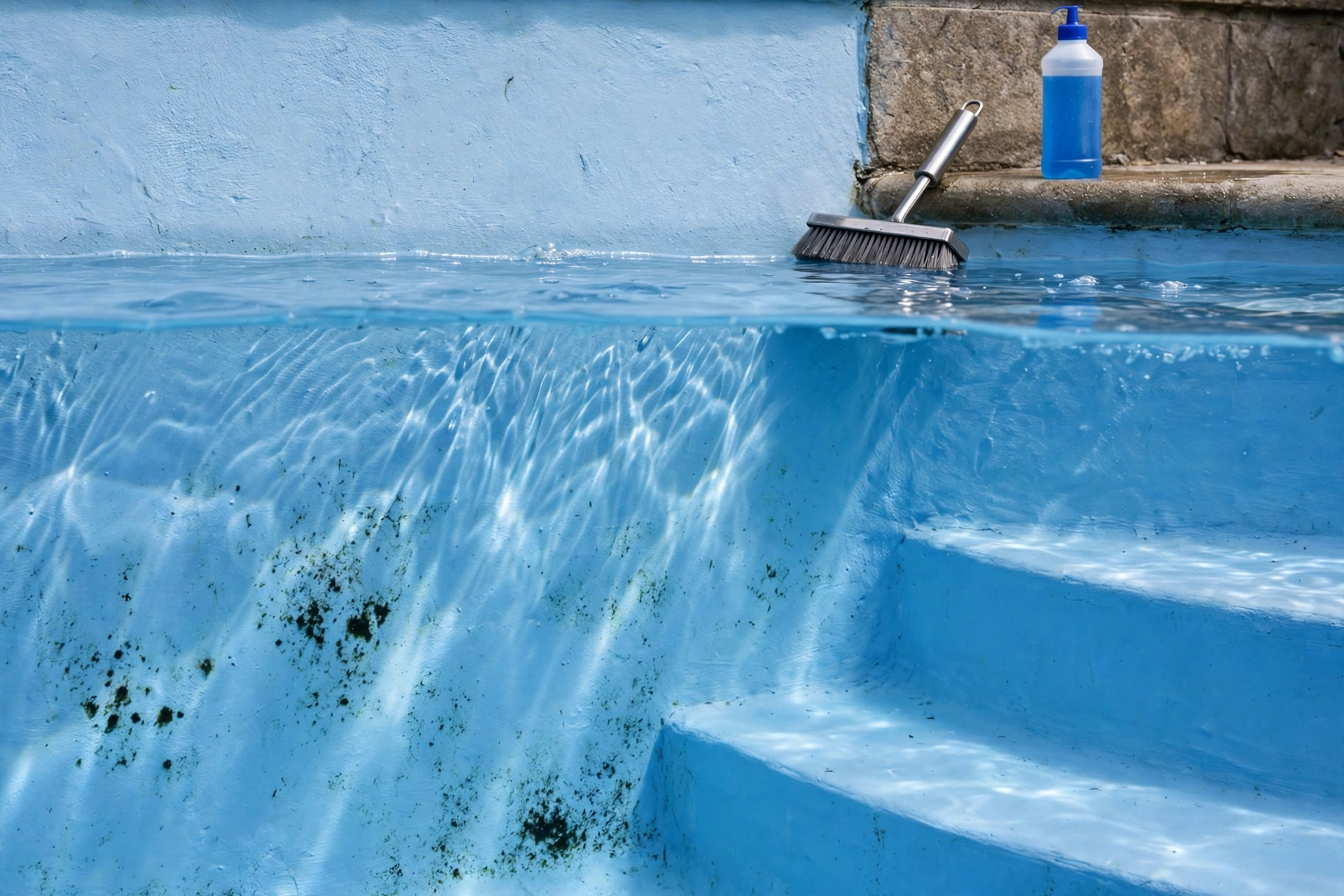
Those small black or dark-blue spots on your pool walls are not dirt. They do not brush off, they do not fade when you add chlorine, and they come back in the same places every time you think they are gone. That is black algae — the toughest algae a Karachi pool owner will meet — and it needs a different fight from the green water most owners know.
Black algae is common in Karachi for a reason. It loves warm water, rough plaster surfaces, and pools where the chlorine level has dipped even briefly. Once it roots into plaster or grout, normal chlorination barely touches it. This guide explains what it is, why it keeps returning, and the step-by-step treatment that actually kills it.
How to Tell It Is Black Algae
Black algae forms in clusters of small, raised black or blue-black spots, usually 5–25mm across, most often in shaded corners, on steps, along the waterline, and in any rough or cracked patch of plaster. Run your hand over a spot: it feels slightly raised and gritty, like sandpaper, because the colony grows roots into the surface.
It is easy to confuse with other marks. A quick check:
| Mark | What it looks like | The test |
|---|---|---|
| Black algae | Raised black/blue-black spots in clusters | Does not brush off; returns in the same place |
| Dirt or debris | Loose dark patches | Brushes away easily |
| Metal stains | Flat brown/black stains, often streaky | Smooth to the touch; does not grow |
| Mould on grout | Dark grout lines, mostly above the waterline | Stays on grout; does not spread onto plaster |
If a spot survives a firm brushing and reappears in the same place within days, treat it as black algae. The sooner you act, the shallower the roots and the easier the kill — a colony left for a whole summer can root so deep that only replastering removes it fully.
Why Normal Chlorine Does Not Kill It
Black algae protects itself with a waxy, layered coating that ordinary pool chlorine cannot penetrate. The chlorine in the water kills the exposed top of the colony, the spot fades to grey for a day or two, and then the protected cells underneath regrow. That is why owners tell us they shocked the pool three times and the spots came back: the shock never reached the roots.
Three Karachi conditions make it worse. First, warm water: black algae grows fastest above 28°C, which is most of the year here. Second, rough or ageing plaster gives the roots something to grip — a smooth, well-maintained surface is far harder to colonise. Third, low chlorine episodes: a pump left off during a loadshedding afternoon, a week without dosing while the family travels, or stabiliser lock from months of tablets alone all drop the chlorine low enough for a colony to establish. Our chlorine types guide explains how stabiliser lock happens and how to avoid it.
The Treatment: Scrub, Shock, Repeat
Killing black algae is a process, not a single dose. Plan on three to five days, and do the steps in order.
Step 1 — Test and balance first. Check pH, free chlorine, and stabiliser (CYA). Bring pH to 7.2–7.4 — chlorine works best slightly low — and check CYA. If CYA is above 80 ppm, the shock will be weak no matter how much you add; dilute the pool with fresh water first or the treatment will fail. Our chemical balance guide covers the readings and the order to fix them.
Step 2 — Scrub every spot hard. Use a stainless-steel brush on plaster and concrete, or a stiff nylon brush on fibreglass and vinyl — never steel on fibreglass, it scratches. Scrubbing breaks the waxy coating open; without this step, the chlorine cannot reach the colony. Scrub every spot you can see, including steps, corners, and the waterline. This is the most tiring part and the most important one.
Step 3 — Shock with granular chlorine. Immediately after scrubbing, shock the pool with granular chlorine (cal-hypo) to raise free chlorine to 10 ppm or higher, and hold it there. Pre-dissolve the granules in a bucket and pour the solution around the pool with the pump running. For heavy colonies, scatter a small amount of granular chlorine directly onto each scrubbed spot — the concentrated contact kills the roots. Do this in the evening so the sun does not burn the chlorine off. See our green pool guide for shock dosing basics.
Step 4 — Brush and re-shock daily. Brush the spots again every day and keep free chlorine high for three to five days. The spots will fade from black to grey to nothing. Do not stop the day they disappear — the roots take longer to die than the visible colony. Run the pump 24 hours a day during treatment so the chlorine circulates everywhere.
Step 5 — Add an algaecide for the finish. Once the spots are gone, add a copper-based or polyquat algaecide at the maintenance dose. Algaecide is not the killer — the chlorine did that — but it stops the regrowth while the water stabilises. Keep the filter clean during treatment: backwash or clean the cartridge when the pressure gauge rises, because dead algae loads the filter fast. Our backwash guide covers the timing.
Step 6 — Test again and restore normal levels. When the water is clear and no spots have returned for a week, let chlorine fall back to the normal 2–3 ppm range, restore pH to 7.2–7.6, and resume the usual routine.
When the Spots Are in the Grout or Tiles
Tiled pools get black algae in the grout lines, where the rough cement gives roots a grip. The treatment is the same, but use a grout brush or an old toothbrush on the lines, and be patient — grout colonies are stubborn because the roots sit deep in a narrow crack. If the grout is already crumbling, the colony will return no matter how well you shock it, because the damaged grout is a permanent home. In that case the real fix is re-grouting the affected lines and then treating. Our pool tile options guide covers grout and tile choices that resist algae.
On fibreglass pools, black algae is rarer because the surface is smooth — but it still appears where the gelcoat is scratched or where fittings meet the shell. Use only a nylon brush, and never scatter dry granules directly on fibreglass; pre-dissolve everything.
How to Stop It Coming Back
Killing the colony is half the job. These habits keep it from returning:
- Never let chlorine hit zero. Even a single day at zero in summer is enough for black algae to take hold in a rough patch. A floater with tablets as a backup covers holidays and travel.
- Brush the pool weekly. A weekly brush of the walls and steps breaks up new colonies before they root. It takes ten minutes and prevents the hardest algae problem there is.
- Keep stabiliser in range. Test CYA monthly. Above 80 ppm, chlorine goes sluggish and algae gets its chance — switch to liquid chlorine for a few weeks to reset it.
- Fix rough plaster promptly. Cracks, chips, and etched plaster are where black algae lives. A small plaster repair now is far cheaper than a full resurface later — see our pool resurfacing guide.
- Mind the shady corners. Black algae starts in shade: behind steps, under the skimmer ledge, in the corner the sun never reaches. Brush those spots first every week.
When to Call a Professional
Call us if the spots cover large areas, if they have survived two rounds of shock treatment, or if the plaster is rough, cracked, or more than ten years old. Deep-rooted colonies sometimes need an acid wash or a drain-and-scrub, and those are jobs for a crew with the right equipment — draining a pool incorrectly can damage the shell, especially in areas with a high water table like Clifton and DHA. Our acid wash guide explains when that step is appropriate.
Frequently Asked Questions
Is black algae dangerous to swim in?
Black algae itself is not the main danger — the danger is what it signals. A pool with black algae usually has low or ineffective chlorine, which means bacteria are not being controlled either. Do not swim until free chlorine is back in the 2–3 ppm range and the water is clear.
Why does black algae keep coming back in the same spot?
The roots survive in tiny cracks and pores in the plaster. Shocking kills the visible colony, but if the waxy layer was not scrubbed open first, the roots regrow. Scrubbing before every shock is the step most people skip.
Can I use a pressure washer on black algae?
Not in a filled pool, and not on plaster — it damages the surface. The right tool is a stiff brush, used repeatedly, with the chlorine doing the chemical work.
Will an algaecide alone kill black algae?
No. Algaecide prevents regrowth; it does not kill an established colony. The kill comes from scrubbing plus sustained high chlorine. Algaecide is the finishing step, not the treatment.
How long does black algae treatment take?
A light case clears in three to five days of daily brushing and high chlorine. A heavy, long-established case can take a week or more, and very deep colonies in old plaster may need professional help.
Get Rid of Black Algae for Good
If black spots keep coming back no matter what you try, book a free pool inspection. We identify whether it is black algae or a stain, test your water on the spot, and treat the colony properly — including the plaster repairs that stop it returning.
Call or WhatsApp +92 321 2077638. The Pool Guy — 22 Dr Ziauddin Ahmed Rd, Civil Lines, Karachi. Open Monday to Saturday, 9 AM–6 PM, Sunday closed. See our services, gallery of completed pools, and pool products including brushes, testing kits, and algaecides.
Leave a Reply