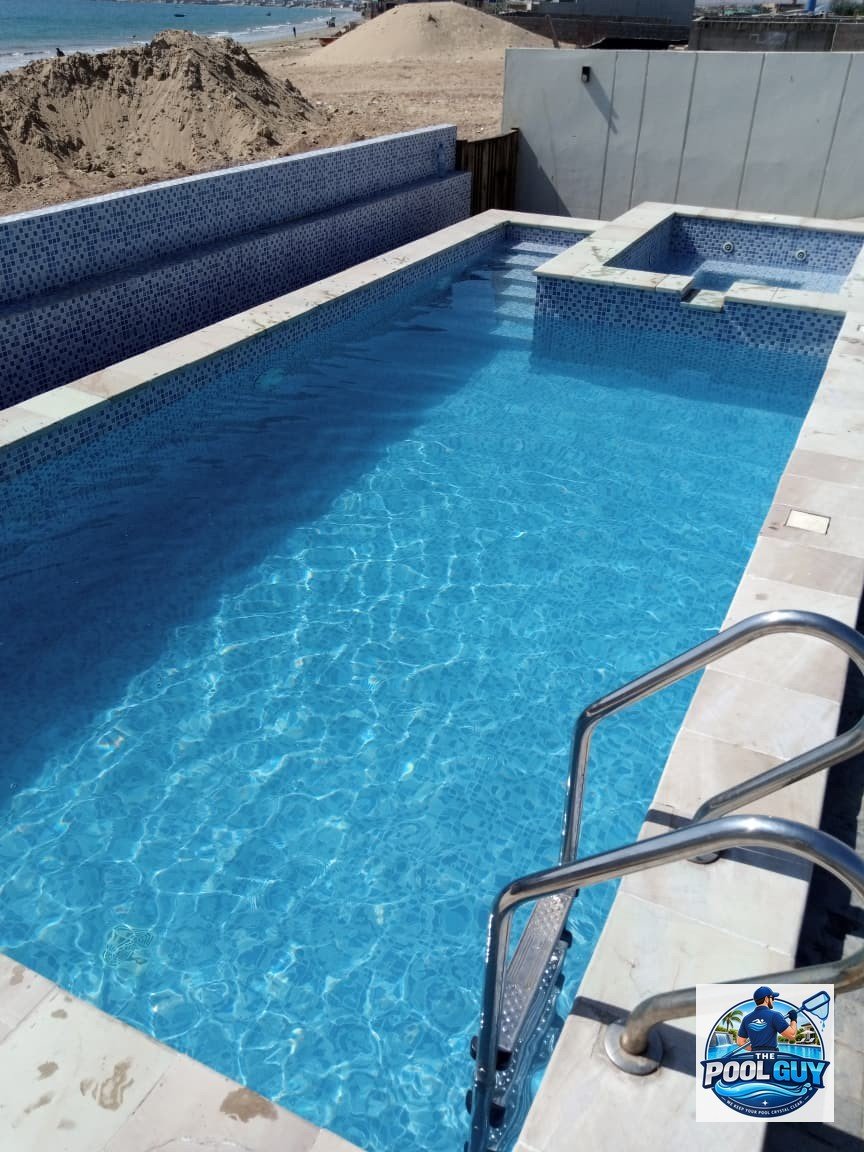
Walk into any tile market in Karachi — Shahrah-e-Faisal's tile rows, or the shops around Gulshan — and you'll find dozens of tiles labelled "pool tiles." Half of them are ordinary bathroom tiles that will pop, stain, or crack within two summers of real pool use. The difference between a pool surface that lasts fifteen years and one that peels in two comes down to four things: the tile body, the glaze, the adhesive, and the grout. Most contractors in Karachi obsess over the first and ignore the other three.
We've tiled and re-tiled pools across Karachi for years — DHA, Clifton, Bahria Town, Gulshan — and we've seen every failure mode: grout that dissolved in eighteen months, mosaics that fell off in sheets, and floors so slippery they sent someone to the hospital. This guide is the honest version: what each tile type really costs in Pakistan, what survives our heat, hard water, and coastal air, and where contractors quietly cut corners.
Why tile choice is harder in Karachi than anywhere else
A pool in Karachi lives a tougher life than a pool in Lahore or Islamabad, for four reasons:
1. Heat. Deck tiles in direct June sun hit 60°C+. Waterline tiles bake at the surface where chlorine concentration is highest. Cheap glazes craze (hairline-crack) under thermal cycling, and once the glaze crazes, stains sink into the tile body.
2. Hard water. Karachi's water supply is moderately hard, and bore water — which half the bungalows in DHA and Bahria use — is very hard. Calcium scale builds on waterline tiles as a white crust. On the wrong tile finish, that scale bonds and becomes permanent. This is the single most common complaint we hear: "the waterline tiles went white and nothing removes it."
3. Coastal salt air. Clifton and DHA Phase 8 pools sit in salt-laden air. It doesn't attack the tile itself, but it accelerates the breakdown of cheap cementitious grout and corrode any metal trim.
4. Dust and monsoon. Karachi's dust storms coat everything, and monsoon flooding washes muddy, chemical-laden water into pools. A tile that's hard to scrub becomes a maintenance headache — darker tiles and rough textures show every stain.
So when a tile shop tells you "yeh pool tile hai" (this is a pool tile), what you actually need to know is: what's the water absorption rate, is it frost-rated and chemical-rated, and what's the slip rating? Most shopkeepers can't answer any of those. Buy the spec, not the label.
The 4 pool tile types you'll actually find in Pakistan
1. Ceramic glazed tiles — the budget standard
What they are: Ordinary glazed ceramic tiles, usually 6×6 inch or 8×8 inch, sold in every tile market in Pakistan.
2026 Karachi price: Rs 350–600 per sq ft installed (material only: Rs 200–350/sq ft).
Honest verdict: Fine for budget renovations and waterline bands, marginal for full pool interiors. The body absorbs water (5–10% absorption rate is typical), which means in a Karachi pool the glaze eventually crazes and the body swells. We've seen cheap ceramic interiors fail in 3–5 years. For waterline-only use on a tight budget, they're acceptable — but spend the savings on better grout.
2. Porcelain tiles — the contractor's default
What they are: Denser, harder-baked tiles with under 0.5% water absorption. Anti-slip textured porcelain (R10/R11 rated) is what should be on every Karachi pool deck.
2026 Karachi price: Rs 700–1,200 per sq ft installed for interiors; anti-slip deck porcelain Rs 450–800/sq ft.
Honest verdict: This is our default recommendation for 80% of Karachi residential pools. Porcelain shrugs off hard-water scale (it's chemically inert and dense), resists UV fading in our brutal sun, and the anti-slip versions genuinely prevent falls. The catch: cheap imported porcelain is often just ceramic with a porcelain label. Real porcelain rings like a bell when tapped and shows uniform colour through the body. Insist on seeing the box specification — water absorption ≤ 0.5%.
3. Glass mosaic — the luxury look
What they are: Small glass tiles (usually 25×25 mm) on mesh sheets, famous for that shimmering hotel-pool look. Iridescent and mother-of-pearl variants are the most requested.
2026 Karachi price: Rs 2,500–6,000+ per sq ft installed (material: Rs 1,500–4,000/sq ft). A full glass-mosaic interior on a 25×12 ft pool can add Rs 15–30 lakh to the project.
Honest verdict: Beautiful, essentially waterproof (zero absorption), and the most stain-resistant option against Karachi's hard water — scale sits on glass and wipes off. The risk isn't the tile, it's the installation: glass mosaic on a badly prepared surface delaminates in sheets, and we've repaired three such jobs this year alone, all done by bathroom tilers who had never tiled a submerged surface. If you go glass, hire someone who has done at least five pool interiors, and budget for epoxy grout (non-negotiable with glass).
4. Natural stone — travertine, sandstone, slate
What they are: Natural stone, used almost exclusively on decks and coping — never inside the pool shell in Karachi.
2026 Karachi price: Travertine deck: Rs 1,200–2,500/sq ft installed.
Honest verdict: Travertine feels cool underfoot even in June — genuinely the best barefoot deck material for Karachi summers. But stone is porous: it stains from sunscreen, rusts from metal furniture, and needs sealing every 1–2 years. Inside the pool shell, stone dissolves under sustained chlorine and pH swings. Deck only, sealed, and only if the client accepts the maintenance.
| Tile type | Best use in Karachi | 2026 price/sq ft (installed) | Lifespan in pool |
|---|---|---|---|
| Ceramic glazed | Waterline band, budget reno | Rs 350–600 | 3–5 yrs (interior) |
| Porcelain | Full interior, decks | Rs 700–1,200 | 12–15 yrs |
| Glass mosaic | Luxury interior, features | Rs 2,500–6,000+ | 15–20 yrs (epoxy grout) |
| Natural stone | Deck & coping only | Rs 1,200–2,500 | N/A interior |
Pool floor vs waterline vs deck: different zones, different tiles
One of the most common mistakes we see: the same tile everywhere. A pool has three zones with three different jobs:
- Pool interior (walls + floor): Needs zero-to-low absorption, chemical resistance, and a smooth-enough finish to brush clean. Porcelain or glass mosaic. Light blue or aqua shades hide scale and look best in Karachi's hard sunlight.
- Waterline band (the 6-inch strip at the water's surface): This is where scale, oils, and sunscreen collect. Glass mosaic or glazed porcelain in a darker tone works best — it hides the tide line and scrubs clean. This is the single zone where spending more pays off most visibly.
- Deck: Anti-slip is everything. R10 minimum, R11 for commercial or farmhouse pools with kids. Light colours stay cooler in June. And whatever you do, don't let anyone lay polished indoor tiles around a pool — we've treated enough slip injuries from exactly that mistake.
Grout and adhesive: where Karachi contractors cut corners
Here's the industry secret nobody tells pool owners: the tile rarely fails — the grout and adhesive do. In Karachi's heat and chemical water, standard cement grout breaks down in 2–4 years. The failure looks like tiles popping, but the tile was innocent.
- Adhesive: Must be a polymer-modified cementitious adhesive rated for submerged/pool use (C2TE class). Standard tile bond from the hardware store is not pool adhesive. The price difference is small; the consequence difference is total failure.
- Grout: Epoxy grout for waterlines, steps, and any glass mosaic. It's stain-proof, chemical-proof, and doesn't feed algae in the joints. It costs 3–4× cement grout — which is exactly why it's the first thing budget contractors "forget." For full porcelain interiors on a budget, a high-quality polymer-modified cement grout is acceptable, but insist the contractor names the brand in the quotation.
Ask your contractor two questions and you'll know instantly whether they're legitimate: *"Kaunsa adhesive use karenge — brand aur class?"* and *"Grout epoxy hoga ya cement?"* If they can't answer both, don't hire them.
Installation mistakes we fix on other people's jobs
- No waterproofing membrane under the tile. Tile is not waterproof — it's a wearing surface. The shell needs its waterproofing layer first. (We covered the full waterproofing story in our pool waterproofing mistakes guide.)
- Bathroom tilers doing pool work. Submerged tiling needs full mortar coverage (no hollow spots) and movement joints. Hollow spots blister within a year under water pressure.
- Rushing the cure. Adhesive and grout need full curing before the pool fills — typically 7–14 days. Filling early dissolves uncured grout from behind.
- Dark tiles in full sun interiors. Dark blue and black interiors look stunning in photos and cook the water in Karachi summers — they absorb heat and make the pool 3–4°C warmer. If you want the look, use dark tiles for accents only.
- Skipping movement joints. Karachi's temperature swings crack rigid tile fields. Proper expansion joints every 3–4 metres are not optional.
What tiling a standard Karachi pool actually costs (2026)
Take a typical 25×12 ft residential pool in DHA or Bahria Town:
- Waterline band + steps in glass mosaic, interior in porcelain: Rs 4–6 lakh
- Full interior in mid-range porcelain: Rs 3.5–5 lakh
- Full interior in glass mosaic: Rs 15–30 lakh
- Deck (500 sq ft) in anti-slip porcelain: Rs 2.5–4 lakh
These are material-plus-labour ranges from real 2026 Karachi jobs. Anyone quoting dramatically less is cutting the adhesive, the grout, or the surface preparation — you'll pay the difference twice when it fails.
Pool plaster vs tiles — the quick honest answer
The full head-to-head comparison deserves its own article, but here's the short version we give clients: plaster (marcite) is cheaper upfront and gives that classic smooth finish, but in Karachi's hard water it stains, etches, and needs acid-washing every few years. Tiles cost more but last longer and look better for longer. If your budget allows tiles on the interior, do it — it's the single upgrade with the best long-term value on a Karachi pool.
Frequently asked questions
Which pool tile is best for Karachi's hard water?
Glass mosaic, then porcelain. Both are dense and chemically inert, so calcium scale sits on the surface and wipes off. Ceramic's porous body lets scale bond permanently. Whatever you choose, a weekly waterline brushing prevents 90% of staining.
Can I use normal bathroom tiles in a swimming pool?
Technically you can; practically you shouldn't for the submerged interior. Bathroom tiles aren't rated for constant submersion, chlorine, and thermal cycling. They fail in 3–5 years. Use them only for the waterline band if the budget is tight — never the floor.
Why do pool tiles fall off in Karachi?
Almost never the tile's fault. The usual causes: wrong adhesive (not pool-rated), cement grout in a chemically aggressive environment, no waterproofing membrane, hollow spots from poor installation, or filling the pool before the grout cured. Fix the system, not just the tile.
Are dark pool tiles a bad idea in Pakistan?
For the full interior, yes — they absorb Karachi's sun and heat the water noticeably. For waterline bands, steps, and feature walls, dark glass mosaic looks spectacular and causes no problems. Accents, not interiors.
How do I stop white scale on my waterline tiles?
Keep pH between 7.2 and 7.6 (scale forms faster above 7.8), brush the waterline weekly, and if you use bore water, test hardness — very hard water may need a sequestering agent. See our chemical balance guide for the full routine.
Tiling or re-tiling your pool? Get it done once, properly. The Pool Guy handles pool tiling across Karachi — from waterline repairs to full glass-mosaic interiors — with pool-rated adhesives, epoxy grout, and waterproofing done right. Call or WhatsApp +92 321 2077638 (Mon–Sat, 9 AM–6 PM). Visit us at 22 Dr Ziauddin Ahmed Rd, Civil Lines, Karachi — or see our past work in the gallery and full services list.
Leave a Reply