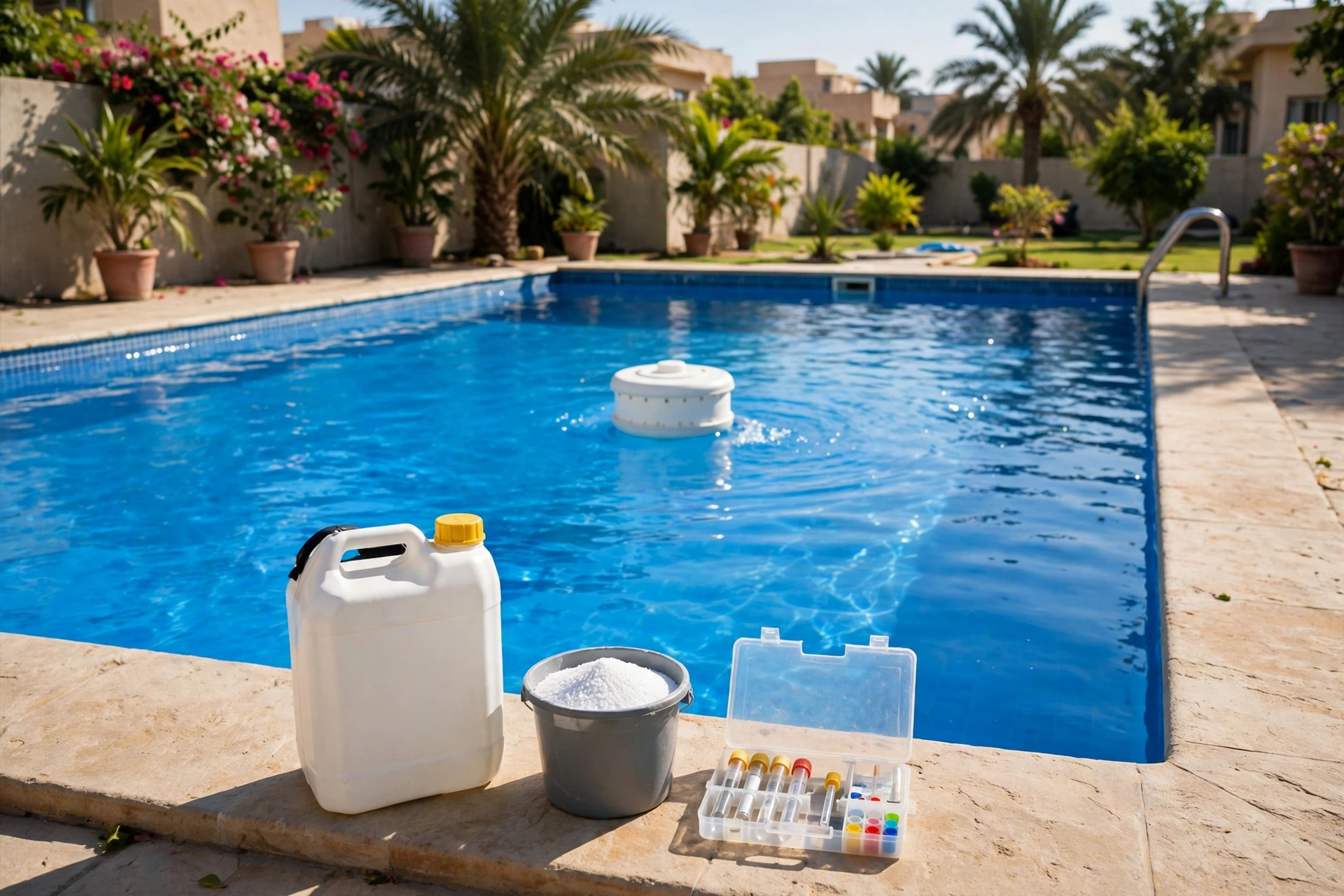
Walk into any pool-chemical shop in Karachi — Saddar, Urdu Bazaar, or the suppliers around DHA — and you will find chlorine in three forms: white tablets, liquid in jerry cans, and granular powder in drums. They all kill germs. They do not all behave the same way in a Karachi pool, and picking the wrong one is the most common reason a pool that was crystal clear on Monday turns cloudy by Friday.
Karachi’s heat is the deciding factor. Chlorine breaks down fast in strong sunlight and warm water, and a pool here can lose most of its free chlorine in a single sunny afternoon. The right chlorine type for your pool depends on how you dose it, how much sun your pool gets, and whether anyone is checking the water every day. Here is the honest comparison, from a contractor who has dosed all three in Karachi pools for years.
The Three Types, in Plain Terms
Chlorine tablets (trichlor) are slow-dissolving pucks, usually 200g, placed in a floating dispenser or an automatic chlorinator. They release chlorine steadily over several days. They are the most common choice in Karachi homes because they are the most forgiving: forget the pool for two days and the tablet is still working.
Liquid chlorine (sodium hypochlorite) is the same chemical used to treat Karachi’s municipal water, sold in 20–30 litre jerry cans. It acts immediately — pour it in and the chlorine level rises within the hour. It is the cheapest per kilogram of active chlorine, and it is what most commercial pools and hotels in Karachi use.
Granular chlorine (cal-hypo, calcium hypochlorite) is a fast-dissolving powder, usually 65–70% available chlorine. It is the shock-treatment workhorse: it raises the chlorine level quickly, kills algae, and clears a green pool. It is also the most hands-on form, because you have to pre-dissolve it and dose it yourself.
| Form | Available chlorine | Speed | Best for | Main drawback |
|---|---|---|---|---|
| Tablets (trichlor) | ~90% | Slow, steady | Daily maintenance, holiday cover | Adds stabiliser; lowers pH |
| Liquid (sodium hypochlorite) | 10–12% | Immediate | Daily dosing, commercial pools | Bulky; loses strength in heat |
| Granular (cal-hypo) | 65–70% | Fast | Shocking, algae treatment | Adds calcium; must pre-dissolve |
Tablets: The Set-and-Forget Option — With One Catch
Tablets are the easiest chlorine to live with. A floater with two or three tablets keeps a typical 8×4m home pool chlorinated for a week, and an inline chlorinator plumbed after the filter doses automatically every time the pump runs. For a homeowner in Gulshan or Bahria Town who does not want a daily chore, tablets are the practical answer.
The catch is stabiliser. Trichlor tablets contain cyanuric acid (CYA), which protects chlorine from sunlight — useful in Karachi’s sun. But CYA does not leave the water. Every tablet adds a little more, and over a season the stabiliser level climbs. Once CYA passes roughly 80–100 ppm, chlorine becomes sluggish: the test kit shows chlorine present, but the water still goes cloudy and algae takes hold. The pool looks chlorinated and behaves unchlorinated. We see this every summer in pools that have run on tablets alone for months.
The fix is simple and often missed: test CYA at least once a month, and when it climbs above 70 ppm, switch to liquid or granular chlorine for a few weeks and dilute the pool with fresh water. Never add stabiliser on top of a tablet-only routine. Our chemical balance guide explains the test readings and the order to adjust them in.
Tablets are also acidic. They slowly push pH down, so a tablet pool usually needs a regular dose of soda ash to stay in the 7.2–7.6 range. If your pH keeps drifting low and your eyes sting, the tablets are the likely cause, not the water.
Liquid Chlorine: Cheapest and Fastest — If You Store It Right
Liquid chlorine is the cheapest chlorine in Pakistan per unit of sanitising power, and it is available everywhere because the same chemical treats drinking water. It has no stabiliser and no calcium, so it never causes the CYA lock or calcium scaling that the other two forms can. It raises pH slightly, which in Karachi — where fill water is often alkaline — is usually a minor point, not a problem.
Its weakness is storage. Sodium hypochlorite degrades in heat and sunlight, and a jerry can left on a sunny equipment pad in June can lose a large part of its strength in a week or two. Buy it from a supplier with fast turnover, keep it in a shaded, ventilated spot, and use it within a few weeks of purchase. A can that has sat in a hot storeroom since last summer is mostly salt water by now.
Dosing is hands-on: pour the measured amount slowly in front of a return jet with the pump running, preferably in the evening so the sun does not burn it off before it works. For a home pool, that means a daily or every-other-day habit. Hotels and clubs manage this easily because they have staff; a homeowner who travels often will find tablets more forgiving. Many of our maintenance clients in DHA and Clifton use a hybrid: tablets in a floater as the baseline, liquid chlorine for top-ups and after heavy use.
Granular Chlorine: The Shock Specialist
Cal-hypo is the chlorine to reach for when something has gone wrong. A green pool, a pool after a monsoon dust storm, or a pool that has hosted a big weekend gathering — granular chlorine raises the free chlorine level fast and burns through the contamination. It dissolves quickly, has no stabiliser, and is easy to measure by weight.
It does add calcium. Karachi’s fill water is already hard, and heavy cal-hypo use pushes calcium hardness up over time — the scale and cloudy water we cover in our calcium hardness guide. Used for occasional shocking, that is not a problem. Used as the only daily chlorine for a whole season, it becomes one.
Two safety rules matter with granular chlorine. First, always pre-dissolve it in a bucket of water and pour the solution in — undissolved granules sitting on a plaster or tile floor can bleach spots into the surface. Second, never mix it with any other chemical, and never store it near acid or tablets: cal-hypo reacts violently with some other pool chemicals. Keep it dry, sealed, and away from other products.
What Karachi’s Sun and Heat Do to All Three
Chlorine loss in a Karachi pool is mostly a sunlight problem. Unstabilised chlorine (liquid or granular) can lose most of its strength in a few hours of direct midday sun. That is why the evening dose matters more here than in cooler climates: chlorine added at 6 PM works all night, while the same dose added at noon is largely gone by evening.
Dose in the evening, run the pump for at least an hour after dosing so the chlorine circulates, and keep the target free chlorine at 2–3 ppm in summer rather than the 1 ppm that is enough in winter. A shaded pool in a farmhouse with big trees needs less chlorine than an open rooftop pool in DHA baking in full sun — there is no single dose for every pool, and the test kit is the only honest guide. Our water testing kits guide covers which kit to buy and how to read it.
Cost Comparison for a Typical Karachi Home Pool
Prices move with the dollar and the season, so treat these as the pattern rather than a quote:
- Tablets cost the most per kilogram of chlorine, but you use less of your own time. A month’s supply for a home pool is the middle of the three on total cost.
- Liquid chlorine is the cheapest per dose by a clear margin — often half the cost of tablets for the same sanitising effect — but you pay in daily effort and in storage losses if you buy in bulk.
- Granular chlorine sits between the two on price, and because it is mainly used for shocking rather than daily dosing, a single drum lasts a long time.
The cheapest chlorine is the one you actually dose correctly. A pool dosed irregularly with cheap liquid chlorine costs more in the end — in algae treatments, extra water, and filter wear — than a pool kept steady on tablets. If you want the low cost of liquid chlorine without the daily chore, ask about a peristaltic dosing pump: it drips liquid chlorine automatically and pays for itself in a season on a busy family pool.
The Combination That Works in Most Karachi Homes
For most home pools in Karachi, the best answer is not one type but two: tablets as the steady baseline, plus liquid or granular chlorine for top-ups, shocking, and the weeks when stabiliser needs a rest. That combination gives you the forgiveness of tablets, the low cost of liquid, and a way to reset CYA before it locks the pool.
Whatever you choose, keep three habits: test free chlorine and pH at least twice a week in summer, dose in the evening, and store every chemical shaded, sealed, and separate. Chlorine is a tool, not a magic powder — used on a routine, any of the three forms keeps a Karachi pool safe and clear.
Frequently Asked Questions
Which chlorine is best for a home pool in Karachi?
For most homeowners, trichlor tablets in a floater or inline chlorinator, with liquid chlorine for top-ups. Tablets forgive missed days; liquid chlorine is cheaper and resets stabiliser levels. The combination beats any single type.
Is liquid chlorine safe for a fibreglass pool?
Yes, when dosed correctly — pour it slowly at a return jet with the pump running, never pour it directly onto the surface. The same rule applies to granular chlorine, which must be pre-dissolved first.
Why does my pool still go green even though I add chlorine every day?
The usual causes are stabiliser lock from months of tablets alone (CYA above 80 ppm), chlorine dosed at midday and burnt off by the sun, or a filter that is not running long enough. Test CYA and free chlorine together — the two readings explain most green pools. See our green pool guide for the full recovery steps.
How long does liquid chlorine last in Karachi’s heat?
A sealed jerry can stored in shade keeps most of its strength for a few weeks. Left in direct sun or a hot storeroom, it can lose significant strength within a week. Buy small quantities often rather than stocking up for the season.
Can I switch from tablets to liquid chlorine?
Yes, and it is the standard way to bring stabiliser down. Stop the tablets, dose with liquid chlorine for a few weeks, and replace a portion of the water if CYA is very high. Never mix tablets and granular chlorine in the same dispenser.
Get Your Chlorine Routine Right
If your pool keeps going cloudy, your chlorine costs keep climbing, or you are not sure which type suits your pool, book a free pool inspection. We test chlorine, pH, stabiliser, and calcium hardness on the spot, check your dosing setup, and set a routine that fits your pool and your schedule.
Call or WhatsApp +92 321 2077638. The Pool Guy — 22 Dr Ziauddin Ahmed Rd, Civil Lines, Karachi. Open Monday to Saturday, 9 AM–6 PM, Sunday closed. See our services, gallery of completed pools, and pool products including chlorinators and dosing equipment.
Leave a Reply