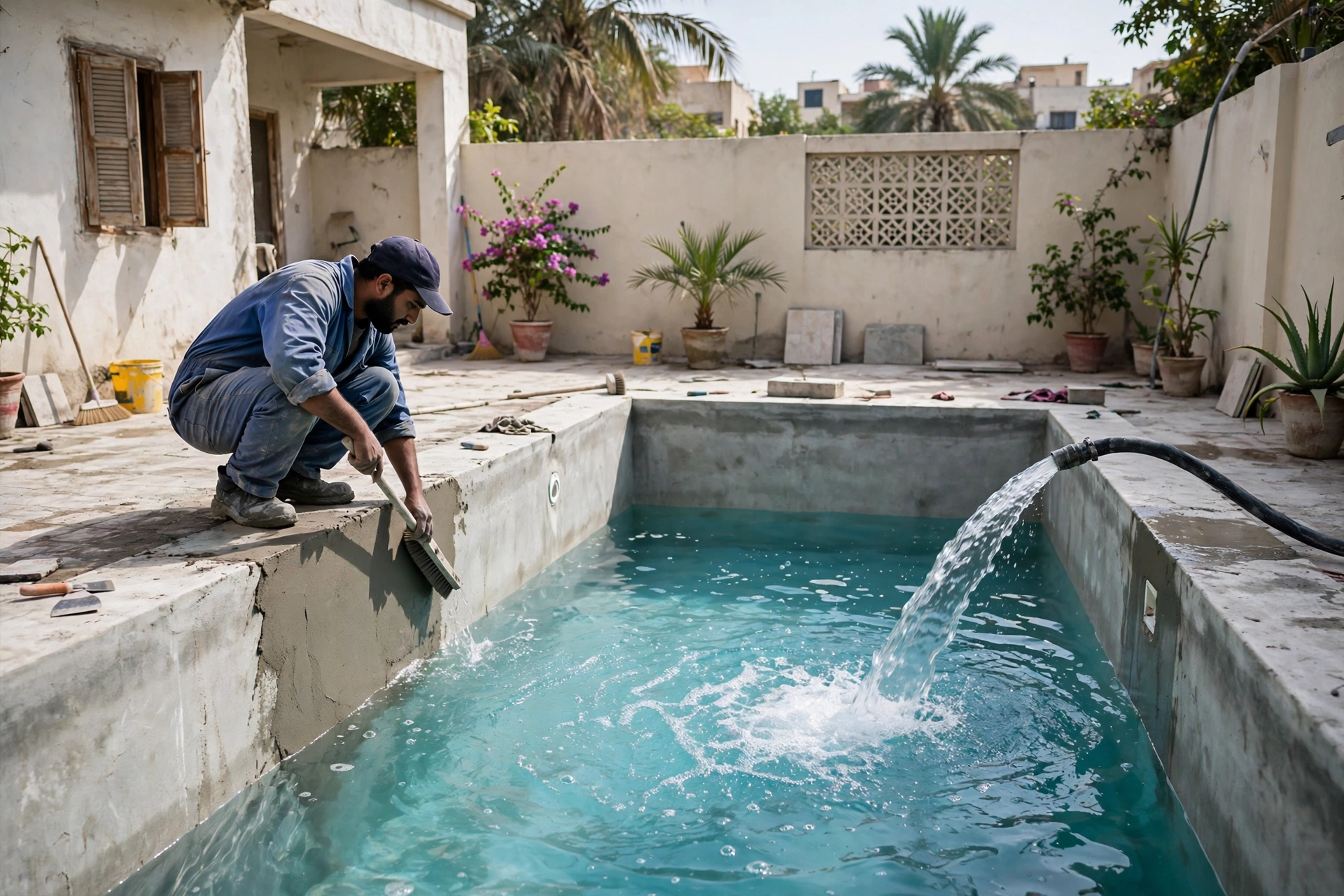
Your pool is filled. The water looks clear, the tiles sparkle, and it is tempting to declare the job done. It is not. The first 30 days after a newly built concrete pool is filled — what contractors call the *startup* — decide the health of your pool's plaster for the next 15 years. Done right, the plaster stays smooth and stain-free for a decade or more; done wrong, expect rough plaster, scaling, or an acid wash within two years.
Why the First 30 Days Matter
New plaster — white marble plaster, quartz aggregate, or pebble finish — spends its first month curing underwater. While it cures, the surface is soft and reactive, releasing calcium hydroxide (plaster dust), and its long-term density depends on keeping water chemistry in a narrow band.
Karachi adds three complications. First, tanker water is often high-TDS and alkaline — total alkalinity of 120–180 ppm is common, and curing plaster in it invites scale. Second, heat and dust: fast summer evaporation and daily sea-breeze dust from April through October. Third, monsoon timing — pools filled June to August face rain-debris spikes in chlorine demand when plaster is most vulnerable.
Week-by-Week Startup Schedule
| Week | Brushing | Filtration | Chemistry Focus | Key Actions |
|---|---|---|---|---|
| Week 1 (Days 1–7) | Twice daily | Pump runs 24 hours/day | pH 7.2–7.6, alkalinity 80–120 ppm | Brush all plaster surfaces; check filter pressure daily; no heater, no salt system |
| Week 2 (Days 8–14) | Once daily | 12–16 hours/day | Begin light chlorination (1–2 ppm) | Continue brushing; check calcium hardness; introduce automatic cleaner |
| Week 3 (Days 15–21) | Once daily | 10–12 hours/day | Stabiliser (cyanuric acid) to 30–50 ppm | Add stabiliser via skimmer sock; clean waterline tile |
| Week 4 (Days 22–30) | Every other day | Normal 8–10 hrs | Full balance: chlorine 1–3 ppm | Move to regular maintenance; hand over test kit |
Days 1–3: The Critical Window
Brush the entire pool twice a day. This is the single most important startup task. Use a soft nylon-bristle brush — never stainless steel on new plaster. Work top-down: waterline tile first, then walls, then the floor, finishing at the main drain, overlapping each stroke by half a brush width. The cloudy white trail behind your brush is plaster dust — lift it into suspension so the filter removes it instead of it settling back and bonding into the surface.
Run the pump 24 hours a day for the first week. Continuous circulation is non-negotiable: it distributes chemicals evenly and pulls plaster dust into the filter. If filter pressure rises 8–10 psi above its clean reading, backwash or clean the cartridges.
Do NOT start the salt chlorinator. Keep it off for 28–30 days — salt interferes with plaster curing and can cause permanent discolouration and premature surface breakdown. One of the most common and most expensive mistakes we are called in to fix.
Do NOT use the heater yet. Do not fire a new heater until the plaster has cured 30 days and chemistry is balanced — running it during startup stresses the plaster and scales the heat exchanger.
Never broadcast granular chlorine directly onto the floor of a new pool. Dissolve chemicals in a bucket first, or add and brush to distribute.
The Startup Chemical Sequence (Order Matters)
Test the fill water on day one with a proper drop test kit — not just strips. Dose in this order:
- Total alkalinity first (80–120 ppm). Karachi tanker water usually arrives high, so this almost always means adding acid. High alkalinity locks pH upward and drives scaling on fresh plaster.
- pH second (7.2–7.6). Aim for the lower half of this range during curing — a pH above 7.8 on new plaster is how calcium scale gets its start.
- Calcium hardness (200–400 ppm). New plaster needs moderately hard water — too-soft water etches the curing surface; too-hard water scales it. Karachi water is usually on the hard side, so this is rarely a problem, but test it.
- Chlorine — introduce gradually (days 2–3 onward, 1–2 ppm). Do not shock a new pool in week one; heavy doses bleach uncured plaster unevenly. Start with small, frequent additions of liquid chlorine.
- Cyanuric acid (stabiliser) — week 2–3, target 30–50 ppm. Karachi's sun burns off unstabilised chlorine in hours, but adding it too early complicates curing chemistry. Wait until plaster dust tapers off, add it in a sock in the skimmer, and do not backwash for 48 hours afterward.
What NOT to Do in the First 30 Days
- Do not drain the pool. Emptying a new pool exposes curing plaster to air and Karachi's heat, causing shrinkage cracking. If a serious problem needs a drain, talk to your contractor first.
- Do not walk on the plaster with shoes. Socks or bare feet only for the first month — grit under shoes scores soft plaster permanently.
- Do not install the automatic pool cleaner in week one. Wait until week 2–3, when chemistry has settled and dust has tapered off.
- Do not let the water level drop below the skimmer. Top up regularly — evaporation in Karachi is fast, and low water lets the waterline tile ring bake on.
- Do not swim for the first 3–4 days if you can avoid it, and keep swimmers out until chlorine and pH are in range. After that, swimming helps — movement distributes dust for the filter.
- Do not panic about plaster dust. White dust is normal for the first 7–14 days. Worry about brown or green discolouration (metals or algae), or dust persisting past week three (chemistry is off) — call your contractor in either case.
Handover Day: Five Things to Get in Writing
Whoever built your pool, get these five things in writing at handover: the day-one water test results; the first week's chemical dosing log; confirmation the salt system and heater were NOT started; the filter's clean-pressure reading (your backwash benchmark); and a 30-day startup checklist signed off as completed. A contractor who cannot produce these did not run a real startup — and you will inherit the consequences in year two.
After Day 30: Transitioning to Normal Maintenance
At day 30 the plaster is cured enough for normal life: normal pump schedules, the salt system can be started, the heater is safe to fire, and chlorine runs at the standard 1–3 ppm. Keep brushing twice a week for the next month — cheap insurance.
From here your pool moves into regular maintenance and cleaning territory: weekly brushing, balanced chemistry, and scheduled filter cleans. Our maintenance plans start from Rs 15,000/month after a free pool inspection — see what that covers on our services page. If you are sizing or upgrading equipment after startup, browse the products page for pumps, filters, and chlorinators suited to Karachi conditions, and check the gallery to see finished pools we have started up and maintained.
Frequently Asked Questions
How long does new pool plaster take to fully cure?
The critical window is the first 30 days underwater, when the surface is soft and reactive. Curing continues for roughly 60–90 days, so keep brushing and tight chemistry through month two. After 30 days you can start the salt system and heater; after 60 days the pool is fully seasoned.
My new pool water is cloudy white — is something wrong?
Almost certainly not. White cloudiness in the first 7–14 days is plaster dust, and it is expected. Keep brushing twice daily and running the pump 24/7; it clears as the plaster stabilises. If cloudiness persists past week three, or the water turns green or brown, get the water tested — that is a chemistry or metals issue.
Can I swim during the first 30 days?
Light swimming is fine from about day 4–5 once chlorine (1–3 ppm) and pH (7.2–7.6) are in range. Avoid heavy bather loads in week one. Bare feet or socks only on the plaster.
Why can't I start the salt chlorinator right away?
Salt interferes with the reactions that harden new plaster and can cause permanent discolouration and a shortened plaster life. Wait 28–30 days, use liquid chlorine meanwhile, then switch the salt system on once chemistry is balanced.
How much does a professional pool startup cost in Karachi?
A proper startup is usually included when a reputable contractor builds your pool — ask before you sign, not after filling. Maintenance plans start from Rs 15,000/month after a free pool inspection.
Get Your Pool Started Right
The first 30 days decide the next 15 years of your pool. If your pool was just filled — or is about to be — talk to us before the plaster starts curing in unbalanced water. Call or WhatsApp +92 321 2077638 (Mon–Sat, 9 AM–6 PM; Sunday closed), visit 22 Dr Ziauddin Ahmed Rd, Civil Lines, Karachi, or explore our services.
Leave a Reply