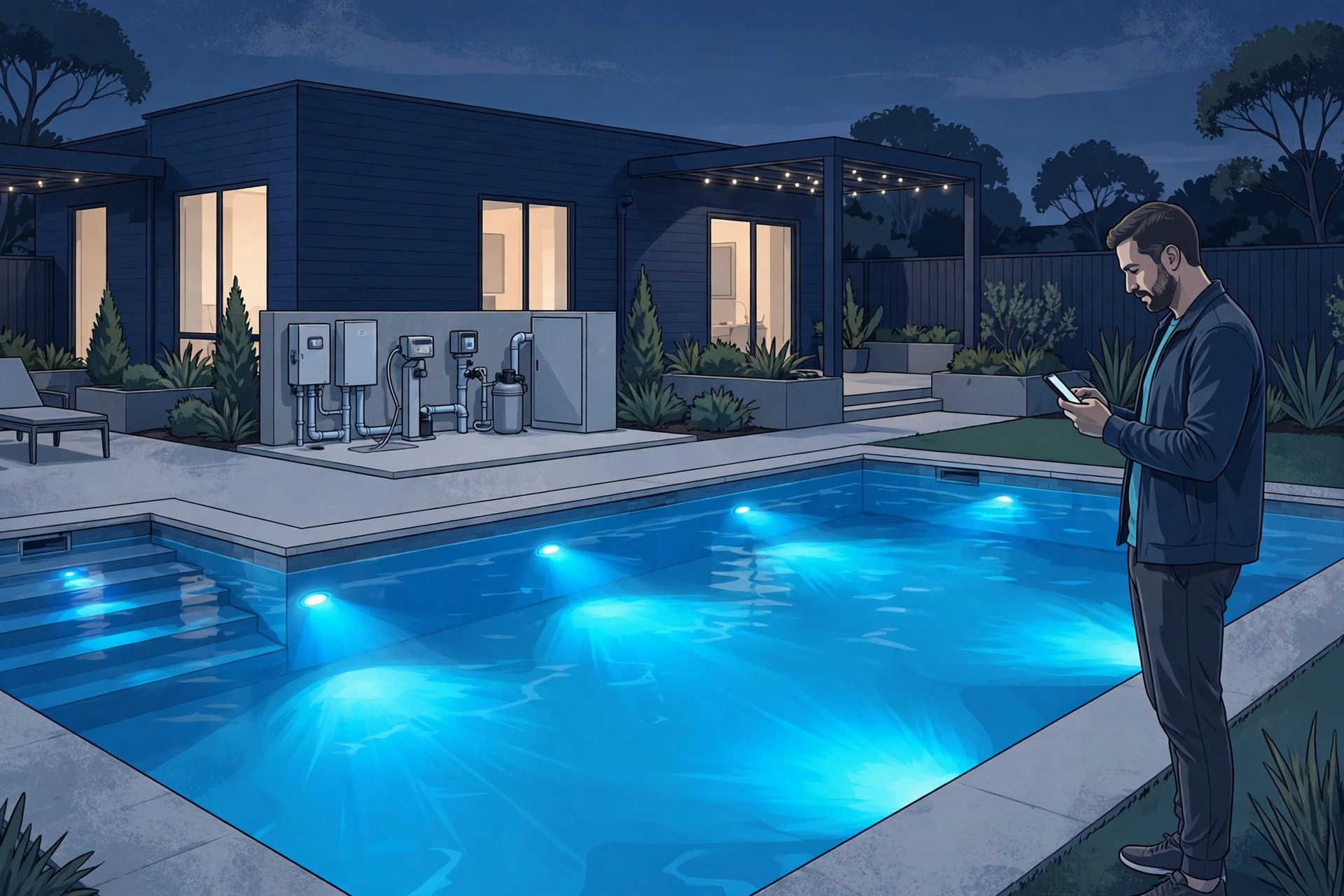
For most Karachi pool owners, the daily routine is familiar: walk to the equipment pad, switch the pump on, remember to switch it off, guess whether the heater has run too long, and hope nobody left the lights on overnight. Smart pool automation replaces that routine with a phone app and a schedule — pump, lights, heater and cleaner run themselves, at the right times, whether you are at home, at the office, or away for the weekend.
Automation is not magic, and it does not replace maintenance. But for the right pool, it cuts electricity waste, keeps water more consistent, and removes the most common owner error: forgetting. Here is what it does, what it costs in practical terms, and when it is worth installing in Karachi.
What Smart Pool Automation Actually Controls
A controller wired to your equipment, operated from a wall panel, a phone app, or both, can run:
| What It Controls | What Automation Does for You |
|---|---|
| Circulation pump | Runs on a set schedule, at set speeds, without manual switching |
| Pool lights | Switches on at dusk, changes colours, switches off automatically |
| Heater or chiller | Heats only before swim time, holds a set temperature, then idles |
| Salt chlorinator | Doses chlorine on schedule, matched to pump run time |
| Water features | Runs fountains and waterfalls only when the pool is in use |
| Robotic cleaner | Starts cleaning cycles on schedule, or on demand from the app |
| Valves and solar heating | Directs water through solar panels when the sun is strong |
The key word is schedule: no pump all day, no heating at 3 AM — automation enforces the schedule you set, every day, without relying on memory.
How It Works in a Karachi Home
A typical installation has three parts: the controller box near the equipment pad, the app on your phone, and a Wi-Fi or mobile connection linking them. You set schedules in the app — pump on at 7 AM and 6 PM, lights on at sunset, heater warming from 4 PM — and the controller follows them, with manual override any time: start the cleaner before guests arrive, or switch lights on from the car.
Two Karachi realities matter. First, power cuts: a good system restarts on schedule after power returns, rather than sitting off until someone notices, and should be protected against voltage fluctuation — ask what happens after a K-Electric outage, and whether a stabiliser or UPS is needed. Second, Wi-Fi reach: equipment pads are often far from the router, behind concrete or at the far end of a garden. A weak signal means an unresponsive app, so check signal strength at the pad before installation, and budget for an extender if needed.
Running-Cost Control: Where the Savings Come From
Automation saves money in three places, without new equipment beyond the controller. First, pump scheduling: a pump running only during planned filtration windows, instead of all day because nobody switched it off, uses far less electricity. Paired with a variable-speed pump, the saving is larger still, since slow-speed circulation uses a fraction of full-speed power.
Second, heating discipline: automation heats only toward swim time and holds the lowest comfortable temperature, then idles. In Karachi’s mild winter, when pools are heated for evening use, that discipline is the difference between a reasonable bill and an unpleasant one.
Third, lights and features on a dusk-to-bedtime schedule, rather than all night, cut waste without anyone noticing. All three savings come from stopping equipment running when nobody benefits — exactly what manual control fails at.
Water Quality: Better Consistency, Not a Replacement for Testing
Automation helps water quality indirectly: a pump on schedule circulates and filters daily, and a salt chlorinator wired to the same schedule doses only while water moves — the correct way to chlorinate. Some systems add automated dosing or pH monitoring, keeping levels steadier between visits.
It cannot test water for you or fix an unbalanced pool alone: sensors drift, dosing pumps need calibration, and a green pool still needs hands-on treatment. Treat it as support for your maintenance routine, not a substitute for weekly testing. Any promise of “never test again” is a sales line, not a fact.
Lighting, Features and the Evening Pool
Where automation is most visible is the evening: lights fading on at dusk, a waterfall starting as guests arrive, the pool at the right temperature — all from one app screen or scheduled scene. For farmhouse pools and houses that entertain often, that convenience is the main reason owners install it: the pool is ready when people are, without a trip to the pad in the dark.
Set scenes up properly at installation: “swim” (pump, lights, heater, features on), “quiet” (circulation only) and “away” (minimum filtration, everything else off). A system with only manual on/off switches per device is not really automation — scenes and schedules are what you are paying for.
What Automation Cannot Fix
Honest limits matter before you spend money. Automation will not fix a leaking pool, a clogged filter, a failing pump, or water that is already green. It will not clear leaves, balance chemicals after a monsoon downpour, or repair a cracked tile. Fix existing problems first — automating a struggling system just schedules its problems more efficiently.
It also adds a point of failure: a controller fault can stop several devices at once. Choose a system your local installer actually supports, with parts available in Karachi, rather than an imported unit nobody here services. A simple, well-supported system beats a feature-rich one with no local backup.
Is It Worth It? Who Benefits Most — and Who Should Skip It
Automation is worth it most for larger pools, farmhouse pools, and houses where owners travel or entertain often — anywhere the pool runs on a schedule and nobody is reliably at the pad twice a day. Commercial pools at hotels and clubs benefit too, since consistent schedules matter to guests and running costs.
It is harder to justify for a small, rarely used pool with one pump and two lights: the convenience is real but modest, and disciplined manual switching achieves most of it. If your budget is tight, spend it first on a good pump, a reliable filter and proper waterproofing — automation is an upgrade on a sound pool, not a substitute for one.
Judge the cost against what it replaces: daily manual switching, wasted heating and lighting hours, and call-outs caused by forgotten equipment. System cost varies widely by brand, devices controlled and installation complexity, so get an itemised quotation — controller, installation, Wi-Fi work and equipment upgrades listed separately — not a single lump sum.
Questions to Ask Before You Buy
- Which devices will the controller run, and which will stay manual?
- What happens after a power cut — does the schedule resume automatically?
- Is there Wi-Fi signal at the equipment pad, or is an extender needed?
- Who supports and services this system in Karachi, and are parts available locally?
- Can schedules and scenes be set for swim, quiet and away modes?
- Does it work with my existing pump, heater and lights, or do they need replacing?
- What is covered by warranty — the controller, the installation, or both?
A supplier who answers these clearly, and shows you the app working on a real installation, is a better bet than one who sells features alone.
Frequently Asked Questions
Will automation work during Karachi power cuts?
The system should resume its schedule when power returns, but it cannot run equipment without power. Ask about voltage protection, and whether a UPS or stabiliser is recommended for the controller.
Can automation be added to an existing pool?
In most cases, yes — a controller can be retrofitted to existing pumps, lights and heaters, provided they are compatible. Very old or damaged equipment may need replacing first, which should be itemised in the quotation.
Does automation replace weekly pool maintenance?
No. It keeps schedules consistent and reduces waste, but water testing, cleaning, filter care and equipment checks still need regular hands-on maintenance.
Is smart pool automation worth it for a small home pool?
It depends on use. For a small pool used occasionally, manual control may be enough. For larger, frequently used or farmhouse pools, the convenience and running-cost control usually justify it.
Automate the Routine, Not the Maintenance
Smart pool automation earns its place when it removes daily forgetting from pool ownership: pumps on schedule, heating only toward swim time, lights off at bedtime, the pool ready when you are. Installed on a sound pool, supported locally, and set up with proper scenes, it is one of the most satisfying upgrades a Karachi pool owner can make — not because it replaces care, but because it makes care consistent.
Call or WhatsApp: +92 321 2077638 | 22 Dr Ziauddin Ahmed Rd, Civil Lines, Karachi | Mon–Sat 9 AM–6 PM (Sunday closed). Maintenance plans from Rs 15,000/month after a free pool inspection. See our services, recent work, and pool products.
Leave a Reply