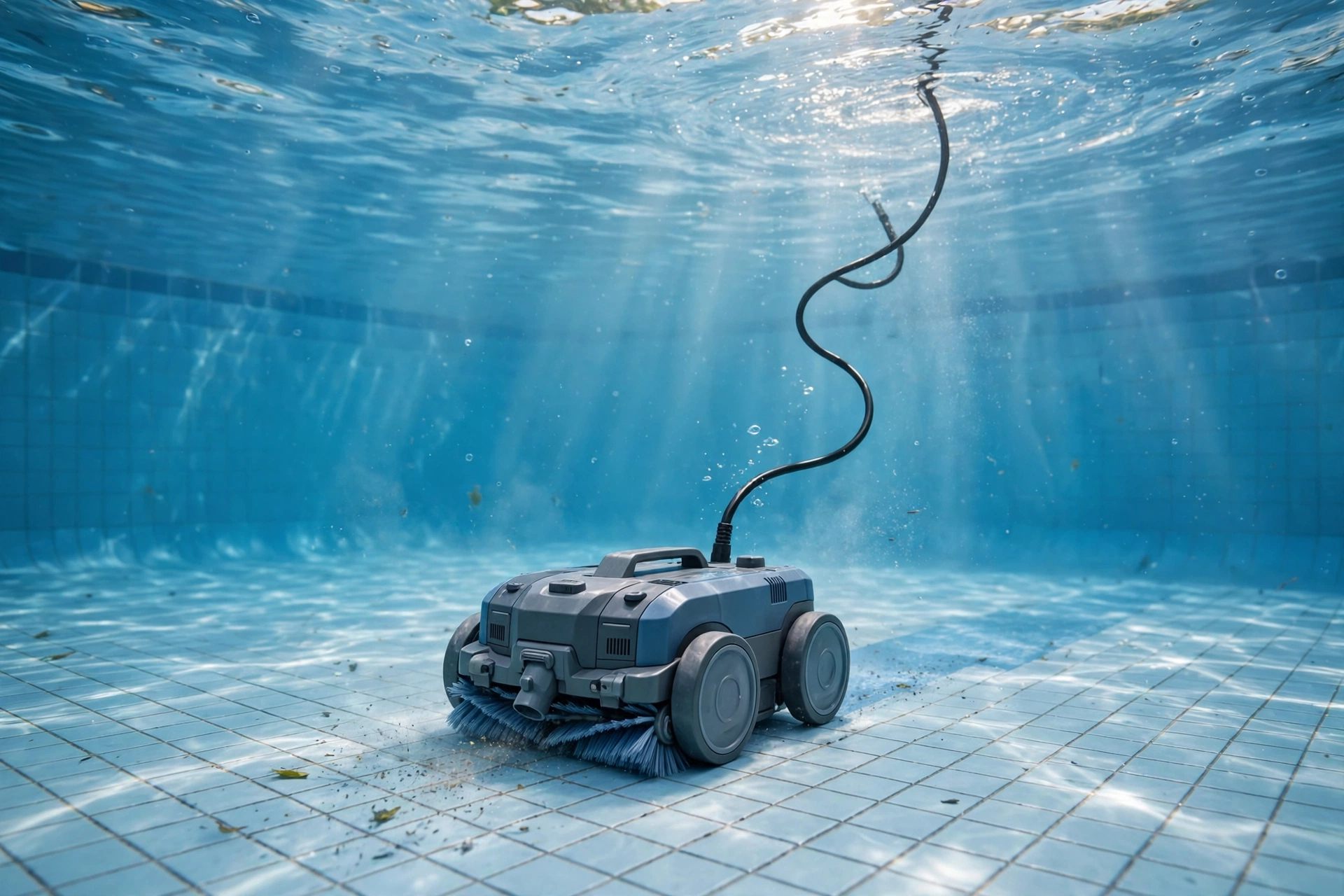
A robotic pool cleaner is a self-contained machine that drives around your pool floor — and on better models, up the walls — scrubbing and vacuuming on its own while you do something else. They have become genuinely available in Pakistan in recent years through importers and pool equipment suppliers, and every Karachi pool owner with a big pool eventually asks the same question: is one worth the money, or is it an expensive toy?
The honest answer is: it depends on your pool, your debris load, and what you are comparing it against. Here is the full picture.
How a Robotic Cleaner Actually Works
Unlike a suction-side cleaner, which plugs into your skimmer and borrows your pool pump’s suction, a robot is independent. It has its own motor, its own filter bag or cartridge, and a power cable (low-voltage, transformer-fed) that runs to a power supply at the poolside. You drop it in, press start, and it follows a programmed pattern for one to three hours, then parks itself or shuts off.
Because it does not use your pool pump, it filters finer debris than most suction cleaners, and it does not load your main filter at all. The better models climb walls to the waterline and scrub the tile line — the dirtiest strip in most pools. Cheaper models clean the floor only, which matters more than the price difference suggests.
What They Cost in Pakistan
Robotic cleaners in Pakistan are imported, so prices vary widely by brand, model, and importer — and they move with the exchange rate. As a rule, a decent robot costs several times what a manual vacuum setup costs, and a multiple of a basic suction-side cleaner. Treat any very cheap “robot” listing with suspicion: no-name units often have weak climbing ability, short cables, and no local parts support.
Do not judge the price on the machine alone. Ask the supplier, in writing: does the price include warranty, and who honours it locally? Is there a service centre in Karachi? Are filter bags, brushes, and cables stocked here, or ordered from abroad with a weeks-long wait? A robot with no local parts support is a robot that becomes scrap after one failed motor seal.
Robot vs Suction Cleaner vs Manual Vacuum
| Robotic cleaner | Suction-side cleaner | Manual vacuum | |
|---|---|---|---|
| Effort | Drop in, press start | Plug in, runs off pump | You do the work, 30–60 min |
| Cleans walls | Yes (good models) | Partly, on some models | Yes, if you reach them |
| Effect on main filter | None — own filter | Loads the main filter | Loads the main filter |
| Pump running cost | Very low (own small motor) | Pump must run for hours | Pump runs while vacuuming |
| Best for | Large pools, heavy debris, farmhouses | Medium pools, regular use | Small pools, spot cleaning |
| Weakness | Price, parts, cable tangles | Gets stuck, misses corners | Your time and back |
For a small rectangular home pool that already gets a weekly maintenance visit, a robot is a luxury, not a necessity — the maintenance team vacuums it anyway. For a large farmhouse pool, a commercial pool, or a pool under heavy leaf and dust load, a robot can genuinely save hours every week and keep the pool presentable between visits.
The Karachi-Specific Pitfalls
Imported pool robots are designed for stable power and mild debris. Karachi is neither:
- Voltage fluctuation. Power surges and dips damage the robot’s transformer and control board. Run the power supply through a stabilizer or surge protector, and never leave the robot plugged in during a storm.
- Load-shedding interruptions. A robot that stops mid-cycle is not damaged by that alone, but do not leave it sitting in the pool for days between runs — the cable and brushes degrade faster in chlorinated water.
- Dust and fine debris load. Karachi dust fills a robot’s filter bag fast. In dusty months you may need to empty the bag mid-cycle on a large pool, or the robot slows and cleans poorly. Check the bag after the first few runs to learn your pool’s rhythm.
- Cable tangling. Robots with swivel cables tangle less. If yours tangles often, shorten the floating cable to the pool’s needs rather than letting the full length coil in the water.
- Parts and service. This is the deciding factor. Before buying, confirm that brushes, filter bags, and drive tracks for that exact model are stocked in Karachi. A robot waiting six weeks for an imported part is not cleaning your pool.
What to Check Before You Buy
- Cable length vs pool size. The cable must reach the far end of your pool with slack. A short cable on a long pool means the robot never finishes the far end.
- Floor-only or wall-climbing. If your tile line gets dirty — and in Karachi it does — a wall-climbing model earns its premium.
- Filter type. Top-loading filter baskets are far easier to empty than bottom-loading bags.
- Pool shape. Robots handle rectangles and freeform pools well, but pools with sharp steps, raised benches, or beach entries can trap them. Ask the supplier whether your pool shape suits the model.
- Warranty in writing. Who repairs it, where, and how long does a repair take? “One-year warranty” means little if the repair goes abroad.
- Try before you buy, if possible. A reputable supplier will demo a unit in your pool or a similar one. A ten-minute demo reveals climbing ability and tangling behaviour that no brochure will.
When a Robot Is NOT Worth It
Skip the robot if your pool is small and rectangular, if you already have a weekly maintenance visit that includes vacuuming, or if your budget would force you into a no-name unit with no local support. In those cases the money is better spent on a good suction-side cleaner or on regular professional maintenance — see our maintenance charges guide for what a service visit covers.
Also be realistic about what a robot does not do: it does not balance your chemicals, it does not clean the waterline tile by hand as thoroughly as a brush, and it does not replace a filter backwash. It is a cleaning tool, not a maintenance plan.
FAQ
Do robotic pool cleaners work in saltwater pools?
Most modern robots do, but check the model’s rating first — seals and materials vary. In a saltwater pool, rinse the robot with fresh water after each run to protect seals and metal parts.
Can I leave a robotic cleaner in the pool all the time?
No. Remove it after each cycle, empty the filter, and store it in the shade. Constant immersion in chlorinated water shortens the life of cables, brushes, and seals.
How long does a robotic pool cleaner last?
With proper care — rinsed, stored dry, filter emptied — a good unit typically lasts several years of regular use in a home pool. Poor power protection and neglected filters are the two things that kill them early.
Is a robot better than hiring a pool cleaner?
They solve different problems. A robot cleans the floor and walls; a maintenance visit also balances chemicals, checks equipment, backwashes the filter, and spots problems early. Most large-pool owners who buy a robot still keep a maintenance visit — just less often.
Where can I buy a robotic pool cleaner in Karachi?
Through pool equipment suppliers and importers — ask for a demo, local warranty, and stocked spares before paying. We can advise on suitability for your pool size and shape.
Ask Before You Spend
A robot is a significant purchase, and the wrong model for your pool is money wasted. If you are considering one, get advice first: The Pool Guy supplies and advises on pool equipment across Karachi — call or WhatsApp +92 321 2077638. We are at 22 Dr Ziauddin Ahmed Rd, Civil Lines, Karachi, open Mon–Sat, 9 AM–6 PM (Sunday closed). See our services for maintenance and equipment work, browse real projects in our gallery, and check cleaners and equipment in our products section.
Leave a Reply