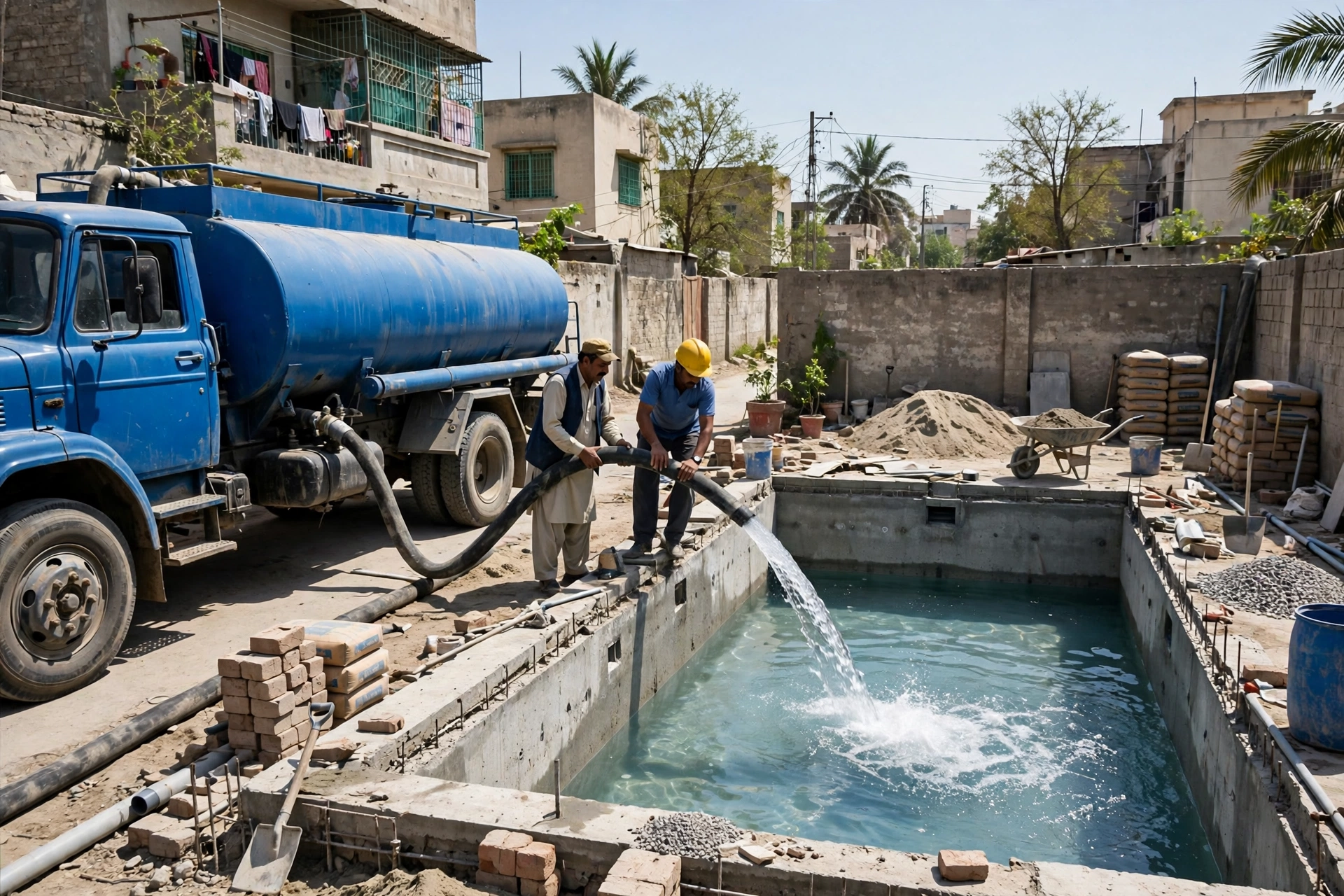
Every pool build in Karachi ends with the same question from the owner: "Pani kahan se ayega?" It's a fair question, because Karachi's municipal water situation makes filling a pool a real logistical decision — not just turning on a tap. A typical residential pool holds 60,000 to 150,000 litres of water. At that volume, your choice of water source affects not just the filling bill, but the first month of chemical costs and how long your equipment lasts.
I've filled hundreds of pools across DHA, Clifton, Bahria Town and farmhouses on the city's outskirts. Here's the honest breakdown of every option Karachi pool owners actually use in 2026 — tanker water, borewell water, and the KWSB line — with real costs, real risks, and what I'd recommend for a first fill.
How much water does your pool actually need?
Before costing anything, know your number. Pool volume in litres is roughly: length × width × average depth (in metres) × 1,000. The average depth of a pool that runs 1.2 m at the shallow end and 2 m at the deep end is 1.6 m.
| Pool size | Volume (approx.) | Tankers needed (3,000-gal tanker ≈ 13,600 L) |
|---|---|---|
| Small plunge pool (20 × 10 ft, 1.4 m avg) | ~32,000 L | 2–3 |
| Standard home pool (35 × 16 ft, 1.6 m avg) | ~83,000 L | 6–7 |
| Large/farmhouse pool (45 × 20 ft, 1.7 m avg) | ~142,000 L | 10–11 |
| Commercial/hotel pool | 200,000+ L | 15+ |
A standard 3,000-gallon tanker delivers about 13,600 litres, but in practice you lose some to spillage and the tanker never arrives completely full. Budget one extra tanker beyond the arithmetic — running the pump dry on an almost-full pool is not worth saving one trip.
Option 1: Water tanker (the Karachi default)
The tanker is how most Karachi pools get filled. Tankers draw from hydrants and wells around the city, and quality varies wildly by source and area. A 3,000-gallon tanker in 2026 costs roughly Rs 4,000–7,000 per trip depending on your area and distance from the hydrant — DHA and Clifton deliveries run toward the upper end, outskirts farmhouses higher still when the driver factors in the drive back.
So a standard home pool costs Rs 25,000–45,000 to fill by tanker. It's a one-time cost, but it's real money — and the quality question matters more than the price.
The quality problem nobody quotes
Tanker water in Karachi is often brackish, high in TDS (total dissolved solids), sometimes carrying fine silt, and occasionally alkaline. What this means in practice:
- High TDS (1,500–3,000+ ppm): the water looks fine but fights your chemistry. Chlorine demand rises, pH drifts, and you burn through chemicals in the first weeks. Severely hard water also scales the heater and tiles.
- Silt and turbidity: some tanker water arrives visibly cloudy. Your filter clears it, but you start the pool's life with backwash cycles and wasted chemicals.
- pH surprises: I've tested tanker fills at pH 8.4+. Your first chemical balance session becomes an all-day job instead of an hour's work (see our pool chemical balance guide for the starting procedure).
My advice: ask the tanker supplier which hydrant the water comes from, and test the first delivery with a strip before accepting the rest. A Rs 500 test kit used once saves Rs 15,000 in corrective chemicals. Order one trial tanker if the supplier is new to you — five minutes with a test strip tells you whether to book five more from the same source or look elsewhere.
Option 2: Borewell / submersible pump water
Many Karachi farmhouses and some DHA/Clifton homes have their own bore. It's tempting — the water is "free." But Karachi groundwater is notoriously variable: in some areas it's sweet, in others it's saltier than seawater.
The honest rule: test before you fill. Borewell water in Karachi commonly runs TDS of 2,000–5,000 ppm in brackish zones. Above ~1,500 ppm TDS, a first fill from the bore sets you up for a month of chemical wrestling and early scaling on tiles and equipment. Below ~800 ppm, it's perfectly good pool water and saves the entire tanker bill.
There's also a practical limit: a domestic submersible pump delivers maybe 30–60 litres per minute, so a standard pool takes 24–48 hours of continuous pumping to fill — hard on a home pump, and risky if the bore runs low mid-fill (drawing a bore dry can damage it). If you go this route, fill in stages and let the pump rest.
Option 3: The KWSB line (municipal water)
Karachi's municipal supply is the cleanest option — treated, consistent, usually fine for pools. The problem is availability: in most neighbourhoods the line water comes on a schedule (a few hours a day or a few days a week), and pressure is low. Filling 80,000 litres through a house connection takes days, and in water-short months you'd be competing with your own household's drinking water.
Realistic use: the line works as a top-up source after the pool is running (evaporation in Karachi summers costs a few hundred litres a week), but for the first fill almost everyone uses tankers — or a tanker/line mix.
The cost comparison at a glance
| Source | Cost per 3,000-gal equivalent | Standard pool fill (6–7 tankers) | Quality consistency |
|---|---|---|---|
| Water tanker | Rs 4,000–7,000 | Rs 25,000–45,000 | Varies by hydrant — test it |
| Borewell | Pump electricity only | Rs 2,000–5,000 (electricity + wear) | Varies by area — test it |
| KWSB line | Metered tariff | Cheapest, if available | Most consistent — but slow and scheduled |
Five first-fill mistakes Karachi owners make
- Filling over bare plaster/tile grout too fast. A brand-new pool needs the fill completed in one continuous run where possible — a half-filled pool sitting in Karachi's sun leaves a tide mark on fresh plaster that's expensive to remove. Schedule all your tankers for the same day.
- Not testing the water before the chemical startup. Your chemical startup should be based on the water you actually have, not textbook numbers. Test pH, alkalinity, and TDS before adding a single chemical.
- Running the filter before the pool is full. Never start the pump until the water reaches mid-skimmer level — dry-running a new pump for even a few minutes can damage the seal.
- Topping up with different water later. If you filled with low-TDS water and top up for a year with brackish tanker water, the chemistry drifts slowly and mysteriously. Consistency of source matters more than people think.
- Ignoring the first backwash. New fills often carry fine silt that blinds a sand filter in days. Backwash within the first week regardless of the pressure gauge — then follow your normal equipment routine.
What The Pool Guy recommends
For a first fill in Karachi: order tankers from a known hydrant, test the first load, and schedule the whole fill for one day. Budget Rs 30,000–40,000 for a standard home pool and consider it part of the project cost — it's roughly 1% of a Rs 30-lakh pool. If your borewell tests under 1,000 ppm TDS, use it in stages and pocket the saving. And start your chemical balance the same day the fill finishes — new water left standing in Karachi's October–November warmth turns green fast (our green pool recovery guide exists for exactly that emergency, but a same-day startup means you'll never need it).
Frequently asked questions
How many water tankers are needed to fill a swimming pool in Karachi?
A standard 35 × 16 ft home pool needs 6–7 trips of a 3,000-gallon tanker. Measure your pool's volume first (length × width × average depth × 1,000 = litres) and divide by ~13,000 litres per tanker, then add one extra trip for spillage and safety.
What is the water tanker rate in Karachi in 2026?
Roughly Rs 4,000–7,000 per 3,000-gallon tanker, depending on area and distance from the hydrant. Prices rise in peak summer months when demand is highest — booking the fill for October–November (off-season) can save a few thousand.
Can I fill my pool with borewell water in Karachi?
Yes, but test it first. Karachi groundwater varies from sweet to very brackish — above ~1,500 ppm TDS it will fight your chemistry and scale equipment. A Rs 500 test kit before the fill is the cheapest insurance you'll buy for the pool.
Does KWSB water work for pools?
Yes — it's the cleanest option, but scheduled supply and low pressure make a first fill impractical for most homes. Use the line for weekly evaporation top-ups once the pool is running.
How much does it cost to maintain pool water monthly in Karachi?
Beyond the first fill, evaporation top-ups cost a few thousand rupees a month; the bigger recurring cost is chemicals and servicing. Our maintenance charges guide breaks down the monthly numbers.
Planning a pool? Get the water question answered upfront
The Pool Guy builds pools across Karachi — DHA, Clifton, Gulshan, Bahria Town and farmhouses. We plan the first fill with you before construction starts: volume calculation, tanker sourcing, water testing, and a same-day chemical startup so your pool opens clear. Call or WhatsApp +92 321 2077638 (Mon–Sat, 9 AM–6 PM). Visit us at 22 Dr Ziauddin Ahmed Rd, Civil Lines, Karachi, or browse our services, gallery and products.
Leave a Reply