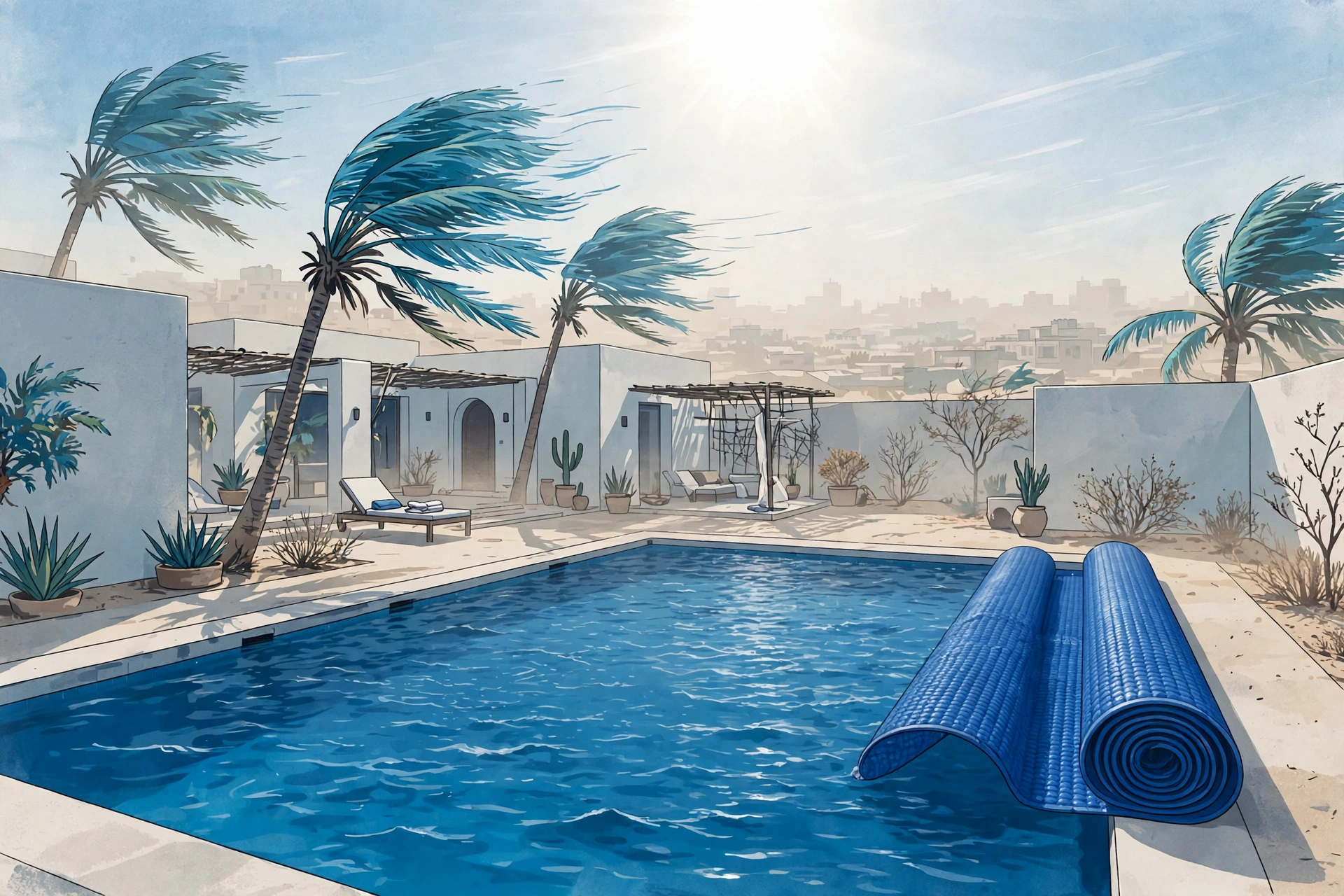
If your Karachi pool seems to lose water faster than it should, you are probably not imagining it — and you may not have a leak. In Karachi's summer, an uncovered pool can lose a visible amount of water every week to evaporation alone, and every litre lost has to be bought back, usually by water tanker. Understanding why evaporation hits Karachi pools so hard, and which fixes actually work, can cut your top-up bill and stop you paying for leak repairs you never needed.
Why Karachi Pools Evaporate So Fast
Evaporation is driven by heat, wind, low humidity, and exposed surface area. Karachi scores badly on the first two for most of the year: summer temperatures regularly pass 40°C, and the sea breeze that makes DHA and Clifton evenings pleasant sweeps constantly across open pool surfaces, carrying vapour away as fast as it forms. A large, uncovered, sun-exposed pool in a windy spot is effectively a shallow evaporation pan — and heated water, or sun-heated dark tiles, accelerates the loss further.
The cost is easy to underestimate because it arrives gradually: a pool dropping a centimetre or two a week does not look dramatic, but over a month that is hundreds of litres — real money where top-ups arrive by tanker. Evaporation also concentrates what is left behind: as pure water leaves, dissolved salts, calcium, and chemicals stay, which is one reason Karachi pools develop scale and cloudy water faster than owners expect.
Evaporation or Leak? The Bucket Test
Before spending money on evaporation fixes, rule out a leak — the two look identical from the deck. The bucket test is the standard check:
- Fill a bucket with pool water and place it on a pool step so the water level inside the bucket matches the pool level outside it.
- Mark both water levels with tape or a marker.
- Leave both untouched for 24–48 hours, pump running normally.
- Compare: equal drops mean evaporation; if the pool dropped noticeably more than the bucket, you likely have a leak.
A leak needs repair, not a cover — see our leak detection guide if the test points that way. If both levels match, evaporation is your problem, and the fixes below are where the money goes.
The Single Best Fix: A Pool Cover
Nothing else comes close to a cover for cutting evaporation: it blocks the surface, traps the humid air layer above the water, and stops wind stripping it away. Well-fitted covers cut evaporation by the large majority, and bring side benefits — less debris, less chemical loss to sunlight, warmer water in winter.
| Cover Type | How It Works | Best For |
|---|---|---|
| Solar / bubble cover | Floats on the surface, absorbs sunlight, warms the water | Residential pools, summer, lowest cost |
| Liquid pool cover | Thin invisible liquid layer slowing evaporation | Where a physical cover is impractical |
| Automatic / roller cover | Motorised cover rolling out at a button press | Frequent use, families who use it daily |
| Winter / safety cover | Heavy anchored cover for low-use months | Winter months, farmhouse pools, child safety |
The honest caveat: a cover only works if it is used — the most expensive automatic cover saves nothing rolled up. For most residential pools, a simple solar cover on a roller, deployable by one person in two minutes, beats a fancy system nobody bothers with. If your household will not use a cover daily, put the money into the other fixes below instead.
Windbreaks: Stop the Wind Before It Reaches the Water
Wind is the multiplier on Karachi evaporation: a pool exposed to the open sea breeze loses far more than an identical sheltered pool. If your pool sits in an open plot — especially in DHA, Clifton, or a farmhouse setting — windbreaks pay for themselves:
- Boundary walls and screens — a solid wall or screen on the windward side (usually south-west in coastal Karachi) cuts wind speed across the water.
- Hedging and planting — dense shrubs act as a living windbreak and look better than a wall, though they take time to establish and shed leaves.
- Pergolas and shade structures — a pergola over part of the pool or deck breaks wind and direct sun, reducing evaporation and keeping water cooler.
- Pool enclosures and roofs — a full or partial roof is the most complete solution, cutting wind and sun together, though it is a bigger investment.
Even a partial windbreak helps — shielding the most wind-exposed side is where most of the gain comes from.
Water Temperature and Level: Two Free Fixes
Two evaporation controls cost nothing. First, keep water as cool as practical: run a heater only when the pool is in use, at the lowest comfortable temperature, and shade part of the pool. Second, keep the level correct — mid-skimmer height, not overfilled. Overfilling means every splash spills water over the edge that you pay to replace, so a correctly set autofill valve, or a disciplined manual top-up routine, keeps the level where it belongs.
Pump Timing and Equipment Habits
Small equipment habits add up. Running water features during the hottest, windiest part of the day maximises evaporation: fountains and jets spray water into the air, where wind carries it away — so run them in the cooler evening hours when the pool is enjoyed, not all day as decoration. Likewise, backwash only when the pressure gauge says so — every unnecessary backwash dumps hundreds of litres. Small savings individually, they compound across a Karachi summer.
Splash-Out and Everyday Losses
Not all water loss is evaporation: enthusiastic splashing displaces real water over the coping, so keep the level slightly below the coping edge. Check for small constant losses too: a weir door stuck open, a skimmer seal leak, or an autofill valve that never quite shuts off can each mimic evaporation.
What Evaporation Costs You in Karachi
The real cost of evaporation in Karachi is not just water — it is tanker water, chemicals, and scale. Every top-up dilutes balanced chemistry, so you re-dose chlorine and adjust pH more often; and as minerals stay behind, calcium hardness climbs, building scale on tiles and heaters faster than in softer-water cities. Reducing evaporation saves three ways: fewer top-ups, steadier chemistry, less scale damage. For a regularly used pool, a cover plus a windbreak typically pays for itself within a season or two.
Frequently Asked Questions
How much water does a Karachi pool lose to evaporation?
It varies with size, exposure, and season, but an uncovered pool in Karachi's summer can easily drop a centimetre or more per week — windy, sun-exposed pools lose more. Use the bucket test to measure your own pool's rate.
Is my pool leaking or just evaporating?
Do the bucket test: equal drops mean evaporation; a pool dropping faster than the bucket points to a leak. Leaks also show other signs — wet patches around the equipment pad, air in the pump, or a level that drops even with the pump off.
Does a solar cover really help in Karachi's heat?
Yes — a cover is the single most effective evaporation control, and it also reduces chemical loss and debris. The catch is discipline: it only works on the days it is on the pool, so choose a roller system one person can deploy quickly.
Will a cover make my pool too warm in summer?
A solar cover does add some heat. If your pool already runs warm, use it at night and on windy days, removing it during the hottest hours — or choose a lighter, reflective cover.
Can I just top up with tanker water instead of fixing evaporation?
You can, but you pay every week for water that will evaporate again, and each top-up dilutes chemistry and adds scale-building minerals. Fixing the loss is cheaper than feeding it indefinitely.
Does pool heating increase evaporation?
Yes, significantly — warmer water evaporates faster. Keep heater temperatures as low as comfortable and cover the pool whenever it is heated but not in use.
Stop Paying for Water That Evaporates
Evaporation is not a mystery and it is not inevitable: a cover, a windbreak, sensible heater and pump habits, and a correct water level will cut most of the loss — and the tanker bill with it. If your bucket test suggests a leak instead, that needs a different fix, and we can help there too.
Call or WhatsApp: +92 321 2077638 | 22 Dr Ziauddin Ahmed Rd, Civil Lines, Karachi | Mon–Sat 9 AM–6 PM (Sunday closed). Maintenance plans from Rs 15,000/month after a free pool inspection. See our services, recent work, and pool products.
Leave a Reply