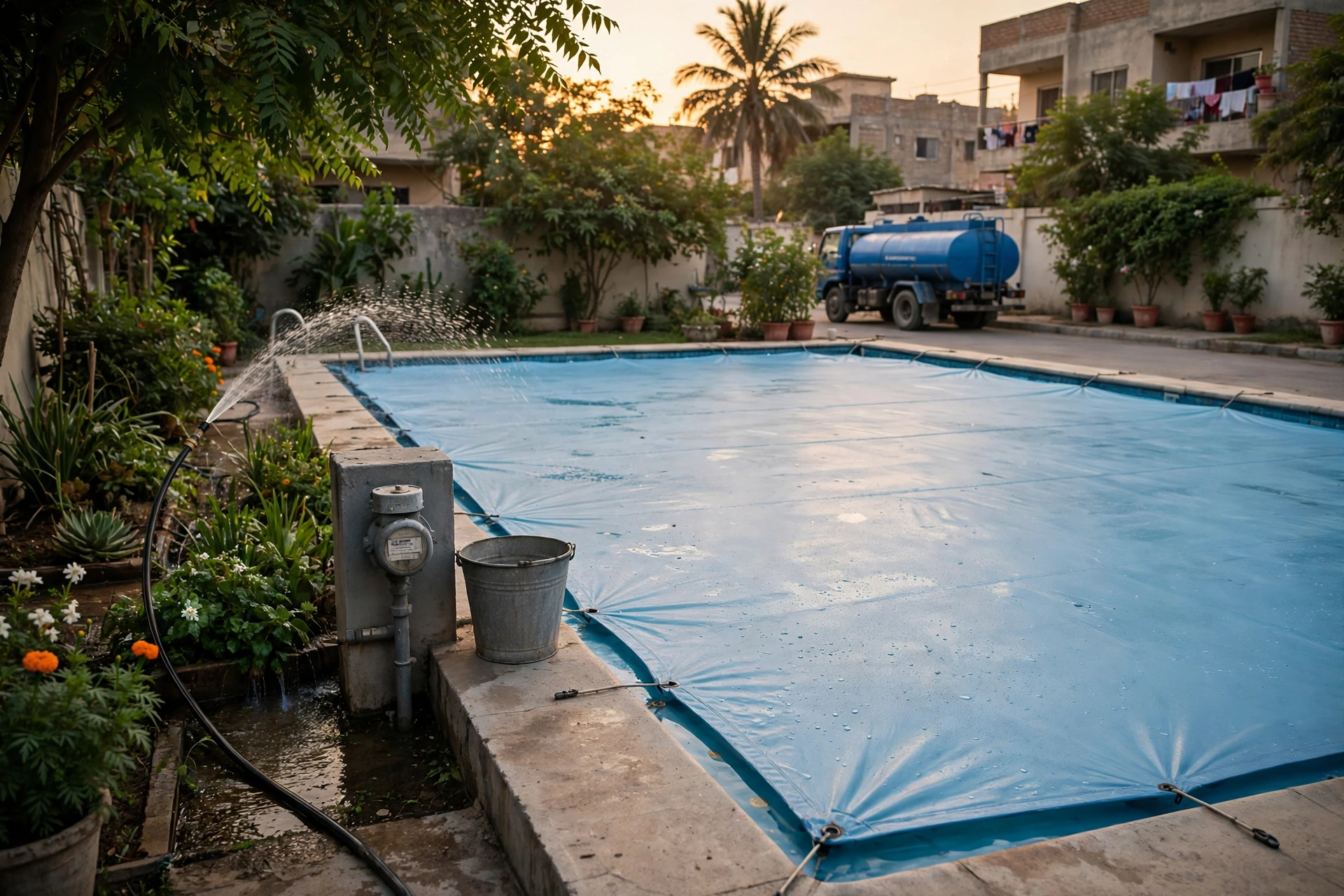
Every litre in a Karachi pool has a price. The city’s piped supply is unreliable, and most pool owners top up with tanker water — which means every litre lost to evaporation, backwashing, splashing, or a slow leak is money poured down the drain, quite literally. A medium home pool can lose thousands of litres a month without the owner ever seeing a puddle.
The good news is that most pool water loss is preventable, and the fixes pay for themselves quickly at tanker-water prices. Here is how a Karachi pool owner cuts water waste, in order of litres saved.
First, Know Where Your Water Goes
Before saving water, measure the loss. A pool that loses more than about 6mm of water level per day in summer — roughly 150 litres a day for a typical 8×4m pool — is losing more than evaporation alone can explain, and something else is going on.
The bucket test settles it: place a bucket of pool water on a pool step so the water level inside matches the pool level outside, mark both, and compare after 24 hours with the pump running normally. If the pool drops more than the bucket, water is leaving through a leak or the plumbing, not the sky. Our leak detection guide explains the test and what to do with the result.
Typical losses for a Karachi home pool in summer:
| Source | Typical loss | How to tell |
|---|---|---|
| Evaporation | 3–6mm/day (75–150 litres for 8×4m pool) | Bucket test shows equal drop |
| Backwashing a sand filter | 300–500 litres per backwash | Weekly backwash adds up fast |
| Splash-out and swimmers | 50–200 litres per swim session | Wet deck, low level after parties |
| A slow leak | 100–500+ litres/day | Bucket test shows extra drop |
| Overflowing after rain or overfill | Varies | Waterline above the skimmer mouth |
A Pool Cover Is the Biggest Single Saving
Evaporation is the largest daily loss, and a cover attacks it directly. A fitted cover cuts evaporation by 70–90% overnight, when the pool is not in use. For a pool losing 150 litres a day to evaporation, a cover saves roughly 100 litres a day — 3,000 litres a month — which is real money at tanker rates, plus the cover keeps dust and leaves out, so the filter works less.
The cover does not need to be expensive or permanent. A simple floating cover used overnight does the job. The habit matters more than the product: cover the pool every night it is not being used, and the saving is automatic. In winter, when the pool is used less, a cover is even more effective — see our winter pool care guide. For cover types and fitting, our pool cover options guide covers what suits Karachi’s climate.
One Karachi-specific caution: a cover left on during a dust storm collects a thick layer of dust, which washes into the pool when you remove it. After a storm, hose the cover off before rolling it back, or you trade evaporation savings for a dirty pool and an extra backwash.
Choose a Filter That Does Not Drink Your Water
This is the saving most owners never calculate. A sand or DE filter wastes several hundred litres every time it is backwashed — and in Karachi’s dust, backwashing is frequent. A pool backwashed weekly at 400 litres a time loses over 20,000 litres a year to filter cleaning alone.
A cartridge filter has no backwash: you remove the cartridge and hose it clean, using a few litres instead of hundreds. Over a season in a tanker-water home, the cartridge filter often ends up cheaper overall than sand, even though the cartridge itself costs more to replace — the full comparison is in our filter comparison.
If you already have a sand filter, you can still cut the waste: backwash on pressure, not on a calendar. Watch the gauge and backwash only when pressure rises 8–10 psi above the clean reading. Backwashing a clean filter wastes water and filters worse for a day afterwards — a slightly dirty sand bed catches finer particles than a freshly washed one. Our backwash guide covers the timing.
Reuse Backwash Water in the Garden
Backwash water is dirty pool water — but it is perfectly good for the garden. Chlorine levels in backwash water are low after dilution, and most garden plants tolerate it well. Running the backwash hose to a lawn, flower bed, or trees instead of the drain turns a waste stream into free irrigation.
Two practical rules: let the water sit for a day in a drum if you are worried about chlorine, and do not dump it on the same patch of soil every time — spread it around so salts do not build up in one spot. Saltwater-pool owners should be more careful: salty backwash water can harm sensitive plants, so use it on hardy trees and lawns, not on a vegetable patch or delicate ornamentals.
Fix Leaks Early — They Compound
A leak of 200 litres a day sounds small until you multiply it: 6,000 litres a month, every month, plus the autofill or tanker top-ups hiding it. Worse, a leak that starts small rarely stays small — water undermines the soil around the shell, and a minor plumbing leak can become a structural problem.
Check these regularly:
- The waterline. Mark the level and check it weekly. A steady fall beyond evaporation is the first warning.
- Around the equipment pad. Damp soil, a green patch of grass, or a musty smell near the pump and filter means a plumbing joint is weeping.
- The skimmer and return fittings. Hairline cracks around fittings are a common leak point in Karachi’s heat, where plastic expands and contracts daily.
- The autofill, if fitted. A faulty autofill valve can run silently for weeks, masking a leak by constantly topping up — and your water bill tells the story instead.
If the bucket test points to a leak, do not keep topping up and hoping. Find it and fix it — our leak detection guide explains the process, or book an inspection and we will trace it.
Control Splash-Out and Overfilling
Splash-out is real water loss, and it is worst when the pool is overfilled. A pool filled to the top of the skimmer mouth loses water with every cannonball; a pool kept at the correct level — halfway up the skimmer mouth — keeps most of the splash inside.
- Keep the level right. Mid-skimmer is correct. Higher wastes water; lower starves the pump.
- After a party or a children’s swim session, expect the level to drop and top up only to mid-skimmer — not to the brim.
- Turn off water features when the pool is not in use. A waterfall or fountain left running splashes water out and evaporates faster than still water.
- Watch the autofill after rain. Karachi’s monsoon can dump enough rain to overflow a pool in an hour. If your autofill is also running, you are adding water to a pool that is already spilling. Our monsoon pool care guide covers rain-season water management.
Use Rainwater — Karachi’s Free Top-Up
Karachi’s monsoon is short but intense, and a pool is a ready-made rainwater tank. A single heavy monsoon shower can add thousands of litres to an uncovered pool — water you would otherwise buy by tanker. The trick is to capture it rather than let it overflow: lower the water level slightly before a forecast storm so the pool has room to receive the rain, and let the rain do the topping up.
Rainwater is soft and low in minerals, which actually helps in Karachi, where hard tap and tanker water push calcium levels up over time — see our calcium hardness guide. After a storm, test and rebalance: rain dilutes chlorine and can drop the pH, so a shock dose and a chemistry check are part of the routine.
Water-Saving Habits That Add Up
- Shower before swimming. It sounds unrelated, but bather oils and sunscreen load the filter and force more frequent backwashing. A quick rinse cuts filter load.
- Keep the chemistry balanced. Balanced water stays clear longer, which means fewer emergency backwashes, fewer shock treatments, and fewer partial drains to fix a green pool. Our chemical balance guide covers the targets.
- Fix the autofill float. A sticky float valve that overfills the pool wastes water every cycle. Check it monthly.
- Do not drain to clean. A green or cloudy pool tempts owners to drain and refill — the most expensive “fix” there is. Almost every water-quality problem can be fixed in place with chemistry, filtration, and patience, at a fraction of the cost of a refill. Our green pool guide and cloudy water guide explain the in-place fixes.
- Service on schedule. A pump with a worn seal leaks; a filter with a cracked lateral backwashes badly; a skimmer with a perished gasket weeps. Routine servicing catches all three before they become water bills. See our maintenance visit checklist for what a visit should cover.
What the Savings Look Like
For a typical 8×4m Karachi home pool in summer, the combined measures are substantial:
| Measure | Saving per month |
|---|---|
| Night cover (evaporation) | ~3,000 litres |
| Backwash on pressure, not calendar | ~800–1,200 litres |
| Cartridge filter instead of sand | ~1,600 litres |
| Leak found and fixed | 3,000–15,000 litres |
| Rain capture in monsoon | Varies — up to a full top-up |
At tanker-water prices, a cover and a disciplined backwash routine can save several thousand rupees a month — and a fixed leak can save far more. The cover pays for itself in a season; the habits cost nothing.
Our maintenance plans start from Rs 15,000/month, final quote after a free pool inspection, and include leak checks, pressure-gauge monitoring, and backwash discipline on every visit. See finished projects in our gallery and equipment.
Frequently Asked Questions
How much water does a Karachi pool lose to evaporation?
In summer, 3–6mm a day — roughly 100–150 litres a day for a typical 8×4m pool. A cover used overnight cuts that by 70–90%.
How do I know if my pool has a leak or is just evaporating?
Do the bucket test: a bucket of pool water on a step, levels marked, compared after 24 hours. If the pool drops more than the bucket, water is leaving through a leak or plumbing, not evaporation.
Does a cartridge filter really save that much water?
Yes. A sand filter wastes 300–500 litres per backwash, weekly in dust season — over 20,000 litres a year. A cartridge filter is hosed clean with a few litres and no backwash at all.
Can I water my garden with pool backwash water?
Yes, for most gardens — chlorine levels are low after dilution. Spread it around rather than dumping on one spot, and keep salty backwash water away from delicate plants and vegetable patches.
Is rainwater good for my pool?
Yes, with a check afterwards. Rain is soft and low in minerals, which helps against Karachi’s hard water. But it dilutes chlorine and can lower pH, so test and rebalance after a storm.
Get a Free Quote
Losing water faster than you can top it up, backwashing every week, or watching the tanker bill climb — the cause is usually a cover habit, a filter choice, or a leak, and all three are fixable.
The Pool Guy designs, builds, and maintains pools across DHA, Clifton, Gulshan, Bahria Town, and PECHS. Call or WhatsApp +92 321 2077638, or visit 22 Dr Ziauddin Ahmed Rd, Civil Lines, Karachi. Open Monday to Saturday, 9 AM to 6 PM (Sunday closed). Request a free pool inspection and we will run a bucket test, check your filter and fittings, and show you exactly where your water is going — final quote after inspection.
Leave a Reply