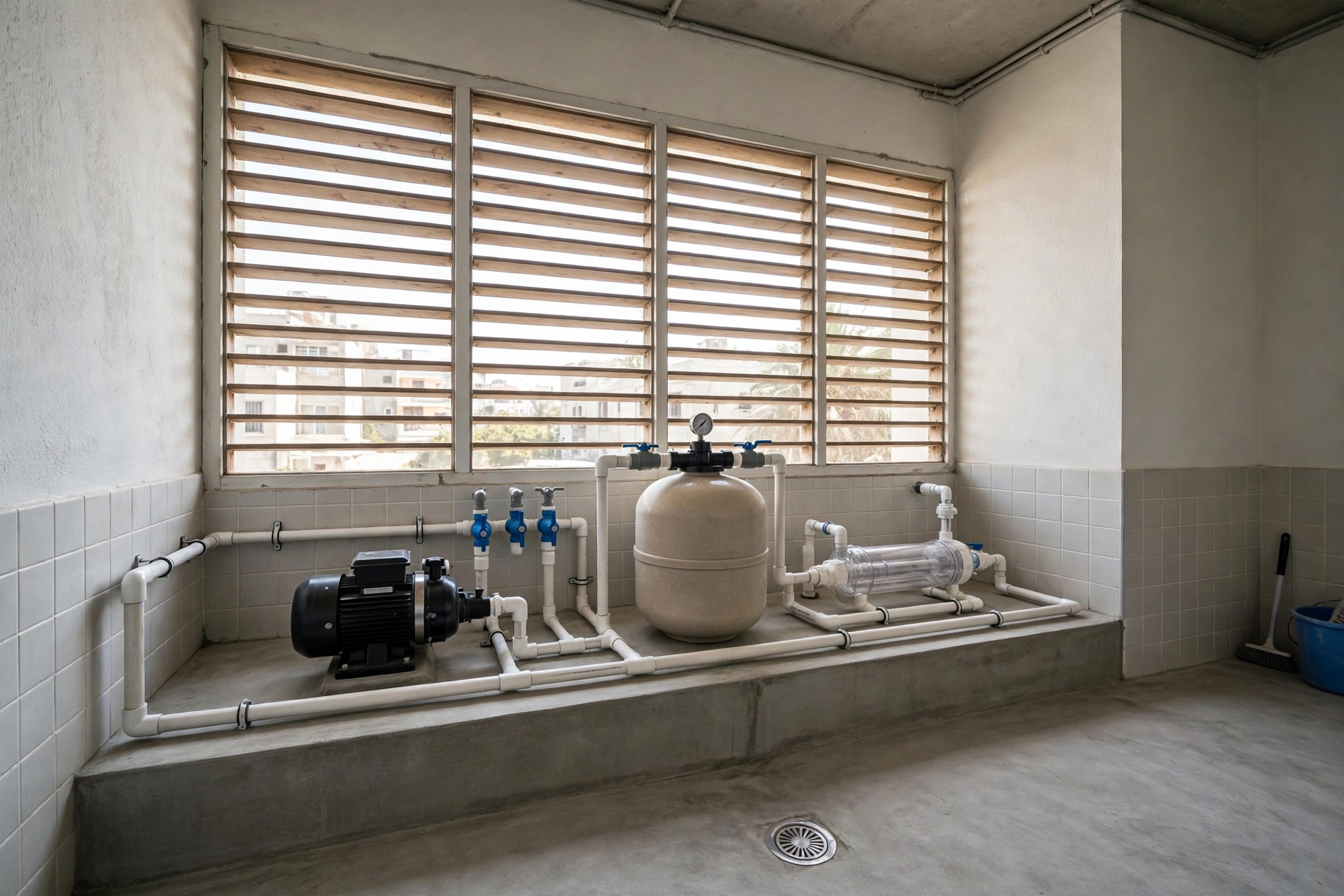
Every Karachi pool owner knows the pump, filter and chlorinator. Far fewer ever think about the room that houses them — until a pump burns out in a flooded, airless corner, or a technician cannot reach a valve without dismantling half the pipework. The equipment room, often called the pump room or plant room, is the most overlooked part of pool construction. It is also where cheap shortcuts cost the most money later.
Here is how to get it right, from a contractor who has rebuilt too many rooms that were designed as an afterthought: protect equipment from heat, dust and monsoon water, give a technician room to work, and keep noise and leaks away from the house.
What Goes in the Equipment Room
A typical Karachi home pool room holds the circulation pump, the sand or cartridge filter, a chlorinator or salt cell, the heater or chiller if one is fitted, valves and pipework, and the electrical control panel. Larger pools add a variable-speed pump drive, a UV or ozone unit, an automatic dosing system, and a backwash line. The room is not a storeroom: every item needs clearance around it for servicing, and the filter needs space above it for the sand or cartridge to be removed.
Before construction, list every piece of equipment with its dimensions, including the filter’s height with the multiport valve on top. Allow one empty wall bay for a future addition — Karachi owners almost always add a heater or salt system later.
Size: How Big Should It Be?
For a standard home pool of 20 to 40 feet, a room of roughly 8 by 6 feet is a workable minimum, with a ceiling high enough to stand in comfortably and lift a filter lid. Bigger pools, commercial pools, and pools with heaters need more — plan 10 by 8 feet or larger. These are planning guides, not building-code figures; the real test is whether a technician can walk around the filter, open every valve, and pull the pump out without moving another machine.
Doors matter as much as floor area. A narrow doorway that a filter tank cannot pass through turns every replacement into a demolition job. Fit the widest practical door, and make sure the access route from the street can carry a replacement filter tank.
Location: Close to the Pool, But Not Under Water
The pump room should sit as close to the pool as practical, because long pipe runs waste pump energy and make priming harder. The classic Karachi mistake is putting it in the lowest corner of the plot — the same corner where monsoon rain collects. A pump room that floods once a season will kill pumps, corrode electrical panels, and breed damp that never fully dries.
Choose the highest practical spot near the pool, never a pit without drainage. In DHA and Clifton plots near the sea, where the water table runs high, a below-ground room needs tanking, a sump, and a drainage route that works when the power is out. In Gulshan and Bahria Town, where plots often slope, use the slope: put the room on the high side and let gravity help the drainage, not fight it.
Ventilation: Karachi Heat Kills Pumps
A pump room in Karachi is a hot box for most of the year. Pumps and motors are air-cooled, and a sealed concrete room in a May afternoon can run far hotter than the motor’s rating. Overheating shortens motor life, trips thermal cut-outs, and makes the room unbearable to work in.
Provide real ventilation, not a token vent: a louvred opening low on one wall and another high on the opposite wall, so air moves across the equipment. Where the room sits inside a house or basement, fit an exhaust fan. Never vent a room containing chlorine storage into a living space, and keep the electrical panel on the driest wall. A mesh screen over vents, cleaned monthly, keeps out sea-breeze salt and construction dust that clog motor cooling fins.
Drainage and Flooding: Design for the Worst Rain
Every equipment room needs its own floor drain, sloped floor, and a route for water to leave without passing through the equipment. Backwashing the filter releases hundreds of litres; a burst pipe releases more. If the only drain is a small hole that blocks with leaves, the room becomes a pond and the pump — sitting at floor level — is the first thing under water.
Raise equipment on a concrete plinth at least 4 to 6 inches above the floor, so a shallow flood laps at concrete instead of motors. Pipe the backwash line to a proper drain, not onto the garden or a neighbour’s plot — housing societies in DHA and Bahria Town have rules about discharge, and chlorinated backwash water should not be dumped where it can damage plants or draw complaints. Fit a floor drain with a trap that can be cleaned, and check it every monsoon season.
For below-ground rooms, add a sump pit and, where budget allows, a sump pump — bearing in mind Karachi’s power cuts often coincide with the heaviest rain.
Layout: Build It So a Technician Can Work
Good layout follows the water’s path: pool to pump to filter to heater to chlorinator and back to the pool, with valves in between that can isolate each item. Label every valve — “skimmer”, “main drain”, “return”, “backwash” — with a paint pen or tag. A labelled system saves a visiting technician half an hour and prevents the classic error of backwashing into the pool.
Leave clearance in front of the pump’s strainer basket (opened weekly), above the filter, and around the electrical panel. Run pipes along walls on brackets, not across the floor. Keep chemicals on a separate shelf, never above electrical equipment or a pump motor.
Electrical Safety in a Wet Room
Pool equipment rooms mix water and electricity: use a dedicated circuit with proper earthing, a residual-current device, waterproof fittings, and a panel high on a dry wall. Never bypass a tripping breaker, and if water has reached the panel, call an electrician.
Common Equipment Room Mistakes We See in Karachi
The usual faults are a “leftover corner” room with no drain and no door wide enough for a filter; a sealed, unventilated box that cooks the pump motor every summer; floor-level pumps in a flood path; no isolation valves, so servicing one item means draining the whole pool; chemicals stored over electrics; and no room to grow when a heater or salt system is added later.
What to Ask Your Contractor Before the Room Is Built
Ask: what are the internal dimensions, and can a replacement filter pass through the door? Where does water go if a pipe bursts? How is the room ventilated? Is equipment raised on a plinth? Are valves labelled? What happens in a monsoon downpour and a power cut? A contractor who answers with specifics has designed the room.
Frequently Asked Questions
Can the pool equipment sit outside instead of in a room?
It can, under a weatherproof cover, and many older Karachi pools do this. But exposed equipment suffers more from sun, dust, rain and theft. A roofed, ventilated enclosure is a good compromise — but it still needs drainage and a raised plinth.
How often should the equipment room be checked?
A quick look weekly for drips, noise, and the pump strainer basket, and a proper monthly check of vents, the floor drain, and chemical storage. Before monsoon season, clear the drain and vents.
My pump room floods every monsoon. Can it be fixed?
Often yes. Raising equipment onto a plinth, adding or clearing a floor drain, and re-routing the backwash line usually solve it. Below-ground rooms may need a sump pump — far cheaper than replacing a drowned pump yearly.
Should the equipment room be locked?
Yes — especially where children play nearby. A locked room with the key held by an adult keeps children safe and equipment undisturbed.
The Bottom Line
The equipment room will never be the part of the pool you photograph. But it decides whether your pump lasts three years or ten, whether a repair takes an hour or a day, and whether monsoon season is an inconvenience or a disaster. Size it generously, ventilate it properly, drain it as if a pipe will burst — because one day, one will — and raise everything off the floor. If your existing pump room floods, overheats, or is impossible to work in, talk to The Pool Guy before the next breakdown. Maintenance plans start from Rs 15,000/month after a free pool inspection.
Call or WhatsApp The Pool Guy on +92 321 2077638. We build, repair, and maintain swimming pools across Karachi — DHA, Clifton, Gulshan, Bahria Town, and beyond. Visit us at 22 Dr Ziauddin Ahmed Rd, Civil Lines, Karachi, Mon–Sat 9 AM–6 PM. See our work on the gallery, explore our services, and browse pool equipment on our products page.
Leave a Reply