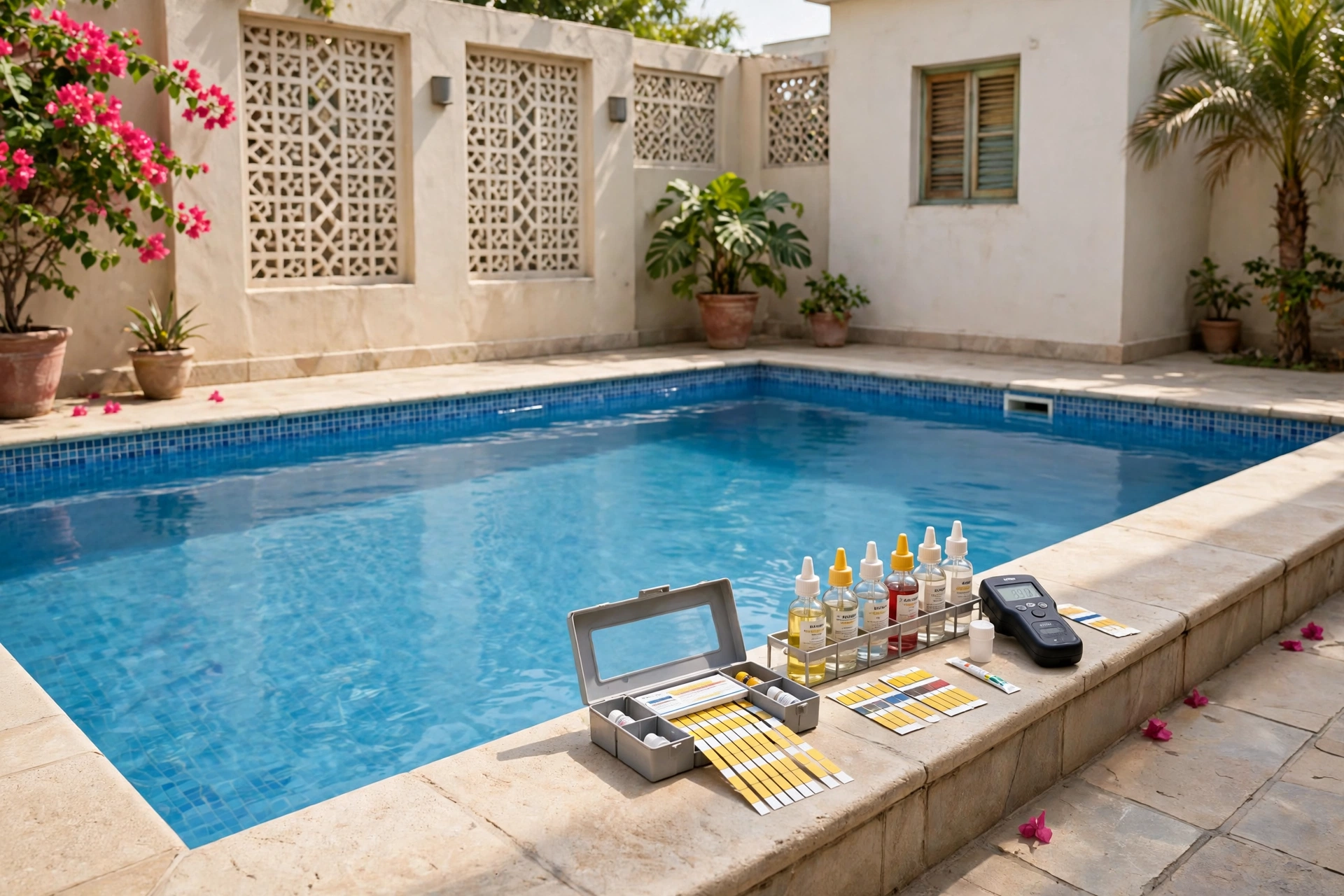
Clear-looking pool water can still be unsafe to swim in. In Karachi, where dust, heat, and monsoon rain constantly push your water chemistry around, the only way to know what is really going on is to test it. A testing kit is the cheapest tool a pool owner can buy — and the one most often bought wrong.
This guide compares the three testing options actually available in Pakistan — test strips, liquid drop kits, and digital meters — and explains which one suits which kind of Karachi pool owner.
Why Testing Matters More in Karachi
Karachi pools face conditions that pools in cooler, cleaner cities do not. Dust blows in daily, especially in open DHA and Bahria Town plots. Summer heat burns off chlorine faster, so a pool that tested fine on Monday can be under-chlorinated by Thursday. Monsoon rain dilutes chemicals and washes debris in overnight. And Karachi’s tap and tanker water is hard, which slowly pushes calcium levels up and leaves scale on tiles and heaters.
The Five Things You Actually Need to Test
A basic kit should cover at least the first two. A good kit covers all five.
- Free chlorine (FC): the sanitiser actually available to kill germs. Target roughly 1–3 ppm for a home pool.
- pH: how acidic or alkaline the water is. Target roughly 7.2–7.8. Out-of-range pH makes chlorine weak and water irritating.
- Total alkalinity (TA): the buffer that keeps pH stable. Target roughly 80–120 ppm.
- Cyanuric acid (CYA): the stabiliser that protects chlorine from Karachi’s strong sun. Target roughly 30–50 ppm for an outdoor pool.
- Calcium hardness (CH): dissolved calcium. Karachi’s hard water pushes this up over time; very high levels cause scale, very low levels etch plaster.
Test Strips: Fast, Cheap, and Imprecise
Test strips are the most common kit in Pakistan because they are cheap and sold everywhere pool chemicals are sold. Dip a strip, wait the stated seconds, and match the colours against the chart on the bottle.
Pros: instant results, no mixing, no glassware, easy for a housekeeper or guard to use.
Cons: the colour matching is subjective, especially in bright sunlight, and strips read in broad steps rather than exact numbers. Humidity is their enemy — a bottle left open near a Karachi pool in July absorbs moisture and the strips go unreliable. They also cannot measure CYA or calcium accurately.
Verdict: fine as a quick between-visits check, but do not base chemical dosing decisions on strips alone. Keep the bottle sealed, dry, and out of direct sun, and replace it once it passes its expiry date.
Liquid Drop Kits: The Best Value for Most Owners
A liquid kit uses reagent drops and a small comparator block: fill the vials with pool water, add the drops, and compare the colour. The standard DPD test for chlorine and the phenol-red test for pH are the same methods pool professionals use on site.
Pros: noticeably more accurate than strips, cheap per test, and the reagents last well if stored cool and dark. A mid-range kit covers chlorine, pH, alkalinity, and often CYA.
Cons: each test takes a couple of minutes, and reading the colour still involves judgement. Reagents expire — typically within a year or two — and faded or cloudy reagent gives wrong readings.
Verdict: this is the kit we recommend to most Karachi home-pool owners. It is accurate enough to dose chemicals confidently and cheap enough that there is no excuse not to test weekly.
Digital Meters and Photometers: Precise, Pricier, and Needing Care
Digital testers range from pocket pH pens to handheld photometers that read chlorine, pH, alkalinity, CYA, and calcium with a digital display. The better ones are imported and cost several times a liquid kit.
Pros: exact numbers instead of colour matching, fast repeat readings, and useful if you manage a commercial pool, a hotel pool, or several pools.
Cons: price, and maintenance. pH pens need regular calibration with buffer solutions, and their probes dry out if stored badly. Photometers need specific reagent tablets for each parameter, which must be sourced in Pakistan. A neglected digital meter is worse than a liquid kit because its confident-looking number hides a bad calibration.
Verdict: worth it for commercial pools and serious owners who will calibrate. Overkill for a single home pool that is already on a weekly maintenance visit.
Comparison at a Glance
| Test strips | Liquid drop kit | Digital meter | |
|---|---|---|---|
| Cost in Pakistan | Lowest | Low–moderate | Highest |
| Accuracy | Rough | Good | Excellent (when calibrated) |
| Speed | Seconds | 2–5 minutes | Under a minute |
| Tests CYA/calcium | Poorly | Yes (bigger kits) | Yes |
| Main weakness | Humidity, colour guessing | Reagent expiry | Calibration, probe care |
| Best for | Quick spot checks | Most home pools | Commercial / multi-pool owners |
How Often Should You Test in Karachi?
- Chlorine and pH: at least once a week; twice a week in peak summer (May–August) and after heavy rain.
- Full panel (all five): once a month, and after any big event — a pool party, a monsoon downpour, a refill from a tanker, or a green-water episode.
- After a chemical shock: retest before swimming, not just the next morning. Chlorine can stay high longer than owners expect.
Buying Tips: Avoiding Fakes and Expired Stock
Test kits in Pakistan are mostly imported, and a few traps are common:
- Check the expiry date before paying, especially for strips and reagents. Shops sometimes stock old inventory.
- Buy reagents from a pool supplier, not a general store. General stores may store kits in heat, which degrades them.
- Keep kits indoors, not in the pump room. Heat and humidity are the two things that quietly ruin them.
- Beware of unbranded “digital” pens sold at suspiciously low prices. A pH pen that cannot be calibrated is a random-number generator.
- Match the kit to your pool type. Saltwater pools need a salt test as well; ask your supplier for a salt-compatible kit rather than discovering the gap later.
Five Mistakes Karachi Pool Owners Make
- Testing only when the water looks bad. By then you are treating a problem, not preventing one.
- Dosing from a strip reading alone, then wondering why the water still stings eyes.
- Storing the kit by the pool. Heat and humidity kill strips and reagents.
- Ignoring CYA. Many Karachi owners keep adding stabilised chlorine tablets without realising CYA has crept so high that the chlorine barely works.
- Using expired reagents and trusting the result because the colour “looked about right”.
Frequently Asked Questions
Can I use a drinking-water test kit for my pool?
No. Drinking-water kits test different ranges and do not measure free chlorine, CYA, or the alkalinity levels a pool needs. Use a kit made for pools.
Are test strips accurate enough for a home pool?
For a rough weekly check, yes. For dosing decisions after a problem — green water, eye irritation, cloudy water — use a liquid kit or a professional test.
How long do test kits last in Karachi’s climate?
Unopened, roughly one to two years depending on the product. Once opened, strips degrade faster in humidity; keep them sealed and indoors, and replace any kit past expiry.
Does my maintenance team test the water for me?
A proper maintenance visit includes testing — ask your provider what they test and when. But owning your own kit means you can check between visits, especially after rain or a party.
What should I do if my readings are all over the place?
Retest with fresh reagent or a second kit. If results still disagree, get a professional water test before adding more chemicals — chasing a bad reading with chemicals is how pools end up worse.
The Bottom Line
If you would rather not manage testing yourself, The Pool Guy’s maintenance visits include full water testing and balancing as part of the service — maintenance plans start from Rs 15,000/month after a free pool inspection.
Call or WhatsApp The Pool Guy on +92 321 2077638. We build, repair, and maintain swimming pools across Karachi — DHA, Clifton, Gulshan, Bahria Town, and beyond. Visit us at 22 Dr Ziauddin Ahmed Rd, Civil Lines, Karachi, Mon–Sat 9 AM–6 PM. See our work on the gallery, explore our services, and browse pool equipment on our products page.
Leave a Reply