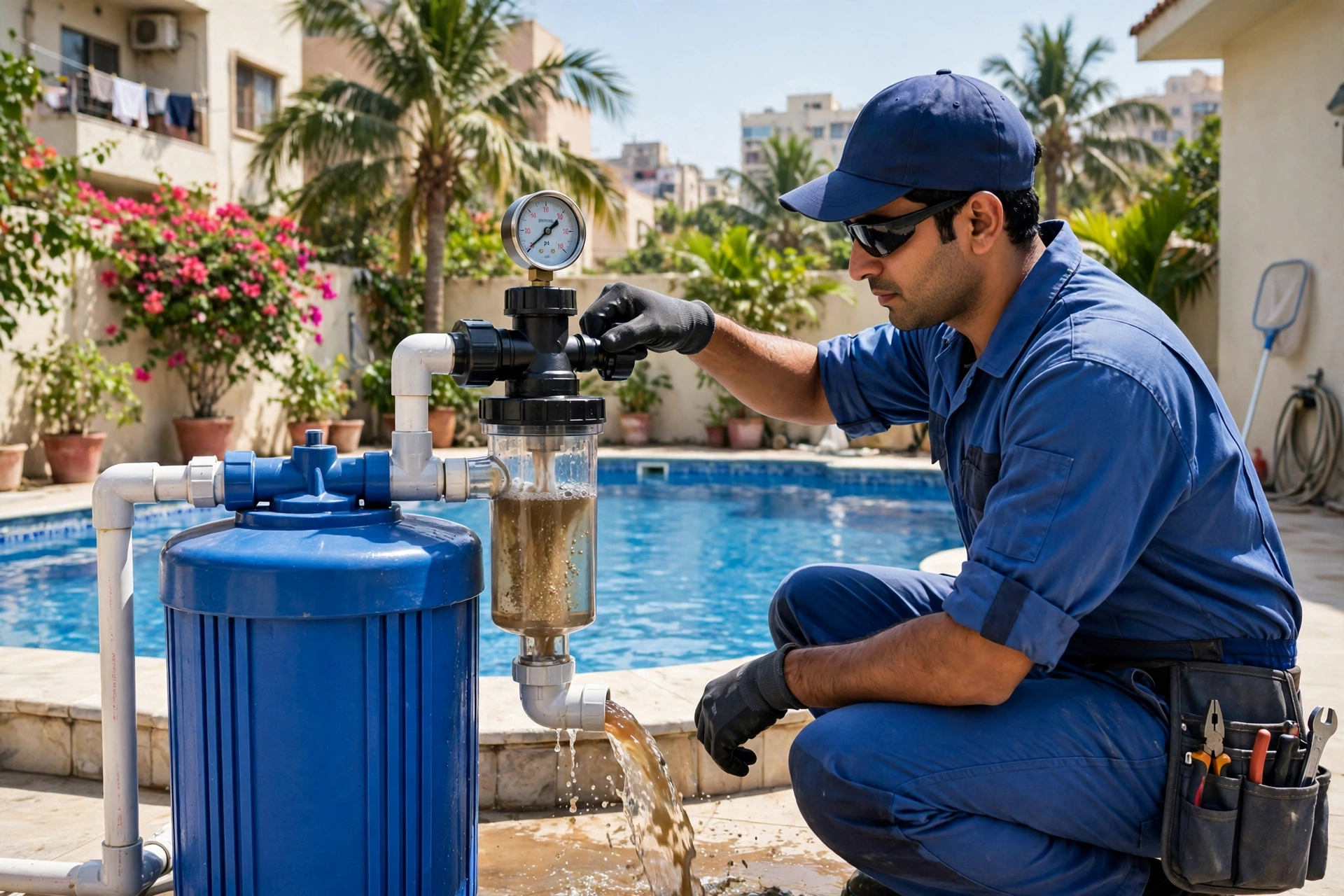
Backwashing is the single most misunderstood routine in pool care. Done right, it keeps your water clear and your pump healthy. Done wrong — too often, too rarely, or with the valve in the wrong position — it wastes expensive water, wears out your sand, and can even damage your filter. In Karachi, where dust, sea breeze, and tanker-priced water all raise the stakes, backwashing properly matters more than most owners realise.
What Backwashing Actually Does
A sand filter traps dirt in the top layer of its sand bed. Over days and weeks, that trapped dirt builds up and the sand bed gets tighter. Water then struggles to pass through, pressure rises, and flow to the pool drops. Backwashing reverses the water flow through the filter: clean water is pushed up through the sand from below, lifting and loosening the bed, and flushing the trapped dirt out through the waste line.
It is not a deep clean of the sand, and it is not a substitute for replacing sand that is years old and worn smooth. Think of it as shaking out a rug: it removes the surface dirt that is choking flow, but it does not renew the rug itself.
How to Tell Your Filter Needs Backwashing
Do not backwash on a calendar alone. Watch these signs instead:
- The pressure gauge. This is the reliable test. Note the pressure reading when the filter is clean (right after a backwash, with a clean pump basket). When the gauge reads 8–10 PSI above that clean baseline, it is time to backwash. A gauge that never moves may be stuck — tap it lightly or replace it, because a dead gauge hides a clogged filter.
- Weak return flow. If the jets feel noticeably weaker than usual and the pump basket is clean, the filter is probably clogged.
- Cloudy water that chemicals do not fix. If chlorine and pH are balanced but the water stays hazy, poor filtration is a prime suspect.
- The pump struggling or noisy. A filter choked with dirt forces the pump to work harder, which shortens its life — see our pool pump troubleshooting guide if your pump is making unusual noises.
Step-by-Step: Backwashing a Sand Filter
This is for a standard sand filter with a multiport valve — the most common setup on Karachi residential pools. Never move the multiport valve handle while the pump is running.
- Switch the pump off. Always. Moving the valve under pressure damages the valve seal.
- Set the valve to BACKWASH. Turn the handle to the BACKWASH position.
- Open the waste line if it has its own valve, and make sure the waste water has somewhere legal to go (more on this below).
- Switch the pump on. Let it run for 2–3 minutes, or until the water in the valve sight glass runs clear. Do not run it longer than needed — every extra minute is water down the drain.
- Switch the pump off and set the valve to RINSE.
- Run on RINSE for 30–60 seconds. This settles the sand bed back down and flushes any remaining dirt out of the valve, so it does not return to the pool.
- Switch the pump off, set the valve back to FILTER, and switch the pump on.
- Note the new clean pressure on the gauge. This is your baseline until the next backwash.
The whole job takes under ten minutes. If you have a cartridge filter, do not backwash it at all — cartridge filters are cleaned by removing the cartridge and hosing it down. If you have a DE filter, the process is similar but you must add fresh DE powder after every backwash, or the filter will run almost unfiltered.
How Often Should You Backwash in Karachi?
Karachi conditions push filters harder than a textbook schedule assumes. Dust from dry months, leaves during windy spells, and monsoon debris all load the filter faster. As a practical guide:
| Situation | Typical backwash frequency |
|---|---|
| Home pool, light use, winter | Every 3–4 weeks |
| Home pool, regular summer use | Every 1–2 weeks |
| After a dust storm or heavy wind | As soon as pressure rises |
| After monsoon rain and debris | As soon as pressure rises |
| Farmhouse or commercial pool, heavy use | Weekly, sometimes more |
The pressure gauge overrides every row of this table. A pool under a dusty construction site next door may need backwashing twice as often as an identical pool in a sheltered DHA lane — that is normal, not a fault.
The Water Question: Where Does Backwash Water Go?
A single backwash uses a meaningful amount of water — roughly what a long shower uses several times over, depending on pump size and duration. In a city where many pools are filled by tanker, that water has a real cost, which is exactly why you should backwash only when the gauge says so, and never on a fixed “every Monday” habit.
A few Karachi realities to respect:
- Do not flood your neighbour or the street. Route the waste line to a proper drain, not over a boundary wall or onto a public road.
- Check housing-society rules. Some societies in DHA, Bahria Town, and Clifton restrict where pool wastewater may be discharged. A quick check with the society office avoids a fine.
- Do not water the garden with it. Backwash water carries chlorine and concentrated dirt; it will stress plants and stain light paving.
- Top up after backwashing. The pool level will drop. Top it up promptly — a pump running with low water can suck air and lose prime.
Mistakes That Cost Karachi Pool Owners Money
- Backwashing too often. Every backwash wastes water and disturbs the sand bed. A filter that is backwashed daily never builds the fine dirt layer that actually helps trap the smallest particles, so water can look worse, not better.
- Skipping the rinse step. Dirt left in the valve after backwashing returns straight to the pool on the next FILTER run — the classic cause of a “dust cloud” right after backwashing.
- Moving the valve with the pump running. This tears the valve gasket, which then leaks between positions and may need a valve rebuild.
- Backwashing a cartridge filter. There is no backwash setting for a reason. Forcing water backwards through a cartridge damages the pleats.
- Ignoring a rising gauge for months. The pump works harder, electricity use climbs, and the filter can channel — water carving a path through the sand instead of filtering evenly. Once sand channels, only a sand change fixes it; see our guide to pool filter sand replacement.
Backwash vs Sand Replacement: Which Do You Need?
If backwashing restores normal pressure and clear water, your sand is fine. If pressure climbs again within a day or two of every backwash, or the water never fully clears, the sand itself may be worn, clumped, or channelled. Sand typically lasts several years in a home pool, but heavy Karachi dust loads and poor chemical balance shorten that. A filter that needs backwashing constantly is telling you to look at the sand, not to backwash more.
FAQ
How long should I backwash my pool filter?
Usually 2–3 minutes, or until the sight glass water runs clear — whichever comes first. Then rinse for 30–60 seconds. Longer backwashes only waste water.
Can I backwash too much?
Yes. Over-backwashing wastes water, disturbs the sand bed, and can make filtration worse. Backwash when the pressure gauge reads 8–10 PSI above its clean baseline, not on a fixed schedule.
Why is my pool cloudy right after backwashing?
Almost always a skipped rinse step: dirt trapped in the valve flushed back into the pool. Backwash again properly, including the rinse, and the cloud should clear through normal filtration.
Does backwashing lower the pool water level?
Yes, noticeably. Top the pool up after every backwash so the skimmer and pump do not run low on water.
My pressure gauge never moves. Is that good?
Probably not — it usually means the gauge is stuck or broken. A working gauge rises as the filter loads. Replace a dead gauge; without it you are backwashing blind.
Get Your Filter Checked
If your filter pressure climbs fast, your water stays hazy, or you are unsure whether your sand needs replacing, get it looked at rather than guessing. The Pool Guy services and repairs pool filtration across Karachi — call or WhatsApp +92 321 2077638 for a visit. We are at 22 Dr Ziauddin Ahmed Rd, Civil Lines, Karachi, open Mon–Sat, 9 AM–6 PM (Sunday closed). See our services for maintenance and repair work, browse real projects in our gallery, and check filters and equipment in our products section.
Leave a Reply