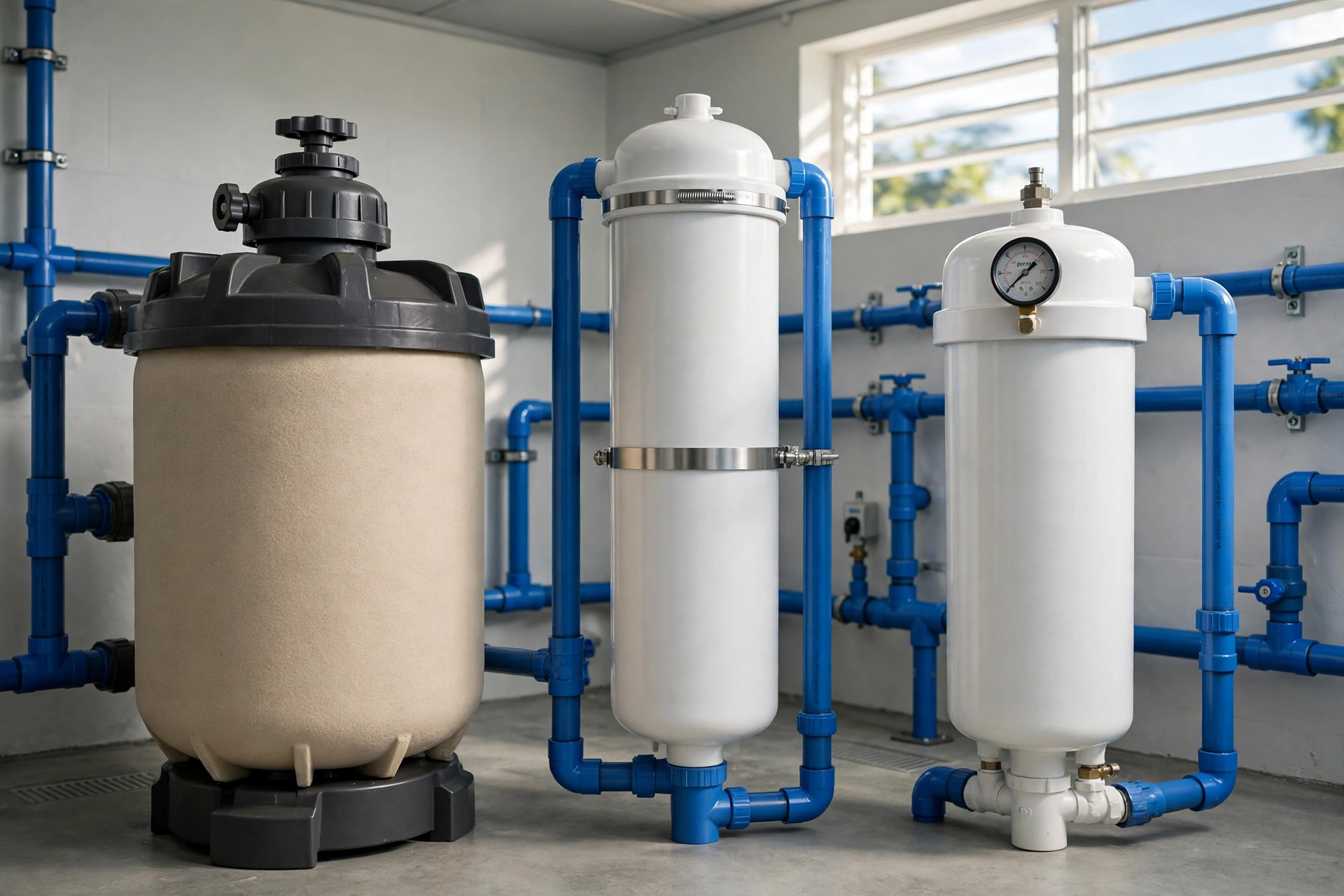
Every pool filter does the same job — trap dirt so the pump can return clean water — but the three filter types do it in very different ways, with very different consequences for your water bill, your electricity bill, and your weekends. Pick wrong and you get cloudy water, constant cleaning, or a filter that wastes water your city cannot spare. Pick right and the filter quietly disappears into the background of pool ownership.
This guide compares sand, cartridge, and diatomaceous earth (DE) filters the way a contractor sees them: not just on paper, but in Karachi's dust, water shortages, and load-shedding reality.
How Each Filter Actually Works
Sand filters push water down through a bed of specially graded silica sand. Dirt collects in the top layers of sand, and when pressure rises you "backwash" — reverse the water flow to flush the trapped dirt out to waste. The sand itself lasts years; only the trapped dirt leaves.
Cartridge filters push water through a pleated polyester cartridge, like a giant air filter. Dirt collects on the pleats' surface. There is no backwash: you remove the cartridge and hose it clean. Cartridges are replaced every one to three years depending on use.
DE filters push water through grids coated with diatomaceous earth, a fine fossil powder. DE traps the smallest particles of any filter type. When pressure rises you backwash like a sand filter, then add a fresh charge of DE powder through the skimmer.
The difference that matters most is filtration fineness — how small a particle each type catches:
| Filter type | Catches particles down to | Cleaning method | Water wasted on cleaning |
|---|---|---|---|
| Sand | 20–40 microns | Backwash | High — several hundred litres per backwash |
| Cartridge | 10–15 microns | Hose down the cartridge | Almost none |
| DE | 2–5 microns | Backwash + fresh DE powder | High, plus DE powder cost |
For reference, a human hair is about 70 microns wide and fine dust is 10 microns and below. Sand filters miss the finest dust; DE catches nearly everything; cartridge sits in between.
The Karachi Factors Nobody Puts in the Brochure
Filter brochures are written for places with unlimited water and stable power. Karachi is neither, and that changes the maths:
Water scarcity. A sand or DE filter backwashed weekly can send thousands of litres to waste over a season. In a city where pool owners already pay for tanker top-ups, that waste has a real price. Cartridge filters, which clean with a garden hose, waste almost nothing — a genuine advantage here, not a footnote.
Dust load. Karachi's dust season loads filters fast. Fine airborne dust is exactly the particle size sand filters struggle with, which is why some Karachi pools with sand filters look slightly hazy in dusty months even when chemistry is perfect. Cartridge and DE handle fine dust better.
Power cuts and pump runtime. Filters only clean while the pump runs. A filter that clogs quickly raises pressure, and a pump pushing against high pressure uses more electricity and wears faster. In areas with load shedding, where pump hours are already limited, a filter that stays efficient between cleanings — cartridge or DE — gets more done in fewer running hours.
Space. Cartridge filters are compact for their capacity; sand filters are bulky; DE filters sit in between. On a tight equipment pad in a DHA or Clifton home, that matters. See typical equipment layouts in our equipment room design guide.
Running Costs, Honestly Compared
Upfront price tells only part of the story. We quote filter systems only after seeing the pool, because size, plumbing, and pump pairing change the figure — but the relative costs are consistent:
- Sand: cheapest to buy, cheapest to run. Sand itself is inexpensive and lasts 5–7 years. The hidden cost is water: every backwash is water you paid for, going to drain.
- Cartridge: mid-range to buy, low running cost. Replacement cartridges are the main expense, every 1–3 years. No backwash water, no DE powder, and cleaning is free apart from your time.
- DE: most expensive to run. The filter itself is mid-to-premium priced, and DE powder is a recurring purchase. Backwashing wastes water too. What you buy with that money is the clearest water of the three — visibly polished, sparkling water.
Over five years in Karachi, a cartridge filter often ends up the cheapest overall once tanker water for backwashing is counted — a calculation that surprises owners who chose sand for its low sticker price.
Which Filter for Which Pool?
Small home pool (up to ~30,000 litres), owner-maintained: Cartridge. Cleaning takes twenty minutes with a hose, water waste is near zero, and filtration is fine enough for Karachi dust. The main job is remembering to hose the cartridge — neglect it and pressure rises fast.
Large family or farmhouse pool: Sand or cartridge, sized generously. Sand suits owners with a gardener or maintenance team who backwash on schedule; cartridge suits owners who want low water waste. Oversize the filter if you can — a bigger filter cleans less often and the pump works less hard.
Pool with heavy use — guests, children, parties: DE or a large cartridge. Heavy bather load means sunscreen, oils, and fine debris; DE's fine filtration keeps water polished where sand would leave a haze. DE suits owners with a service contract, since backwashing and recharging need doing properly.
Commercial pool (hotel, club, school): Usually sand, in multiples, for robustness and simple servicing — with DE as a polishing option where water clarity is a selling point. Commercial sizing is a design exercise, covered in our commercial pool construction guide.
Pool with a salt chlorinator: Any type works, but cartridge owners should note that salt cells scale faster in hard water (see our calcium hardness guide), and a scaled cell plus a dirty cartridge together will cut circulation sharply. Keep both clean.
Sizing: The Mistake That Ruins Good Filters
The most common filter mistake in Karachi is not the type — it is the size. An undersized filter clogs in days, pressure spikes, the pump strains, and the owner concludes the filter type is bad. A correctly sized filter for your pool volume and pump flow rate runs for weeks between cleanings.
The rule: the filter's rated flow must meet or exceed your pump's flow, and the filter should turn over the pool's full volume in 6–8 hours. If your pump and filter were not matched as a pair — common when equipment is replaced piecemeal — ask a contractor to check the pairing before blaming the filter. Our equipment guide explains pump and filter sizing in detail.
Maintenance Schedules That Actually Work
| Filter type | Routine cleaning | Deep service | Replace |
|---|---|---|---|
| Sand | Backwash when pressure rises 8–10 psi above clean pressure | Inspect laterals and sand condition yearly | Sand every 5–7 years |
| Cartridge | Hose down every 2–4 weeks in season | Soak in filter cleaner 1–2 times a year | Cartridge every 1–3 years |
| DE | Backwash + recharge when pressure rises | Strip and clean grids yearly | Grids every 5–7 years, DE powder every backwash |
The pressure gauge is your filter's voice. Note the "clean" pressure after a fresh cleaning; when the gauge reads 8–10 psi higher, clean it. Ignoring the gauge is how pumps burn out and water turns cloudy.
Common Mistakes We See on Service Visits
- Backwashing sand filters on a calendar, not on pressure. Backwashing too often wastes water and actually filters worse for a day — a slightly dirty sand bed filters finer than a freshly backwashed one.
- Hosing cartridges with a pressure washer. High pressure tears pleats. A garden hose, top to bottom, is enough.
- Running a DE filter without DE powder. After backwashing, the grids are bare. Running without recharging lets dirt embed directly in the grids and shortens their life.
- Mixing filter types with the wrong pump. A high-flow pump on a small cartridge filter will crush pleats and spike pressure. Match the pair.
- Forgetting the gauge. A broken pressure gauge means flying blind. Replace it — it costs little and prevents pump damage.
Our maintenance plans start from Rs 15,000/month, final quote after a free pool inspection, and include filter cleaning and pressure checks on schedule. See finished projects in our gallery and equipment.
Frequently Asked Questions
Which pool filter is best for Karachi's dusty conditions?
Cartridge or DE. Karachi's fine dust is at the edge of what sand catches, so sand-filtered pools can look hazy in dust season. Cartridge is the practical choice for most homes; DE gives the clearest water if you accept the running cost.
Does a cartridge filter really save water?
Cleaning uses a garden hose for a few minutes, versus several hundred litres per sand or DE backwash. Over a season in a tanker-water home, the saving is substantial.
How do I know when my filter needs cleaning?
Watch the pressure gauge. Clean or backwash when pressure reads 8–10 psi above the clean-filter reading. Cloudy water and weak return jets are late warnings — the gauge tells you first.
Can I switch filter types without changing my pump?
Sometimes, but the pump and filter must be matched on flow rate. A switch needs a contractor to check the pairing, the plumbing size, and the pad space — it is not always a straight swap.
How long does a sand filter's sand last?
Typically 5–7 years. Sand does not wear out so much as it rounds off and channels, losing filtration quality. If backwashing no longer restores pressure, the sand is due.
Get a Free Quote
Cloudy water, a pressure gauge climbing every week, or a filter that never seems clean — the fix may be the right type, the right size, or just a proper cleaning schedule.
The Pool Guy designs, installs, and services pool filtration across DHA, Clifton, Gulshan, Bahria Town, and PECHS. Call or WhatsApp +92 321 2077638, or visit 22 Dr Ziauddin Ahmed Rd, Civil Lines, Karachi. Open Monday to Saturday, 9 AM to 6 PM (Sunday closed). Request a free pool inspection and we will check your pump-filter pairing, pressure, and water clarity, then recommend the filter that fits your pool and your water bill — final quote after inspection.
Leave a Reply