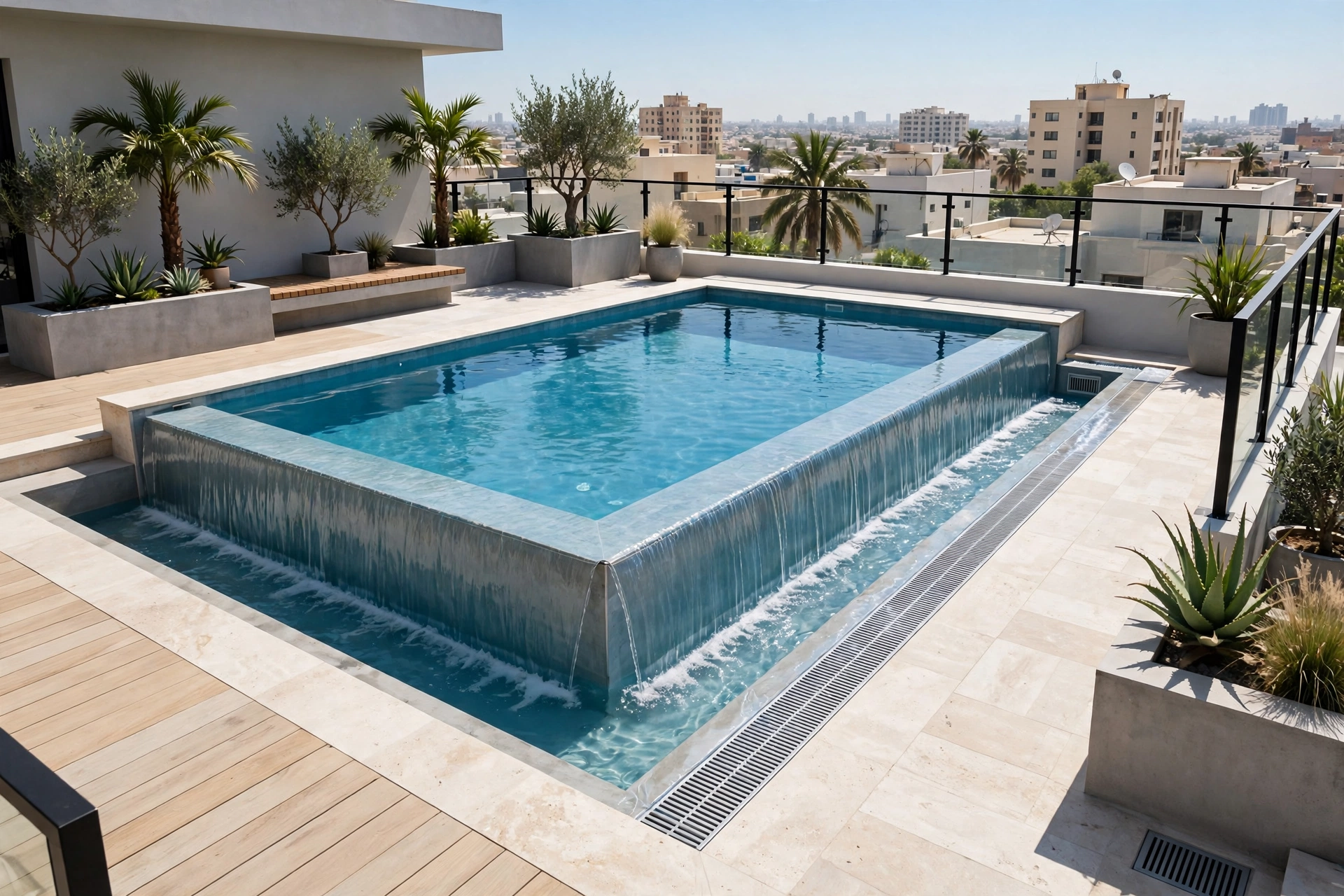
Most pool owners obsess over tiles, lights, and the shape of the pool. Almost nobody asks about overflow and drainage — until the first monsoon downpour floods the deck, or the pool water level keeps dropping for no obvious reason. Drainage is the unglamorous part of pool construction, and it is the part that causes the most expensive damage when it is done badly.
Here is how pool overflow and drainage actually work, what Karachi’s climate and soil demand, and the mistakes to catch before your pool is built — or before a renovation.
How a Pool Handles Extra Water
A pool’s water level is not fixed. Rain adds water, swimmers splash it out, evaporation lowers it, and backwashing the filter removes some. Two systems manage the level:
Skimmers are the most common setup in Karachi home pools. A skimmer is a box set into the pool wall at water level; surface water flows into it, carrying leaves and debris to a basket, and the pump pulls water from there. The water level must sit about halfway up the skimmer mouth to work properly.
Overflow channels (also called deck-level or infinity-edge gutters) run around the pool rim. Water flows over the edge into a channel and drains to a balance tank, from where the pump recirculates it. Overflow systems keep the water level constant, skim the entire surface, and look cleaner — but they cost more to build and need a balance tank, which takes space.
Why Karachi Is Harder on Pool Drainage
Three local factors make drainage design matter more here than in a textbook:
Monsoon rain. A single heavy Karachi downpour can add thousands of litres to an uncovered pool in hours. Without an overflow route, that water has nowhere to go except over the coping and across the deck — carrying dirt with it and flooding garden beds, basements, or neighbouring plots. A pool built without a rain plan will flood its own surroundings at least once a season.
High water tables in coastal areas. In Clifton and parts of DHA near the sea, groundwater sits high. A pool shell built without proper dewatering and drainage around it can literally float or crack when the surrounding ground is saturated. The drainage around the outside of the shell matters as much as the drainage inside the pool.
The Parts of a Good Pool Drainage System
A complete system has several pieces, and a good contractor designs all of them together:
- Surface drainage around the deck. The deck must slope gently away from the pool (about 1–2%) toward drains or garden areas — never toward the pool. Standing water on a deck is a slip hazard and a mosquito breeding ground.
- Channel drains at deck edges. Linear drains along the deck perimeter catch splash-out and rain before it runs into beds or the house.
- An overflow outlet in the pool. Even a skimmer pool needs a way to shed excess water: an overflow pipe set just above normal water level, piped to a drain or soakaway. Without one, the owner must manually drain after every big rain.
- A balance tank for overflow pools. This holds the surge water and feeds it back to the pump. It must be sized for the pool and accessible for cleaning — a tank nobody can open will become a hidden source of dirty water.
- Main drains on the pool floor. These pull water from the bottom for circulation and allow full draining for repairs. Modern safety rules require anti-entrapment covers, and older pools should be checked for these.
- Equipment-area drainage. The pump room or equipment pad needs its own drain. A burst pipe or a backwash overflow in an undrained pump room floods the equipment itself.
Common Drainage Mistakes We See in Karachi Pools
No overflow provision at all. The single most common fault in older Karachi pools. The owner ends up siphoning or pumping water out after rain, and the deck floods in the meantime.
Deck sloping toward the pool. Sometimes done accidentally when the deck is levelled by eye rather than with a proper fall. Every rain then washes dust and dirty water straight into the pool, and the owner blames the filter.
Drains connected to the wrong outlet. Pool backwash water and overflow must not go into a neighbour’s plot or a storm drain that cannot take it. In housing societies, this can draw complaints and fines — check the society’s rules before connecting anything.
Undersized pipes. A 1-inch overflow pipe cannot shed monsoon rain fast enough. Pipe sizes should be matched to the pool’s surface area and Karachi’s peak rainfall intensity, not to whatever was left over on site.
Inaccessible channels and tanks. Overflow channels with fixed grates that cannot be lifted, and balance tanks with no access hatch, guarantee that cleaning never happens and blockages build silently.
Ignoring the water table. In coastal plots, skipping perimeter drainage and a hydrostatic relief valve around the shell risks structural damage that no amount of tiling can hide. This is a design decision made before concrete is poured, not after.
Overflow Channel vs Skimmer: Which Should You Choose?
| Skimmer system | Overflow channel system | |
|---|---|---|
| Build cost | Lower | Higher (channel + balance tank) |
| Water level | Varies with rain and splash | Constant, always full to the rim |
| Surface cleaning | Good at skimmer points | Excellent across the whole surface |
| Space needed | Minimal | Balance tank space required |
| Maintenance | Simple basket cleaning | Channel and tank cleaning too |
| Best for | Most Karachi home pools | High-end homes, hotels, clubs |
What to Ask Your Contractor Before Construction
Before you sign a pool contract, ask these drainage questions — and get the answers in the design, not just verbally:
- Where does overflow water go in a monsoon downpour, and what pipe size carries it?
- How does the deck slope, and where are the deck drains?
- What provision is there for a high water table on this plot?
- Where is the balance tank (if any), and how is it accessed for cleaning?
- Where does backwash water discharge, and does the housing society allow it?
A contractor who cannot answer these clearly has not designed your drainage — they have left it to chance.
Frequently Asked Questions
Does every pool need an overflow system?
Every pool needs a way to shed excess water. That can be a full overflow channel system or a simpler overflow pipe in a skimmer pool — but “no provision” is not an option in Karachi’s monsoon climate.
Why does my pool overflow onto the deck every monsoon?
Usually one of three reasons: no overflow outlet was built, the outlet pipe is undersized or blocked, or the deck slopes toward the pool. All three are fixable, but the fix is cheapest if the pipework is accessible.
Can drainage be added to an existing pool?
Often yes — an overflow pipe can be retrofitted through the pool wall in many cases, and deck drains can be added during a renovation. It is more disruptive than building it right the first time, but far cheaper than repeated flood damage.
Is pool backwash water safe to drain into the garden?
Backwash water contains chlorine and filter debris. Occasional small amounts on lawn are usually harmless, but regular discharge should go to a proper drain, and housing-society rules may restrict it. Check before you connect.
My pool water level keeps dropping — is that drainage or a leak?
Some drop is normal evaporation, especially in Karachi’s summer heat and sea breeze. But a steady, unexplained drop — particularly one that stops at a certain level — often points to a leak at the skimmer, a return fitting, or the overflow line. Get a leak detection check rather than topping up endlessly.
The Bottom Line
Drainage is not the part of a pool you show off — it is the part that protects everything else. A skimmer pool with a proper overflow outlet and a correctly sloped deck will serve most Karachi homes perfectly. An overflow channel system is the premium option, but only if the balance tank is accessible and maintained. If your pool floods every monsoon, or you are planning a new build and want the drainage designed properly from day one, talk to The Pool Guy. Maintenance plans start from Rs 15,000/month after a free pool inspection.
Call or WhatsApp The Pool Guy on +92 321 2077638. We build, repair, and maintain swimming pools across Karachi — DHA, Clifton, Gulshan, Bahria Town, and beyond. Visit us at 22 Dr Ziauddin Ahmed Rd, Civil Lines, Karachi, Mon–Sat 9 AM–6 PM. See our work on the gallery, explore our services, and browse pool equipment on our products page.
Leave a Reply