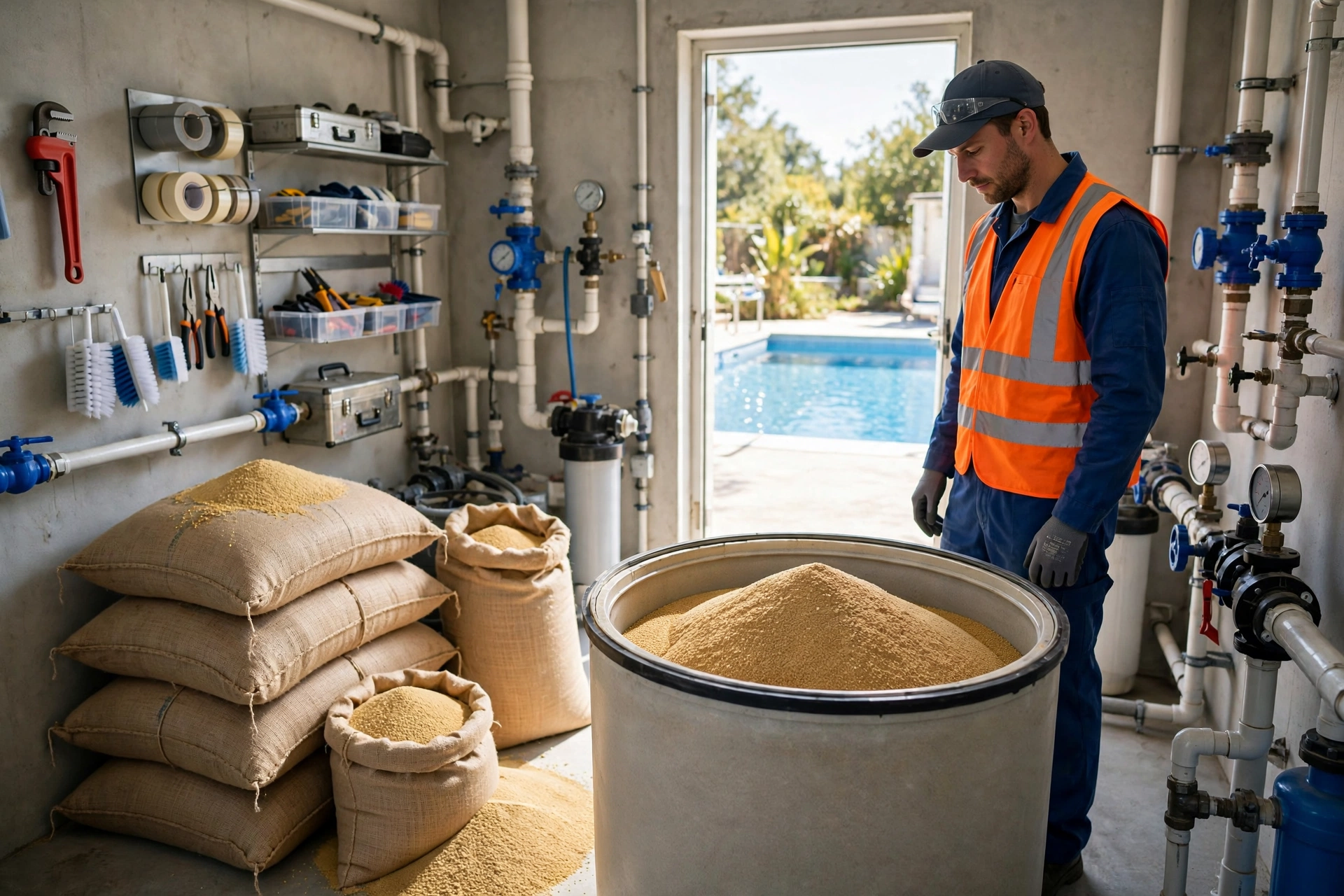
A sand filter is the quiet workhorse of most Karachi home pools: silent, unseen, and ignored while it works. When it stops working well, the symptoms show in the water — cloudiness that survives shocking, pressure that climbs faster than usual, backwashing needed every few days instead of every few weeks. Often the problem is not the pump, chlorine or pool, but the sand inside the filter, worn smooth after years of service.
This guide explains what filter sand actually does, how Karachi conditions wear it out, the signs that replacement is due, what a proper sand change involves, and what it costs. It is written from our day-to-day work on residential and farmhouse pools across DHA, Clifton, Gulshan, PECHS, Bahria Town and North Nazimabad.
What Filter Sand Does — and Why It Wears Out
Inside a sand filter, water is pushed down through specially graded silica sand. Dirt, algae fragments, dust and oils get trapped between the grains, and clean water returns to the pool. New grains have sharp, angular edges that catch fine particles; over time, constant flow rounds those edges off, the grains pack tighter, and they can no longer trap the fine dust that hazes Karachi pool water.
Sand does not disappear or dissolve, so a filter can look fine outside while its media is finished. Typical lifespan in a Karachi home pool is 5 to 7 years — less for a pool near an open plot or busy road, a tree-surrounded farmhouse pool, or one running long summer hours; a lightly used covered pool may stretch longer. Age alone is not the test — performance is.
Karachi’s dust, construction silt and hard, mineral-rich fill water load filters with fine particles, and scale can cement grains into clumps that water channels around instead of filtering through.
Signs Your Pool Filter Sand Needs Replacing
Watch for these signs together, not in isolation — one cloudy day after a dust storm is normal; a pattern is not.
1. Cloudy water that survives correct chemistry. If chlorine, pH and alkalinity are in range, the pool has been shocked, and water is still hazy after 24 to 48 hours of filtration, the media is the first suspect.
2. Pressure gauge climbing fast after backwashing. Note the clean-filter baseline when the filter is fresh. If the gauge climbs 8 to 10 PSI above it within days of a backwash, the bed is clogged, compacted or scaled — backwashing clears loose dirt, not worn grains.
3. Backwashing stops helping. A healthy filter visibly improves after a backwash; worn or clumped sand gives only brief improvement, or none, and the pool clouds again quickly.
4. Sand in the pool. A little after a fresh fill is normal; persistent sand means damaged laterals — found and fixed during a sand change, since the filter is opened anyway.
5. Short filter runs. If the filter now needs attention every two or three days, the media bed has lost capacity.
6. Known age. Sand over five years old plus two or more signs above means replacement is almost certainly due; if the age is unknown, a technician can inspect the media directly.
How Often Should You Change Filter Sand in Karachi?
| Situation | Typical interval |
|---|---|
| Average Karachi home pool, covered, moderate use | 5–7 years |
| Pool near open plots, busy roads or heavy dust | 4–5 years |
| Farmhouse or commercial pool, heavy use | 3–5 years |
| Lightly used, covered pool, good chemistry | Up to 7 years |
| Sand that has scaled or channelled badly | Replace regardless of age |
The cheapest way to extend sand life: keep chemistry balanced, backwash only when the gauge says so, and keep the pool covered when not in use.
What a Proper Sand Replacement Involves
A sand change is straightforward work, but it is not a job to rush, because the parts inside the filter are fragile and the old sand is heavy. Here is what a proper service visit looks like.
Step 1: Shut down and drain. The pump is switched off, valves closed, and the filter drained via its base plug.
Step 2: Remove the old sand. The multiport valve or lid comes off, and the old sand is scooped or vacuumed out — several bags of wet, heavy sand in larger Karachi filters. The tank is then rinsed clean.
Step 3: Inspect the laterals. The slotted pipes at the bottom that let clean water out while holding sand in are checked. Cracked laterals are the usual cause of sand in the pool, and replacing them now costs far less than opening the filter twice. The standpipe and diffuser are checked too.
Step 4: Refill with the correct grade and amount. Pool filter sand is a specific grade — typically 0.4 to 0.8 mm silica sand — not builder’s sand, beach sand or construction sand. The wrong grade passes through the laterals or clogs the filter. The filter is filled to the manufacturer’s level, usually about two-thirds full, with the standpipe protected.
Step 5: Reassemble, backwash and rinse. The valve is refitted (new O-ring if needed), the system primed, and the filter backwashed then rinsed before normal filtration resumes. Pressure is noted as the new clean baseline; water should clear noticeably within a day.
What Does Filter Sand Replacement Cost in Karachi?
Cost depends on filter size, because that decides how many bags of sand are needed, and on whether laterals or seals also need replacing. As a realistic guide for Karachi in 2026:
- Sand itself: graded silica filter sand, sold by the bag; a typical home filter takes several bags.
- Labour and service: the visit, removal, inspection and refill — the larger part, because the work is heavy and careful.
- Parts if needed: laterals, O-rings and seals, charged only if inspection shows damage.
For an exact figure, a technician needs the filter’s make and size (printed on the tank label) or a quick look at the pump room. Beware of quotes that promise a sand change without opening the filter, or that propose ordinary construction sand — both cost more later in cloudy water and repeat visits. The Pool Guy gives the final quote after a free pool inspection.
Mistakes to Avoid
- Wrong sand. Builder’s or beach sand clogs, channels or escapes into the pool.
- Wrong fill level. Too much restricts flow and strains the pump; too little lets dirty water pass. Fill to the manufacturer’s mark.
- Skipping the lateral check. New sand over broken laterals guarantees sand in the pool within weeks.
- Over-backwashing. Backwash at 8 to 10 PSI above clean pressure, not daily by habit — it wastes Karachi’s expensive tanker or line water.
- Ignoring chemistry. New sand cannot fix unbalanced water; test chlorine and pH after the change.
Frequently Asked Questions
How do I know if my filter sand is bad without opening the filter?
Cloudy water with correct chemistry, fast-rising pressure and backwashing that stops helping are the reliable signs. The certain test is opening the filter: worn sand feels smooth and clumps instead of running freely.
Can I just add new sand on top of old sand?
No — topping up mixes fresh grains with worn media and water still channels through the old bed. Remove all old sand first.
Does a sand change fix green pool water?
Not alone. Green water is an algae problem first — shocking, brushing and correct chemistry. But worn sand struggles to clear dead algae afterwards, so a sand change is often part of a full green-pool recovery.
How long does new filter sand last in Karachi?
Typically 5 to 7 years for a home pool, less for dusty locations or heavy commercial use.
Can I change filter sand myself?
An experienced owner with the right tools can, but laterals are brittle and easy to break, the old sand is heavy, and grade and fill level matter. Most owners find a professional visit cheaper than a broken lateral and a second opening.
When to Book a Filter Inspection
If water stays hazy despite correct chemistry, pressure climbs within days of every backwash, or your sand is five years old or older, book an inspection before it becomes a green pool or a strained pump.
The Pool Guy services sand filters across Karachi — inspection, sand replacement, lateral repair and full filter servicing for homes, farmhouses and commercial pools. Call or WhatsApp +92 321 2077638 for a free pool inspection. We are at 22 Dr Ziauddin Ahmed Rd, Civil Lines, Karachi, open Monday to Saturday, 9 AM to 6 PM.
For related reading, see our guides on swimming pool equipment sizing, pool maintenance and our products range — and browse completed work in our gallery.
Leave a Reply