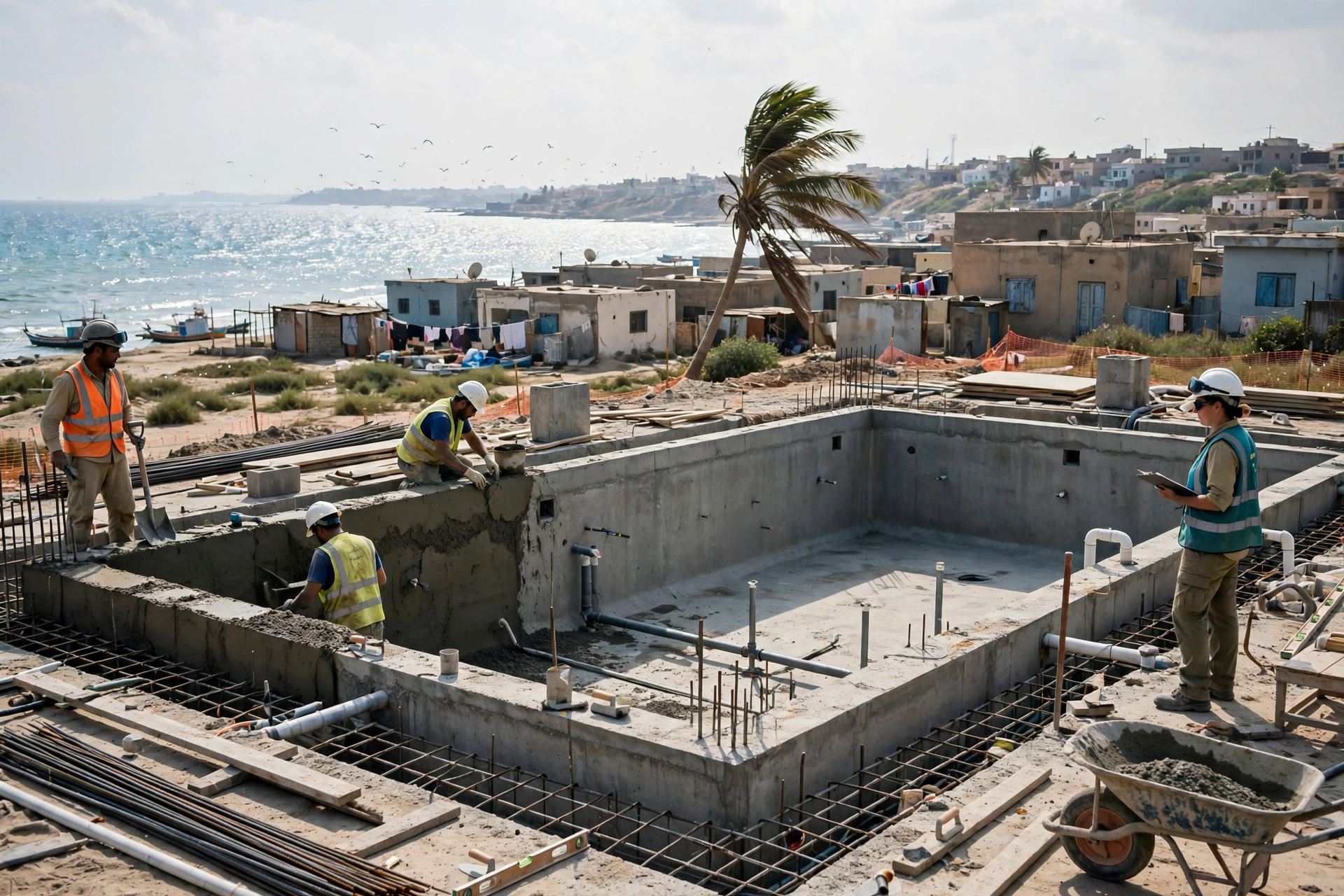
A pool a few streets from the sea in Clifton or DHA is not the same build as a pool inland in Gulshan or Bahria Town. The view is better, the breeze is stronger, and everything that can corrode, stain or shift will do so faster. Salt in the air, wind-blown sand, a high water table and Karachi’s monsoon all act on a coastal pool at once — and a build that ignores them will show its age in a few years, not a few decades.
That is a reason to build one differently: corrosion-resistant materials, stronger waterproofing, better drainage, and equipment specified for salt air. Here is what changes near the sea, and what to ask your contractor first.
Salt Air: The Invisible Enemy of Pool Equipment
Salt does not need to touch the pool to damage it. Sea breeze carries fine salt spray inland, and it settles on everything: pump motors, heater parts, light fittings, ladders, handrails, hinges and any exposed metal. Over time, ordinary steel rusts, chrome pits, and electrical connections corrode.
For a seaside pool, specify corrosion-resistant materials from the start. Stainless steel fittings should be marine grade, not standard grade, and ladders, rails and light niches should be chosen for coastal use. Ask your contractor which grade of stainless steel is being supplied and whether fittings are rated for a marine environment — “stainless” alone is not enough, because grades differ greatly in salt resistance.
Wind, Sand and Debris: Design for Daily Reality
A coastal pool collects more debris than an inland one. Sea wind carries sand, leaves and dust into the water every day, and a pool near an open beach or an unplanted plot will need more skimming and filtration than the same pool in a sheltered garden.
Design choices help. Position the pool, where the plot allows, so the prevailing wind does not blow straight across the water into the main seating area. Make sure skimmers are placed on the downwind side, where floating debris naturally collects, rather than on the side that looks best on the plan. A pool cover helps greatly near the coast, keeping sand out and cutting evaporation.
High Water Table and Groundwater Pressure
Parts of Clifton and DHA sit on ground where the water table is high, especially after monsoon rain. That matters for construction in two ways.
First, during construction, groundwater can flood an excavation and make waterproofing and concreting harder. A contractor experienced in coastal Karachi will plan for dewatering, check groundwater levels before digging, and schedule the shell work for conditions that allow proper curing. A contractor who has only built inland may be surprised by water in the hole — and a rushed shell is a leaking shell.
Second, after construction, groundwater pushes upward on an empty pool. A pool that is drained for renovation or left empty for a long period in a high-groundwater area can lift, crack or shift. This is a known risk in coastal Karachi, and it should be discussed before you buy or build: never drain a coastal pool without professional advice, and ask what hydrostatic relief or design measures are included in the build.
Waterproofing: No Shortcuts Near the Sea
Waterproofing is important for every pool, and unforgiving at the coast. Salt, groundwater pressure and temperature change all stress the waterproofing layer, and a failure shows up as leaks, damp patches, tile loss or staining that is expensive to fix after the pool is finished.
For a seaside build, ask specifically about the waterproofing system: what product, how many coats, how it is detailed at the skimmer, lights, steps and pipe penetrations, and how it is tested before tiling. Penetrations — every place a pipe, light or fitting passes through the shell — are where waterproofing most often fails, because they are hard to seal and easy to rush.
Drainage, Decking and the Surround
A coastal pool needs drainage designed for heavy rain as well as daily splashing. Monsoon downpours in Karachi can dump a large volume of water around a pool in a short time, and if that water has nowhere to go, it will sit against the shell, undermine the deck, or flow back into the pool carrying dirt with it.
The deck should slope away from the pool, drains should be sized for monsoon rain rather than a light shower, and the surrounding ground should not direct garden or street water toward the pool.
Heating, Covers and Year-Round Use
Karachi’s coastal breeze cools the water more than still inland air, especially in winter evenings. A seaside pool that is pleasant at noon can feel cold by sunset, and a heater that is adequate inland may run longer at the coast to hold the same temperature.
A pool cover is the cheapest heating help available: it cuts heat loss overnight and reduces evaporation in dry wind. If you plan to heat the pool, ask for the heater to be sized for coastal wind and heat loss, not just pool volume, and for a cover to be included in the plan rather than added as an afterthought. Solar heating can work well in Karachi’s sun, but at the coast it needs corrosion-resistant collectors and pipework, and a realistic estimate of winter performance.
What to Ask Before You Build Near the Sea
| Question | Why It Matters at the Coast |
|---|---|
| What grade of stainless steel and fittings are you supplying? | Standard grades corrode quickly in salt air |
| How will you handle groundwater during construction? | Dewatering and timing decide shell quality |
| What waterproofing system, and how is it tested? | Coastal leaks are expensive to fix after tiling |
| How is drainage sized for monsoon rain? | Poor drainage undermines decks and floods surrounds |
| Are skimmers on the downwind side? | Debris collects downwind; skimmers should be there |
| What cover and heating are included? | Wind increases heat loss and evaporation |
| What maintenance does a coastal pool need? | Salt, sand and wind raise the cleaning load |
A contractor who answers these clearly, and who can point to coastal pools they have built and maintained, is a better bet than one who prices a seaside pool exactly like an inland one. The cheapest coastal quote is often the one that omitted the corrosion-resistant fittings, the drainage and the waterproofing detail.
Maintenance: The Seaside Routine
A coastal pool rewards a consistent routine and punishes neglect faster than an inland pool. Rinse metal fittings regularly to remove salt, skim daily in windy weather, check the filter more often during sandy periods, and watch grout and coping for early salt staining. Small problems at the coast — a rusting screw, a cracked grout line, a loose tile — become larger ones quickly if they are left through a monsoon season.
Maintenance plans from The Pool Guy start from Rs 15,000/month, with the final quote given after a free pool inspection. For a seaside pool, that inspection-first approach is especially useful: the condition of fittings, equipment and finishes decides the real cost, and a generic rate cannot capture it.
Frequently Asked Questions
Is it harder to build a pool near the sea in Karachi?
It needs different specification, not necessarily a different pool: corrosion-resistant fittings, stronger waterproofing, proper drainage and a groundwater-aware shell design. Built correctly, a seaside pool lasts as well as an inland one.
Why do pool fittings rust faster in Clifton and DHA?
Sea breeze carries salt spray that settles on metal and electrical parts. Standard-grade steel and unprotected fittings corrode in that environment; marine-grade materials and sheltered, washable equipment pads last much longer.
Can a pool lift out of the ground near the coast?
An empty pool in a high-groundwater area can lift or crack because groundwater pushes upward on the shell. Never drain a coastal pool without professional advice, and ask about hydrostatic protection before construction.
Do seaside pools need more cleaning?
Yes, usually. Wind-blown sand and debris increase the skimming and filtration load, and a cover helps greatly. Filtration should be sized for the debris load, not just the pool volume.
Build for the Coast, Not Just the View
A seaside pool in Karachi is worth building well, because the location punishes shortcuts and rewards good specification. Choose corrosion-resistant materials, insist on proper waterproofing and drainage, plan for groundwater and wind, and keep up the coastal maintenance routine. Do that, and the pool will match the view for years — instead of becoming a repair project with a sea breeze.
Call or WhatsApp: +92 321 2077638 | 22 Dr Ziauddin Ahmed Rd, Civil Lines, Karachi | Mon–Sat 9 AM–6 PM (Sunday closed). Maintenance plans from Rs 15,000/month after a free pool inspection. See our services, recent work, and pool products.
Leave a Reply