How to Clean Green Pool Water Fast: A Contractor’s Step-by-Step Rescue Guide
You walked past the pool this morning and yesterday’s blue water is green. It happens every monsoon in Karachi — sometimes overnight after a dust storm, sometimes days after the pump sat idle through power outages. Here is exactly how we fix green pools on service calls, in order, with nothing skipped.
Why Pool Water Turns Green
Green water is algae. Spores land in every pool constantly but only bloom when conditions favour them: low chlorine (pump off, chlorinator dry, or nobody dosed for a week), high pH (chlorine loses most of its killing power above pH 7.8), organic load (monsoon runoff, dust-storm silt, decomposing leaves), and warm, sunny water. Water that went green in 24 hours usually means free chlorine was already near zero when the storm hit.
Step 1: Test the Water First (Don’t Skip This)
This is where most DIY attempts fail. Karachi pool owners routinely dump chlorine into green water without testing, then wonder why it’s still green two days later. Test two things before adding anything: pH — target 7.2 to 7.4 before shocking (a shock dose at pH 8.0+ can be less than half as effective), and free chlorine (zero on a green pool means the shock demand will be large). No test kit? Get a basic drop-test or strip kit before buying chemicals — it’s the difference between one correct treatment and a week of guessing.
Step 2: Balance pH to 7.2–7.4
Bring pH down to 7.2–7.4 with pH reducer (muriatic acid or sodium bisulphate) and circulate 2–3 hours before the next step. Don’t add shock at the same time as the acid — let it mix and re-test. If your kit tests total alkalinity, aim for 80–120 ppm; stable alkalinity stops pH bouncing back overnight, a frequent issue with Karachi’s hard tap water.
Step 3: Brush the Entire Pool Before Shocking
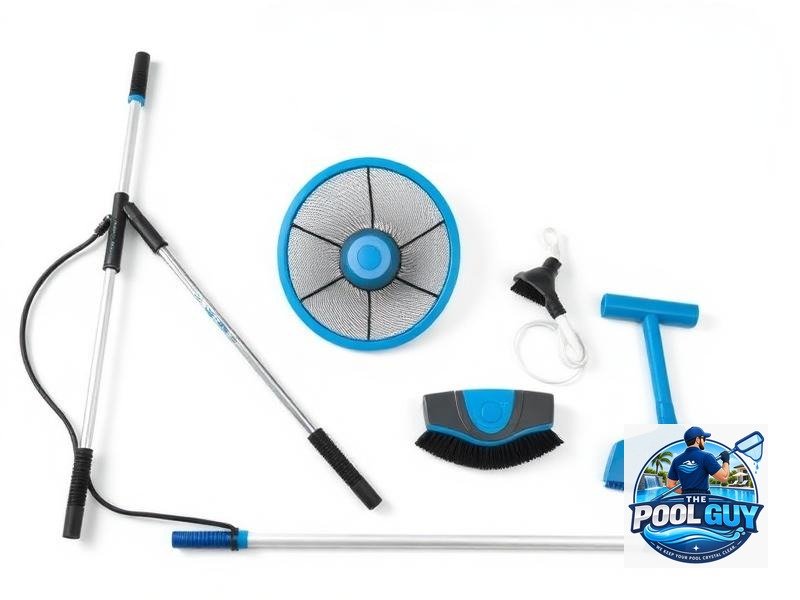
Algae grows in a protective slime layer. Shock kills free-floating algae well, but algae clinging to walls is shielded. Brushing breaks that layer open so chlorine can reach it. Brush walls, floor, steps, ledges, behind ladders, and the waterline with a stiff algae brush — before adding shock, so the exposed algae meets the peak chlorine concentration. It takes 20–30 minutes on a residential pool. Skip it and the green keeps coming back from the walls.
Step 4: Shock in the Evening (Correct Dose)
Add chlorine shock — calcium hypochlorite granules or liquid chlorine — dosed to roughly 10–20 ppm free chlorine (about 10x combined chlorine, the classic breakpoint dose). Two rules we follow on every call: shock in the evening, never midday — Karachi’s intense UV burns off unstabilised chlorine in hours; and dissolve granules in a bucket of pool water first, pouring around the perimeter with the pump running — never broadcast dry granules onto plaster or tile, which bleaches surfaces. Don’t mix algaecide into the shock dose; it comes later as a follow-up.
Step 5: Run the Pump 24–48 Hours Continuously
After shocking, the pump must run non-stop — 24 to 48 hours straight. Filtration does half the work: pushing chlorine into every corner and pulling dead algae out. This is where Karachi realities bite: load-shedding interrupts filtration, and the local habit of running the pump only 2–3 hours a day is often why the algae won. Plan around outages during recovery, and afterwards commit to 6–8 hours of daily filtration — the realistic minimum for a residential pool here.
Step 6: Backwash and Vacuum to Waste
Within 24 hours of shocking, the water turns cloudy grey or milky — that’s dead algae, and it’s progress. Check the filter pressure gauge daily and backwash when it climbs 8–10 psi above the clean reading. Then vacuum to waste, not through the filter — dead algae is extremely fine and passes straight through many sand filters, which is why pools sometimes look clear for a day and then go greenish again. Vacuuming to waste removes it from the system entirely; top up the water level afterwards.
Step 7: Add Algaecide as a Follow-Up
Once the water is clearing and free chlorine is falling back toward normal, add a quality algaecide to kill anything the shock missed. Algaecide is a mop-up and prevention product — it won’t rescue a green pool on its own, which is why it’s step 7 and not step 1. Keep a maintenance dose through monsoon season as cheap insurance against the next bloom.
Step 8: Check CYA (Stabilizer) Against Karachi’s Sun
Cyanuric acid (CYA) protects chlorine from harsh UV — without it, free chlorine burns off in a couple of hours of direct Karachi sun. Target 30–50 ppm. But there’s a trap: tablets and “stabilised” shock add CYA with every dose, and over months it creeps past 80–100 ppm, at which point chlorine becomes “locked” — present but ineffective — so algae blooms *despite* high chlorine readings. If your pool keeps turning green while you’re chlorinating, high CYA is the prime suspect. The only fix is a partial drain and refill.
When to Partially Drain Instead
Sometimes chemistry alone won’t fix it. Consider a 30–50% partial drain when TDS is very high, CYA is above 100 ppm, or the pool is dark green and unserviced for months — chemicals can cost more than fresh water. After refilling, re-test everything from scratch. Never drain a pool completely without professional advice — hydrostatic pressure and Karachi’s high water table can damage an empty shell.
Day 1 → Day 2 → Day 3: Recovery Timeline
| Day | Actions | What to expect |
|---|---|---|
| Day 1 (evening) | Test pH + chlorine → pH to 7.2–7.4 → brush pool → shock in the evening → pump 24–48 hrs | Still green at night — normal |
| Day 2 (morning) | Check pressure → backwash if needed → pump keeps running | Cloudy grey/milky — dead algae, this is progress |
| Day 2 (evening) | Vacuum to waste (or vacuum + backwash) → re-test pH and chlorine | Visibly clearing, light blue haze |
| Day 3 (morning) | Re-test: pH 7.2–7.6, free chlorine 1–3 ppm | Clear blue — don’t swim until chlorine is safe and water is fully clear |
| Day 3 (evening) | Algaecide follow-up → resume 6–8 hr daily filtration | Pool back in service |
A severe bloom (can’t see the drain) can take 4–5 days. No improvement after 48 hours means a chemistry problem — usually pH, CYA, or a failing filter — not the dose.
Common Mistakes We See in Karachi
- Dumping chlorine without testing pH. At pH 8+, most of it is wasted.
- Running the pump 2–3 hours a day during recovery — and year-round. Algae loves stagnant water.
- Swimming too soon after shock. Wait for 1–3 ppm chlorine and fully clear water.
- Brushing after shocking instead of before. The shock peaks while algae is still shielded on the walls.
- Skipping the backwash after vacuuming. Dead algae goes right back in.
- Ignoring monsoon season. After every heavy rain, test and dose — rain dilutes chlorine, dumps nutrients, and brings power cuts.
- Stopping when the water looks “okay.” Finish the algaecide follow-up, or the green returns within days.
FAQ
How fast can green pool water be fixed?
Light green: 24–48 hours. Medium bloom: 2–3 days. Severe dark-green bloom: 4–5 days — provided you fix pH first, brush before shocking, and run the pump continuously.
Can I just add more chlorine?
Only if pH is already 7.2–7.4 and the filter runs properly. At high pH, or with a clogged filter and unbrushed walls, chlorine barely touches a bloom. Test first, then dose.
Is green pool water safe to swim in?
No. Green water means sanitiser has failed, so bacteria can be present too. Don’t swim until the water is clear and free chlorine is 1–3 ppm.
Why does my pool turn green after every monsoon rain?
Rain dilutes chlorine, washes nutrients and debris in, and usually comes with power cuts that stop filtration. Test and dose after every heavy storm and keep a maintenance algaecide dose through the season.
Should I drain a green pool completely?
Usually not. A 30–50% partial drain handles high TDS or CYA. A full drain needs professional guidance — an empty pool in Karachi’s high water table can suffer structural damage.
Get Your Pool Back to Blue
A green pool is fixable — we’ve rescued hundreds across Karachi, from DHA and Clifton to Bahria Town and Gulshan. If you’d rather not spend three days brushing and backwashing, let us handle it.
The Pool Guy — swimming pool construction, renovation, and maintenance in Karachi
📞 Phone / WhatsApp: +92 321 2077638
📍 Address: 22 Dr Ziauddin Ahmed Rd, Civil Lines, Karachi
🕘 Hours: Mon–Sat 9 AM–6 PM (Sunday closed)
Maintenance plans start from Rs 15,000/month (Rs 15,000 / 25,000 / 30,000 tiers) — weekly visits, water testing, chemical balancing, and equipment checks, so the green never comes back. See all 19 pool services, browse our project gallery, and check pool equipment and products.
Leave a Reply